Old Bus Photos

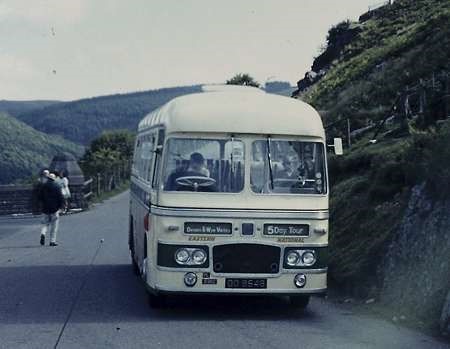
Western National – Bristol MW6G – 253 KTA – 2270

Western National - Bristol MW6G - 253 KTA - 2270
Copyright Ken Jones

Western National Omnibus Co Ltd 
1962
Bristol MW6G
ECW C39F

This is a Bristol MW6G from 1962 with second style MW ECW C39F body, and was hired from Western National to London Country Bus Services Limited in 1975 to 1977. In 2000 it was in service with Memory Lane Vintage Omnibus Services. It has been owned by Bob & Philip White since 2008 and is seen at many rallies and often participates in the annual Royal Blue run. It is preserved as Western National 2270, and was photographed leaving Simonsbath in Somerset on 3/7/10 during that years Royal Blue event. The picture was taken from the proceeding vehicle EDV 502D – a Bristol MW6G with the third style C39F ECW bodywork.

The 2013 Royal Blue run will take place on Friday 21st June to Sunday 23rd June and include Margate to Bournemouth. More details are on line at www.tvagwot.org.uk/events.htm

Photograph and Copy contributed by Ken Jones

A full list of Bristol codes can be seen here.


22/02/13 – 06:28

You never fail to Excel. Another excellent capture.

Alan Coulson


23/02/13 – 13:42

Well up to standard, Ken. Keep going!

Pete Davies


04/03/13 – 07:57

I used to drive 2270 on service out of Royal Blue depot in Portsmouth. Didn’t like her to drive. Also operated a daily service from Portsmouth to Ilfracombe in the 70,s which to us through Simonsbath and over Exmoor but we always had a MW ideal for the bends at Watersmeet which was further on.

Jim Stapleton


06/03/13 – 10:27

WN 2270 also recorded as on loan to Alder Valley during June and July 1975.

Mac Head


21/04/13 – 07:52

Just been catching up on the ITV programme "Endeavour" from 14th April and found this vehicle in it plus Hants and Dorset FEL 951C plus Oxford City Double Decker – very good

Ken Jones


27/04/13 – 07:48

Initial invites and details about the 2013 Royal Blue run have just been released from the organisers as follows.

"This year we are heading east. The South Coast Express from Margate to Bournemouth was jointly operated by Royal Blue, East Kent and Southdown. Royal Blue also operated joint services between Bournemouth and Kent with Maidstone & District and therefore we would like invite owners of vehicles from these companies to join us in this year’s run. In the heyday of the South Coast Express through services from Margate to Bournemouth took around 12 hours for the complete journey. In today’s traffic conditions this would take significantly longer and therefore the plan is as follows:

Day 1 (Friday 21 June) Victoria Coach Station (we have permission to be in VCS from about 10.30 to 11.00 when there will also be an unveiling of a Transport Trust ‘Red Wheel’) – Peckham – Lewisham – Sidcup – Maidstone – Canterbury – Margate – Ramsgate

Day 2 (Saturday 22 June) Ramsgate – Sandwich – Deal – Dover – Folkestone – Rye – Hastings – Bexhill – Eastbourne – Brighton – Worthing – Arundel – Chichester – Portsmouth

Day 3 (Sunday 23 June) Portsmouth – Southampton – Salisbury – Marlborough – Swindon – Cheltenham

Entrants will be welcome from Royal Blue, Southdown, East Kent, Maidstone & District and Associated Motorways companies and any vehicles which might have run ‘on-hire’ to the main operators. Entrants can join in for any part or all of the run over the three days."

Ken Jones


Quick links to the  -  Comments Page  -  Contact Page  -  Home Page
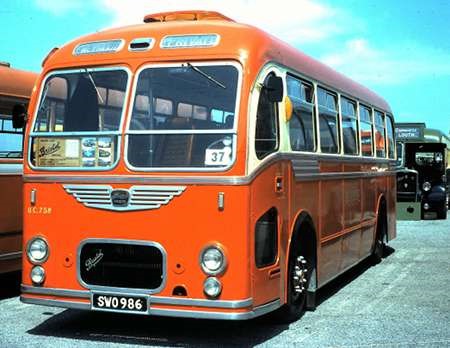


Hants & Dorset – Bristol MW6G – 7123 LJ – 1833

Hants & Dorset - Bristol MW6G - 7123 LJ - 1833
Copyright Pete Davies

Hants & Dorset Motor Services
1962
Bristol MW6G
ECW C39F

This Bristol MW with, as it was called then, the ‘New Look’ design was new to Hants & Dorset as their fleet number 887 in June 1962. In 1963 the batch (882 – 887) were down seated to C30F for extended tours, but reverted to C39F in 1968. In the first view, she has been downgraded to local bus work, as DP41F and is in special livery for the RED FUNNEL FERRIES contract and is seen at Southampton Central Station in April 1974. Her sister, 7122 LJ, was in BRITISH RAIL SEASPEED livery at the same time, but my view of the sister is not suitable for publication.

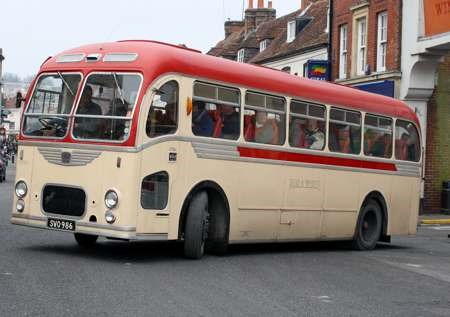
Hants & Dorset - Bristol MW6G - 7123 LJ - 1833
Copyright Pete Davies

In the second view of 7123 LJ, the relegation to service bus duty is complete, having been repainted in NBC poppy red livery with white stripe in 1975. She’s in the yard of Southampton depot in January 1976. In both views, she has the fleet number 1833 but for a brief time in 1971 she had the fleet number 1001.

Photograph and Copy contributed by Pete Davies

———

14/12/12 – 07:21

Never thought NBC poppy red could be an improvement on another livery but…..

Eric Bawden

———

14/12/12 – 07:22

When I photographed sister vehicle 1831 in 1973 on local service at Winchester, she was still fitted with high back seats. I’m amused by the fact that in the upper view, 1833 retains wheel trims, but has been relegated to bus seating.

Alan Murray-Rust

———

14/12/12 – 08:50

Indeed, Eric! I have vague memories that Southern Vectis had a vehicle in similar livery, for the Cowes to Newport element of this service, though I never photographed it. The service connected with the express trains from Waterloo and, in later years, had the service number 91, to match the train headcode! Different people have operated the link over the years, including Marchwood Motorways (using a Ford with Duple coach body and special livery) and Southampton Citybus (both before and after they sold out to First) Current operation is called "City Link" and the Unilink version of Solent Blue Line runs it.

Pete Davies

———

14/12/12 – 10:44

I like to think that even me, colour-blind, would not have come up with such a hideous range of colours and patterns as the poor suffering bus has in the top photo. Sun glasses might have helped! I always liked the ‘New Look’.

Chris Hebbron

———

14/12/12 – 16:26

Just a different way of applying poppy and white, Mr H!!!

Pete Davies

———

15/12/12 – 12:00

Mansfield District had some of these type vehicles, good looking coaches when new, however, the downgrade to DP services saw the addition of the linen box grafted onto the front dome, it spoilt ‘em though at least Mansfield fully removed the original two boxes above the headlights.

Berisford Jones

———

15/12/12 – 14:32

Berisford, I’m not sure what happened to this batch with Hants & Dorset, but most of the H&D coaches just had the box, illuminated, with the lettering HANTS & DORSET under the driver and HOLIDAY TOURS in the other one. Some of the RE coaches, down to NBC DP livery, had the HOLI removed.
Yes, removal of the box would probably have made the outline better!

Pete Davies

———

15/12/12 – 16:21

I like the design of these vehicles – I don’t like the destination box. For comparison take a look at a similar Royal Blue coach at this link which doesn’t have such a box

Ken Jones

———

16/12/12 – 11:00

Yes, Ken, same here! So far as I know, Royal Blue coaches weren’t downgraded to DP or bus work, so they never needed that box in the dome.

Pete Davies

———

16/12/12 – 12:14

United had some of these with a different front panel and destination layout. Drab olive green and cream sounds hideous for a coach livery, but anyone who has ever seen one of United’s coaches will tell you, it works, and these were no exception.

Ronnie Hoye

———

16/12/12 – 14:44

Although some of the Royal Blue MW vehicles like EDV 502D had Western National branding instead of Royal Blue they never [thank goodness] received these horrible destination boxes. There’s a picture at this link showing ENOC with an equally horrible destination box

Ken Jones

———

16/12/12 – 17:31

The later vehicles with the deeper windscreens, such as the one in the link Ken posted never looked right to my eyes and I agree Ken, that thin profile linen display box looks very wrong. Not one of ECW’s best at all.

Berisford Jones

———

17/12/12 – 08:09

You are spot-on with your comments about the United olive green and cream livery Ronnie. It doesn’t sound great on paper, but ‘in the metal’ it had a touch of class. United’s Plaxton-bodied Bristol REMHs brought in a simpler more up to date style later on, yet they still looked stunning. They even retained the scroll-type fleet names.

Brendan Smith

———

17/12/12 – 13:04

Brendan, going off the subject slightly, I know a couple of United L’s have survived into preservation ‘I believe one is in Durham District livery’ but do you know of any DP versions in the reverse livery?

Ronnie Hoye

———

17/12/12 – 16:39

The full list of Bristol L survivors can be found at www.bristolsu.co.uk/  but I don’t think there is an United vehicle in reverse livery. Crosville KFM 893 is in reversed livery. HHN 202 is preserved in Durham District livery as seen at www.sct61.org.uk/

Ken Jones

———

19/12/12 – 07:25

I noted above that I had vague memories of a Southern Vectis vehicle in the same special livery. I’ve found it, in a bought slide from Omnicolour. If you think this is bad, just consider a Bristol FS (VDL 844 to be precise!) then go and lie down in a darkened room until you recover.

Pete Davies

———

19/12/12 – 13:42

On the same link Ken Jones mentions above, you will find a picture of one of these ’7014 HN’ plus one or two other examples of United coaches, in particular is a 1964 Leyland Loepard L2 with Plaxton Panorama body, it became part of United’s fleet when they acquired Wilkinson of Spennymoor in 1968, but they all prove the point that quiet restraint is often more dignified than ‘flash and brash’

Ronnie Hoye

———

20/12/12 – 07:54

Ronnie, sorry but I don’t know if there is a United Bristol L preserved in DP livery. The only ones I’m familiar with are in bus livery – HHN 202 (Durham District green) and two red LS – rear entrance LHN 823 and front entrance LHN 860. The latter vehicle made a touching appearance at Charlie Bullock’s funeral in Scarborough in August, complementing Charlie’s United K5G towing wagon FHN 923, which provided his ‘personal transport’ for the proceedings.

Brendan Smith

———

20/12/12 – 09:45

Ronnie, I’ve just been reading through comments related to United Auto Bristol LL6B NHN 128 on this splendid website, which should interest you. Present owner David Hudson comments that this vehicle is awaiting restoration following fire damage. He also states that the vehicle was converted to DP configuration in 1953, so maybe you could yet see a United L-type in reversed livery.

Brendan Smith

———

20/12/12 – 16:04

Thanks for that, Brendan, if NHN 128 were to be restored as a DP that ‘length and engine size apart’ would that make a full full set of L’s as far as United are concerned? A front and rear entrance in red, a reverse livery DP and a Green Durham District, or did D/D have DP’s as well?

Ronnie Hoye


Quick links to the  -  Comments Page  -  Contact Page  -  Home Page


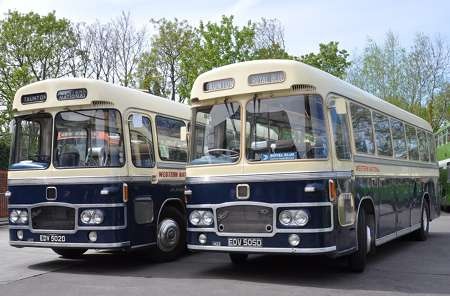
West Yorkshire – Bristol MW6G – AWU 466B – 1146

West Yorkshire - Bristol MW6G - AWU 466B - 1146 
Copyright Brendan Smith

West Yorkshire Road Car Company
1964
Bristol MW6G
ECW DP41F

Originally numbered SMG38, this vehicle became 1146 in West Yorkshire’s 1971 renumbering programme. It was one of twenty-six MW6G buses delivered to WY in 1963/64 – these being the first new single-decker WY buses for some time. For quite a few years previously, the Company had been able to cascade its mid-life dual-purpose vehicles for stage carriage use – repainting them red and cream in the process. The MW6G buses were originally delivered as B45F, but in 1971, SMG33-38 were reseated with high-backed seats from withdrawn LS dual-purpose vehicles. Unusually, the reseated batch retained bus livery, rather than receiving WY’s then dual-purpose/express livery of cream with a red band. As can be seen, ‘T-type’ destination indicators were fitted at the front, but no displays were fitted at the rear. The vehicles sported full-depth rear windows in their nicely rounded domes. They were quiet and comfortable buses to ride in, whether coach or bus seated, not to mention being very reliable and economical workhorses.

Photograph and Copy contributed by Brendan Smith

———

08/09/12 – 07:45

There are so many West Yorkshire experts who visit this site that one needs to be very careful about one’s facts. Someone may know otherwise, but my recollection is that WY fitted high back seats as a matter of course in their early MWs, designated SUGs. I remember them well on route 43, Leeds to Scarborough, always in standard livery. ‘SUG’ was explained to me in conductors’ training school as ‘Single, Underslung Gardner’. ‘SMG’ – ‘Single, Maximum Capacity Gardner’ – came later, I thought, as the company started to fit bus seats. Originally, SUGs had destination indicators made up of the two lower sections of ECW’s then standard three-part screens. The change to ‘T-type’ screens embraced all stage carriage vehicles, in the mid-1960′s. It’s a pity that the screen in this picture is sloppy; even if the screen didn’t have the right destination, (which could occasionally happen), the driver could, I think, have made sure the route number was displayed clearly.

Roy Burke

———

08/09/12 – 07:46

I agree entirely with Brendan about such vehicles being quiet and comfortable to travel in. I had many rides on those of Midland General which were all of the 6G type and always found them so. I’ve never had any experience of the MW5G, I suspect the ride may have been rather different.
David O remarks elsewhere about the popularity of the Guy Arab UF/LUF for coaching work. I too, never had any experience of these but I’ve always imagined that there couldn’t have been much difference between them and the MW.

Chris Barker

———

09/09/12 – 08:02

West Yorkshire vehicles were regular visitors to Blackpool on the "Joint Services" pool and also to Morecambe – alias British West Bradford – on the X88 service from Leeds. We could and did get anything that was available.
The "class" letters seem to have gone from most of the former Tilling group fleets at about the same time, though the Crosville arrangement was adopted by Potteries.
A pleasant enough view, but the indicator display would be of no use at all to a stranger. Thanks for sharing, Brendan.

Pete Davies

———

09/09/12 – 08:02

West Riding were a somewhat surprising recipient of West Yorkshire 1125 825 BWY which was new to West Yorkshire in 1963 as SMG17 in 1974. It lasted with West Riding until 1975 when it was scrapped.

Chris Hough

———

09/09/12 – 08:04

You are indeed right Roy, that West Yorkshire’s earlier deliveries of MWs (MW5Gs) with bus outline bodywork were fitted with high-backed coach seats. They were classed ‘EUG’ when new, denoting Express Underfloor Gardner, as were the earlier batches of LS5Gs, also with bus shells and coach seats. In later life many were demoted to ‘SUG’ status, for use mainly on stage-carriage work, gaining more red to their livery, but retaining coach seats. They would no doubt have been comfortable machines to ride in on the Leeds to Scarborough run, but many of us did wonder why WY continued to specify 5-pot rather than 6-pot Gardner engines for it’s longer-distance vehicles. It must have taken an age to reach Scarborough, Blackpool or Middlesbrough from the heart of the West Riding. (Could that be the reason for fitting half a dozen of the more powerful MW6G buses with 41 high-backed seats later on?). Some of the SUGs were fitted out for "one man" operation in later life, and received 45 bus seats in the process. They were re-classified SMG at the same time, the ‘M’ as Roy says, denoting Maximum seating capacity, and described as such in Ian Allan’s BBF No9. I too have heard this quoted by West Yorkshire staff, but have heard other staff say that ‘M’ meant the bus was suitable for one Man operation. Both descriptions appeared to be very relevant to the buses concerned, but as a skinny apprentice at the time, I did not wish to provoke an argument with either party, and came to the conclusion that maybe they were both right!

Brendan Smith

———

09/09/12 – 08:03

Where was this picture taken Brendan? Judging by the route number, could it have been York, Harrogate or possibly Keighley? As we’ve seen on other postings, it was not uncommon to have to ride many miles on express services in bus seats, but to have this DP for a local suburban estate run must have been delightful!

Paul Haywood

———

10/09/12 – 06:56

Paul and Brendan – my trusty 1960 fare table book (seriously speaking one of my most treasured possessions) may hold the answer to this query. At least in 1960 there was no service 9A in Harrogate or Keighley, but in York services 9/9A ran between Clifton and Tang Hall Lane. Our lovely meerkat friend from TV would no doubt click his teeth and remark "seeemples."

Chris Youhill

———

10/09/12 – 06:58

There are other mysteries here! I know the camera can lie (or the process can) but that’s not Poppy Red, and I’m not sure about the side band- should be a sort of grey-white and yet seems to match the presumably original window surrounds- which would be self-colour cream, I imagine: yet the grey wheels are there and NBC fleetname. As to where… looks too warm for Keighley: has a look of east Leeds about it

Joe

———

10/09/12 – 06:59

I remember seeing the first MWs entering service in Bristol in February 1958. These had AHY registrations and ugly flat backs. The second (DAE) series had the more rounded style and I suppose other early operators of the type had bodywork which went through the same design change.

Geoff Kerr

———

11/09/12 – 06:52

We really need Brendan to tell us where this photo was taken to be sure of the location. In 1960, as Chris says, there was certainly a service 9/9A in York, but it was invariably a double-decker route in those days. I worked it many times as a conductor; a very busy urban route. The picture dates from NBC days – at least 9 or 10 years later – by which time things might have changed, of course. If the picture is indeed in York, things must have changed a lot, since the very idea of OMO on the Clifton/Tang Hall Lane service in the mid-1960′s would have been thought laughable. In Tilling days, York had only one single deck city service, (Leeman Road/Hull Road, route 7), necessitated by a low bridge, operated in my time with L5Gs, (YSGs), later replaced with SUs, (YSMAs). There were then very few OMO routes, and all of them, as you’d expect, were light semi-rural services.

Roy Burke

———

11/09/12 – 06:55

Well Chris- that looked like a York street light, too. Did NBC remove the "York", and have West Yorkshire in East Yorkshire (nearly?) …or is this bus out of area, which explains the blinds?

I should have added that its not West Yorkshire red either which was much redder? This is almost maroon.

Joe

———

11/09/12 – 06:58

Sorry Joe but this is not east Leeds West Yorkshire had no service numbers as low as that in the Leeds area all services in east Leeds were either throughs to York and points east or at a push to places like Barwick Scoles and other dormatory villages which were in the West Riding until 1974 West Yorkshire applied NBC fleet names to standard Tilling red but often painted the cream band on both saloons and deckers.

Chris Hough

———

11/09/12 – 07:01

Apologies for being a little slow in responding to the above comments folks, but I’m making preparations for my ‘jollies’ and have been ‘sidetracked’ away from OB Photos several times! Paul, Chris Y and Joe, sorry to keep you in suspense as a result, but the photo was taken on Woodfield Road, Harrogate. The vehicle was on the newly-introduced 9A Bus Station – Dene Park route, serving a new estate of low-rise flats for older people. From what I can recall, 1146 had been recently transferred from I think, Leeds depot, and presumably had not yet received a blind showing Dene Park, which would go some way in explaining the unhelpful (and slovenly) route display. (There is also what appears to be a maroon Leeds depot allocation disc in front of the fleet number, rather than a green Harrogate one). Joe, your comment on the livery has me puzzled too. I’m not sure whether the processing (AGFA slide) has made the poppy red look like Tilling red, or whether the bus was still wearing Tilling red, with NBC grey wheels, white band and fleetnames applied. Some WY depots did apply white bands and fleetnames to vehicles still in Tilling red, if the paintwork was still sound, pending a full repaint into poppy red at a later date. I smiled at your comment that the view looked too warm for Keighley.

Brendan Smith

———

12/09/12 – 07:11

Thanks for settling this teaser for us Brendan – I had based my wild assumption of the wrong year of course, and on the pretty unlikely possibility of a vehicle transfer or loan to York – and my meerkat informant has received one week’s notice !!

Chris Youhill

———

12/09/12 – 07:11

Brendan, as a Keighley postcoder (although living just over the border into North Yorkshire), I must defend the place! Emily Bronte would have had difficulty selling "Wuthering Heights" with the title "Sunny Hills"! When we think of famous people with "sunny dispositions" we automatically think of Denis Healey, Eric Pickles, and Alastair Campbell who were all born in Keighley! There’s nothing wrong with good old fashioned gloom and misery. Mark my words, no good will come from sunshine, it only attracts the wasps!

Paul Haywood

———

13/09/12 – 06:59

Thanks for settling the mystery, Brendan. I have several views of buses still in Tilling green or red but with NBC style fleetname. A Southern Vectis bus in Southampton (on loan to Hants & Dorset and with the latter’s fleet number – don’t fret, boys, I’ll submit it for consideration in a week or two!) has Tilling green, NBC fleetname and the white stripe.

Pete Davies


Quick links to the  -  Comments Page  -  Contact Page  -  Home Page


All rights to the design and layout of this website are reserved     Old Bus Photos does not set or use Cookies but Google Analytics will set four see this

Old Bus Photos from 11:53 Saturday 25th April 2009 to 13:08 Tuesday 21st May 2013