Old Bus Photos

Sheffield Corporation – Leyland Tiger – MWA 757 – 57

Sheffield Corporation – Leyland Tiger – MWA 757 – 57
Copyright R H G Simpson

Sheffield Corporation
1950
Leyland Tiger PS2/1
Strachan B34R

Despite the low fleet number, 57, this was a B fleet vehicle. The computer hadn’t taken over yet. This was one of a batch of eight delivered in 1950. Seen here in Pond Street Bus Station before the concrete and glass version. It could be cold and breezy then but us northerners are made of stern stuff. Ready for service 6 to Kiveton Park in this view but I remember boarding one of these to Eyam on one occasion in the dim and distant past. Photo bought from R H G Simpson many moons ago.

Photograph and Copy contributed by Les Dickinson


10/02/13 – 08:06

Sheffield bought hoards of PS1 Tigers from 1947 but only eleven PS2s. These were a last (half-cab) gasp, the three Weymann examples had been delivered earlier. Apart from the PS1s, there were Weymann/Regals and apart from Weymann PS1s there were five Wilkes and Meade and ten Cawood, already seen on these pages.

David Oldfield


11/02/13 – 07:10

These used to my favourite Sheffield half cab single deckers. I always thought they looked really elegant-but that was from the frontal aspect. This photo shows them to have deep side skirt panels with correspondingly shallow saloon windows. A childhood impression shattered in one photo!!! The 6 to Kiveton Park would be converted to double deck operation in the mid 50s with the arrival of the lowbridge Weymann bodied AECs.

Ian Wild


11/02/13 – 10:19

Yes Ian, but with the 0.600 they would shift…..

David Oldfield


11/02/13 – 10:21

Nice view, Les, but you seem to have caused distress to at least one reader. Go and sit in a darkened room for a week, Ian. You might feel better! I had similar thoughts years ago about a particular steam locomotive. After first seeing it, I spent many years under the impression it was an A4, but it wasn’t . . .

Pete Davies


12/02/13 – 07:03

Yes David, superb performers on the 48 to Manchester

Ian Wild


12/02/13 – 07:04

Going "off piste" mention of A4, I was surprised when I saw a photo of the controls lay out of the recently built "Tornado", that the controls were exactly the same as the 2-6-2 LNER, Doncaster built tank engine No. 498 which usually pulled our school train to Hamilton (which we sometimes rode illegally on the footplate)

Jim Hepburn


12/02/13 – 10:42

Oh the joys of living pre Health & Safety, Jim.

David Oldfield


12/02/13 – 14:49

On the theme of pre Health & Safety, my friend John Whitaker and I had the free run of climbing into the drivers’ cab of any of the buses at the Bradford Corporation Ludlam Street bus depot on a Sunday morning when it was quiet and there were no bosses around. We were given this freedom by a good neighbour who was a mechanic there, but with the strict instruction not to press the starter button of any of the buses which we pretended to drive. We were still about 11/12 years of age at this time, but what wonderful freedom and trust given by our parents and our neighbour Tony.

Richard Fieldhouse


12/02/13 – 14:50

Ah but never forget, even pre-Health and Safety, it was officially "strengst verboten"! OK Pete, you can’t keep us in suspense any longer. What was the quasi-A4 really and where did you see it? One of the streamlined "East Anglian" B17s or the seemingly jinxed W1 rebuild?

Stephen Ford


12/02/13 – 17:01

An A3, actually, Stephen! 60095 FLAMINGO, at Carlisle in about 1960 or 61. I am supposing it had come off the Waverley route. Looking at views of the two types now, I can understand where I went wrong! It was because of the shape of the firebox. Ah, well!

Pete Davies


Quick links to the  -  Comments Page  -  Contact Page  -  Home Page
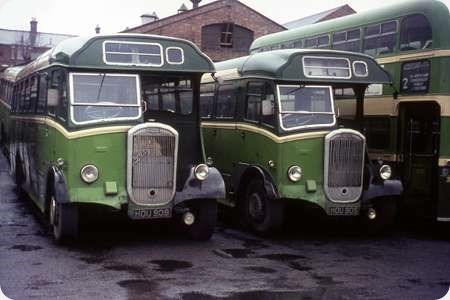


Aldershot & District – Dennis Dominant – HOU 900 – 174

Aldershot & District - Dennis Dominant - HOU 900 - 174
Copyright Roger Cox

Aldershot & District
1950
Dennis Dominant
Strachan B41C

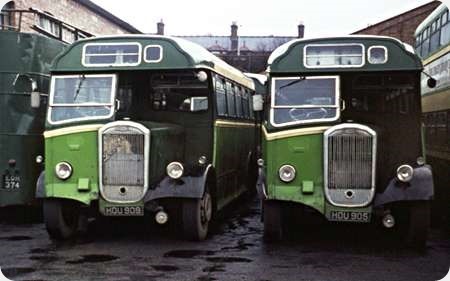
The Dominant represented the initial attempt by Dennis to offer an underfloor engined single deck chassis. Like the contemporary Regal IV, Royal Tiger, Freeline and Arab UF models, the Dominant was a heavy beast, but, unlike those competitors, it never achieved quantity production. The engine was a horizontal version of the advanced 24 valve wet liner O6 diesel of 7.58 litres coupled to the Hobbs semi automatic gearbox, which used disc clutches instead of annular brake bands to engage the gears. A two speed axle was also specified. The middle section of the chassis was ‘humped’ slightly to clear the engine and gearbox, which made the design rather more difficult to body than its competitors. Only three Dominants were made, and all were shown at the 1950 Commercial Motor Show. One was displayed in left hand drive chassis form, but it is believed never to have run under its own power. The other two received Strachan bus bodies of very different character. The bus in the demonstration park had a supercharged (not turbocharged) engine, raising power from 100bhp to 130 bhp, and full air braking, and had a front entrance bus body, probably with 41 seats, of conventional appearance. The other, vacuum braked Dominant became very well known as Aldershot & District No.174, HOU 900, and its B41C body was an example of the uncertain approach to styling adopted by a number of coach builders in the early years of the underfloor engined chassis. The initial strange wing pattern was subsequently simplified to a more usual style by A&D as seen in the picture above.
The Hobbs transmission revealed early weaknesses, and it was replaced in both running Dominants by standard Dennis two plate clutches and five speed gearboxes. The demonstrator was sold to Trimdon Motor Services who registered it MUP 297 and ran it, now without the supercharger, for seven years, before selling it on to become a mobile shop. The other Dominant remained in the Aldershot & District fleet from 1951 for fourteen years, spending much of that time ploughing its way on the Aldershot – Cove group of services. It is seen here in 1961 leaving Aldershot Bus Station with Weymann L25/26R rebodied Guy Arab I of 1943 No.873, EHO 695 alongside. This Arab was one of a number of such chassis originally destined for, but ultimately not wanted by London Transport. It was initially fitted for A&D service with a Strachans L22/26R body, rebodied in 1950, and finally withdrawn in 1962.

More information about the Dominant may be found on this site:-
www.dennissociety.org.uk and a picture of the Trimdon example may be found here:- http://trimdon.com/galleries/

Photograph and Copy contributed by Roger Cox


20/01/13 – 13:38

Thank you for posting this view. It has settled a problem I’ve had for some years, in respect of my "bought" slides. Not all photographs come with an indication of where (and/or when) they were taken. I have several where this building features in the background. Clearly, it was in A&D or AV territory, but the precise location was a mystery until now!

Pete Davies


20/01/13 – 14:11

Thanks for the links Roger. The original wing embellishments were rather odd – those sort of things did not really belong on coaches of the new underfloor-engined era, but the front one being the ‘wrong way round’ was plain silly. Many coachbuilders and operators of the time must have been really confused as to what to do with this new layout of vehicle. However once A&D had modified it in the fashion depicted on this photo I think it looked rather nice, with its gently curved lower windscreen line just taking the edge of any tendency to boxiness. The A&D livery of the period was just superb and enhanced any vehicle.
The Arab looks really fine too. Weymann bodies looked great on any type of chassis. Many operators who rebodied their utilities after the war also converted them to the low-bonnetted Arab III layout, but I always felt – purely from an enthusiast/aesthetic perspective – that the Arab II’s original tall bonnet looked far more balanced, and in keeping with its rugged, no-nonsense nature.

John Stringer


20/01/13 – 14:51

The bus station at Aldershot was opened in August 1933, and I believe that it was the only company owned bus station within the BET group. Sadly, it has now gone. The site is now occupied by residential development, and the replacement bus station is an austere affair near the railway station entrance.

Roger Cox


20/01/13 – 15:31

Omnibus Stations Ltd, a company jointly owned by North Western and Ribble owned Lower Mosley St Bus Station Manchester, also long gone.

Phil Blinkhorn


20/01/13 – 16:26

The Wilts and Dorset bus station in Endless Street, Salisbury is up for sale. When it is gone all the services using it will be decanted onto the surrounding streets to join the local services in an already congested City centre. Is this progress? No,it’s called asset stripping. Sorry to go off topic. I’m a great Dennis fan and on a sunny summer afternoon I sometimes cut my grass with my 1960′s Dennis lawnmower.

Paragon


20/01/13 – 17:56

I know it’s off topic, unless the lawnmowers were scale model prototypes for buses, dustcarts or fire appliances, but I’d no idea they were still being made as recently as the 60′s. I saw one at Amberley on one occasion, several years ago.
To be fair, Paragon, I visit Salisbury every couple of months or so, to exercise my "dodders’ pass". Salisbury Bus Station is in dire need of fairly extensive refurbishment, at least. Is it purely asset stripping, or is it another of those odd instances where the site is sold and then leased back? Is the aim to clog Blue Boar Row, Endless Street and New Canal even more than they are already as a permanent feature, so even more shoppers will be discouraged from visiting, and go out of town or use mail order/internet shopping instead? You’re right. It is NOT progress!

Pete Davies


21/01/13 – 06:12

………with supercharger, no doubt, Paragon!

Chris Hebbron


21/01/13 – 06:13

Paragon, Is it a petrol mower?


21/01/13 – 06:14

Pete, the Dennis lawnmower business was sold off by Hestair, which also disposed of the Mercury truck business. However, Dennis lawnmowers are still made, albeit by the Derby firm of Howardson. See http://www.dennisuk.com/history/

Roger Cox


21/01/13 – 06:16

With reference to Roger’s comment (20/01) about BET-owned bus stations . . . how about: Cleckheaton, Dewsbury, Batley – YWD (or corporation?; Newcastle Worswick Street, Northern; Scarborough Westwood, and Bridlington, EYMS; Skelhorne Street (Liverpool) and Carlisle, Ribble; Ammanford, James; Haverfordwest, Western Welsh; and this is now getting too far south for clear recollection – didn’t Southdown own a bus station at either Lewes or Uckfield? (one of the few instances of Southdown using their own premises – on the grounds that they’d already paid road tax to use the public roads, so why pay again to provide their own terminal facilities off-road). And then again what is a bus station – didn’t BMMO use its Stourbridge garage as a "bus station" of sorts?

Philip Rushworth

Oops, I forgot! Didn’t M&D own two bus stations in Maidstone until the early ’70s?


21/01/13 – 06:18

As has been mentioned, body builders weren’t quite sure what to do with the new-fangled underfloor-engined chassis. A few builders seem to have noticed that, unlike half cabs where the front and rear were very different, it was possible here to build in features which emphasised the symmetry of the new shape. A flat side view of this Dominant in its original form would show this symmetry in the ‘wings’, and perhaps something similar was attempted in the mouldings above, but they didn’t quite have the nerve to carry it through. The whole idea was, of course, a big mistake, because a bus/coach is not a static object but something that moves FORWARD!

Peter Williamson


21/01/13 – 14:25

The BET Group North Western Road Car Co also owned many of its bus stations – Macclesfield, Oldham, Altrincham, and Northwich for sure. This was fairly common practice among area agreement companies of any size. More interesting perhaps (to me at least!) are the independent operators who had their own bus stations – Birch Brothers’ Rushden facility springs to mind along with Blair & Palmer’s East Tower Street premises in Carlisle.

Neville Mercer


21/01/13 – 14:26

Yes it is a petrol mower. The engine was made by another great British engineering company now long gone, Villiers of Wolverhampton. I use a modern Dennis on our bowling green, superb quality but unfortunately powered by a trouble-free Japanese engine, just like my car. Where did we go wrong? No. Don’t lets get started on that.

Paragon


22/01/13 – 06:52

Villiers was a long established company in small engines for motor-cycles and lawnmowers. In the early 1980s, they produced a 2-stroke engine for lawnmowers with Mountfields. Unfortunately, this was a disaster and led to the demise of the company.

Jim Hepburn


22/01/13 – 11:07

Mention of Villiers reminds me of a Fanny Barnett motorbike I had, briefly, in the 1950′s. It was a distress purchase from a friend, when my trusty Ariel broke down, and was soon sold on. A similar distress purchase was a Wartburg, also briefly owned. I was not a lover of two-strokes, although, of course, I exclude the Commer TS3 engine!

Chris Hebbron


22/01/13 – 12:26

Chris, my dad and I drove a 1967 Wartburg Knight from Stockport to Rome and back in the summer of 1967 with my mum and two sisters.
Fuelling was a two stage process which we thought might cause problems once we left French and German speaking countries. The first fuel stop in Italy at Aosta we were approached by a typically dressed Italian widow, all in black. I handed her a note in Italian stating what we needed. Her reply was "Awight Duck, nah problem I’ll get ma son ta fill y’ap all cushty".
Turns out that, though she was Italian, she’d lived in London from 1920 to 1965.
The Wartburg was faultless, its 998cc engine tackling Alpine passes with 5 adults on board as brilliantly as it managed the autobahns and the Autostrada del Sole.

Phil Blinkhorn


22/01/13 – 14:11

I know others who share the positive view of the old Wartburg. I also know people who swore by – not at – their Comecon Skodas. As a dyed in the wool VW person (from Beetle onward) I am a very happy modern Skoda (VW in sheeps clothing) owner – despite recent comments by Phil. Just bought a new one at the weekend – so haven’t worn it out yet!

David Oldfield


22/01/13 – 17:04

Wife had a fourth hand Comecon Skoda in the late 1970s. Rubbish body ended up 50 shades of mustard but the engine and transmission were fantastic as, I’m told, were their PSVs which I have ridden on from time to time over the last 40 odd years.
BTW my latest Skoda troubles with the bonnet lock follow on from a leaking water pump and damaged timing belt at 38,000 miles. Have had partial compensation from Skoda but they are hardly my favourite people at present.

Phil Blinkhorn


23/01/13 – 15:49

There was a lot of snobbery about Comecon products fostered by the likes of Clarkson and Co. who rarely have to pay for their motoring. Saab won the Monte Carlo Rally using a 3 cylinder 2 stroke engine just like the Wartburg. My daughter had a Comecon Skoda for a couple of years. I had to replace the water pump but other than that it was totally reliable. She then wanted a more fashionable Seat-disaster. For nearly 40 years I have ridden East German MZ motorcycles, I’m on my second one now. Practical, easy to maintain – just like we used to make in this country.

Paragon


HOU 900_lr Vehicle reminder shot for this posting


06/03/13 – 06:57

A slightly late comment on Roger’s excellent article and the mention of the "hump" in the chassis rails – which was actually on the nearside only, over the engine and certainly no higher than the raised sections over front and rear axle. The contemporary press were most unforgiving and scathing with their comments about the uneven surface. Strangely, other manufacturers with even worse "humps" escaped such criticism. I have always thought that quite possibly the press were encouraged by the likes of AEC and Leyland who were marketing their chassis (Regal IV, Royal Tiger) with the expectation that the provided outriggers would be used as pick up points for the vertical body frames and floor. The truth was of course that many body builders simply ignored the top level of the chassis and used substantial cross bearers as a foundation for floor and body where required. Certainly though, this issue pointed the way to the later dead flat chassis on Reliance, Tiger Cub and Lancet UF, to name but three.

Nick Webster


06/03/13 – 16:44

Thanks for your very informative comment, Nick. I am sure that you are right in your suspicions that the ‘big two’ massaged the publicity machine of the commercial press to wound the sales of the Dominant. During WW2, notwithstanding the supreme peril of the nation, Rolls Royce, with its eye on post war dominance, tried every trick to get the Napier Sabre aero engine cancelled, and much of the unbalanced criticism of that engine that still holds sway today derives from that campaign. Dennis engineering was of a high order, but the trouble with the Dominant (and the later Lancet UF) was the dependence upon the old ‘O’ type gearbox once the Hobbs transmission had proved to be unreliable. That gearbox, with its sliding mesh engagement for indirect gears, and the preselective overdrive that required familiarity for successful operation, together with the wrong way round ‘right to left’ gate, required some skill in use when located halfway along the length of an underfloor engined chassis. If Dennis had equipped the Lancet UF from the outset with a straightforward constant mesh five speed gearbox as it did with the Loline, then the sales might well have been more of a challenge to AEC and Leyland.

Roger Cox


06/03/13 – 18:13

Roger, without wanting to drift too far off topic, there may well be truth in what you say about Rolls Royce but there is no doubt that the 24 cylinder H block Sabre suffered from complexity and poor quality control from the start which, had it emerged through a time of peace would have been solved.
In time of war where reliability was all,it was too unreliable compared to the less powerful Merlin and probably too complex for the Erks to deal with as the war moved swiftly forward through Europe with minimal facilities at the forward bases where the Typhoons and Tempests found themselves in the ground attack role, the Sabre, for all its power being uncompetitive in dog fights above 21,000 feet. Post war there was little for the Sabre to power as air forces turned to jet and turboprop power.

Phil Blinkhorn


08/03/13 – 07:30

Phil, the legend of the Sabre’s ‘unreliability’ dies hard. The most convincing and clearly documented assessment of this engine may be found in the book "The Power to Fly" by the extraordinary author LJK Setright. This site, as you rightly point out, is not the forum for aero engine debates, but the facts about this remarkable engine show the traditional, Derby briefed view to be highly jaundiced. To quote Setright: "..when properly maintained instead of being criminally bodged (a reference to the widespread practice of tampering with the automatic boost control by mechanics at several airfields to achieve even higher outputs and thus airspeeds) it was exemplary in its reliability". Production of Typhoons totalled 3300, and that of Tempest V/VIs reached 942. Engine production would have well exceeded the 4242 airframe total. Those figures could not have been achieved by an untrustworthy piece of engineering. It’s high time that the Derby manipulated Sabre legend was despatched once and for all. Meanwhile, back at OBP…..

Roger Cox


Quick links to the  -  Comments Page  -  Contact Page  -  Home Page


Western S M T – Gilford Zeus – WG 1619 – 723

Western S.M.T - Gilford Zeus

Western Scottish Motor Traction Co. Limited
1933
Gilford Zeus
Strachan H24/24R

The above photograph (from the Dave Jones Collection) is of a Gilford Zeus outside the Bellfield Works in High Wycombe. This was Gilford’s third attempt to get into double decker vehicle market after the 168DOT and the failed front wheel drive double decker which was later converted into a trolleybus. Two were built, the first appearing at the Glasgow Show of 1932 before being registered in 1933 for use as a  Gilford demonstrator before passing to Western S.M.T (Fleet number 723), and the second being sold direct to Western S.M.T (Fleet number 722). The two vehicles were originally fitted with different engines, the demonstrator a Vulcan Juno and the later one a Tangye VM6, but both are believed to have had Leyland oil engines fitted before entering service.

Photograph and Copy contributed by Andrew Stevens

———

22/04/12 – 16:42

A very smart modern-looking bus for its time, apart from the rather scrunched-up windscreen. The radiator suits the body style very well. I always had a soft spot for Gilford and was sorry it failed, partly due to the takeover of independents by newly-formed London Transport. Western SMT were staunch supporters of the marque at this time, taking quite a few coaches for their long-distance services. I wonder how long they lasted and their histories until scrapping. I was never good company at funfairs: a stomach not suited to revolving at high speed, restricted me to dodgems, big dippers, but certainly not waltzers! Thus, I tended to walk around the showmens’ vehicles and enjoy the fare on display there. I always remember seeing a Gilford Hera on one occasion, the only Gilford I ever saw.

Chris Hebbron

———

23/04/12 – 05:35

Don’t know when, but 723 transferred to Sandersons of Glasgow and I don’t know any history after that. 722 was withdrawn from service in 1944 and also transferred to Sandersons with no subsequent history.

Andrew Stevens

———

23/04/12 – 05:36

I have never come across a Gilford myself but every mention of them is always in a positive light – always said to be superb vehicles. As Chris says, circumstances – the customer base disappearing – overtook the firm with disastrous effects.
I lived in High Wycombe for fifteen years and know Bellfield well – never realised that Gilford were based there. I don’t think they left a trace when they moved back to London.

David Oldfield

———

23/04/12 – 05:51

The very interesting subject of Gilfords reminds me that a group are restoring a single decker that started in life with Fred Oade of Heckmondwike. The company is still in business although nowadays they are undertakers the coaching side of the business was sold to Yorkshire Woollen in 1960. The vehicle is WX 3567 and was new in 1930. Oades sold it in 1934 and according to The PSV Circle it passed through several different owners and allegedly was sold for scrap in 1938 although obviously this never happened as I believe it was found in a barn.

Philip Carlton

———

24/04/12 – 06:53

I actually saw ‘WX’ last week and it’s coming along. The survivor list may take some by surprise, with two vehicles, a DF6 and an AS6 I believe road-worthy, along with an AS6, a 166SD, two 168SD’s (one converted to OT) and a 168OT currently under restoration. There is also a Hera chassis at the SVBM. Would be nice to get them all roadworthy and together in the future – here’s hoping. Unfortunately Bellfield works has now been demolished so there certainly is no trace left of the company, and few people in Wycombe seem to know of their existence, something I hope to put right somehow.

Andrew Stevens


Quick links to the  -  Comments Page  -  Contact Page  -  Home Page


All rights to the design and layout of this website are reserved     Old Bus Photos does not set or use Cookies but Google Analytics will set four see this

Old Bus Photos from 11:53 Saturday 25th April 2009 to 10:11 Wednesday 22nd May 2013