Old Bus Photos

Reading Corporation – AEC Reliance – CRD 152C – 52

Reading Corporation - AEC Reliance - CRD 152C - 52
Copyright Pete Davies

Reading Corporation
1965
AEC Reliance 2MU3RA
Neepsend B34D

In my comments on the Royal Tiger coach GWM 981, which John Stringer posted, I noted that there were no views of the vehicles of Reading Corporation in the column on the left. The Gallery section does have some views from Roger Cox, however. Even into the RE era and with bodies of different manufacture, Reading continued the use of that "seagull" motif on the front. Here is a view of CRD 152C, the first of my submissions relating to this operator. CRD 152C is an AEC Reliance of the 2MU3RA format with Neepsend B34D bodywork (and the seagull). She was photographed in Winchester on 1 January 1992 during a visit to the annual King Alfred Running Day.

Photograph and Copy contributed by Pete Davies

A full list of Reliance codes can be seen here.


04/04/13 – 16:02

Well it could have been a genuine Burlingham saloon – had it not been five years after Burlingham were subsumed in Duple.

David Oldfield


05/04/13 – 05:39

Thank you, David. Wait until you see the RE adorned in the same way! I’ll be submitting a couple of view to Peter in the near future.

Pete Davies


05/04/13 – 05:39

One of the things that fascinates me about our hobby is how operators, even relatively small ones, could obtain special designs from fairly large scale builders of bus bodywork. This basically Burlingham design was unlike anything else East Lancs/Neepsend produced in their normal range but they did so for Reading. I wonder what the price penalty was for such ‘specials’ and how transport managers justified it to their committees.

Philip Halstead


05/04/13 – 08:05

One thing East Lancs were known for was supplying operators with what they wanted – ie they built to "any design" required if it was in their power to do so.

David Oldfield


Quick links to the  -  Comments Page  -  Contact Page  -  Home Page


Bradford Corporation – Daimler CVG6 – EAK 232D – 232

Bradford Corporation - Daimler CVG6 - EAK 232D - 232
Copyright Brendan Smith

Bradford Corporation
1966
Daimler CVG6LX/30
East Lancashire (Neepsend) H40/30F

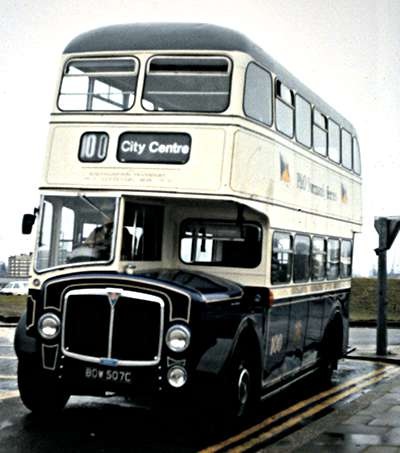
Captured here waiting on Park Road, Bingley is Bradford CT 232, one of a batch of fifteen Daimler CVG6LX/30s supplied to the undertaking in the latter part of 1966. It is seen still wearing BCT’s attractive blue and cream livery, but has had its classic Bradford City Transport fleet name and coat of arms replaced by West Yorkshire PTE’s ‘Metro Bradford’ fleet name and PTE logo. (A ’2′ prefix has also been added to the fleet number, denoting former Bradford ownership). They were very comfortable buses to ride in, and most handsome buses to look at, bearing a strong resemblance – particularly at the rear – to BCT’s forward-entrance re-bodied trolleybuses delivered a few years previously. Saltaire depot had an allocation of these fine machines, and they could often be seen on the 68 service from Bradford to Edwick/Dick Hudson’s, operated jointly with West Yorkshire Road Car. The Gardner 6LX engines fitted to the Daimlers would have been well-suited to the steady climb up to Gilstead and Eldwick.

Photograph and Copy contributed by Brendan Smith

———

17/09/12 – 07:18

All of this batch went new to Saltaire depot, but 234-40 were passed on to Ludlam Street when Saltaire received new Fleetlines 271-85, which was of course only a matter of months later. These latter, and the remaining CVG6s 226-33 constituted the principal complement of Saltaire’s vehicle allocation for several years, although I was surprised when, around 1970, there was also an East Lancs-bodied Regent III based there. While trolleybuses were still operative on service 40 to City via Thackley there were, I think, two trolleys also kept there overnight, outstationed from Thornbury depot. Does anyone know what effect the trolleybus abandonment had for Saltaire’s vehicle allocation?
The CVG6s were standard fare (pun intended) on route 68, indeed while they were around I don’t recall seeing anything else on BCT’s share of the service. Of course Eldwick didn’t need eight buses, so they also appeared on Manningham Lane services, although heavily outnumbered by Fleetlines. Thornbury depot also had a small presence on these routes, using Regent Vs.
In the early 1970s 234-40 moved on from Ludlam Street depot to Horton Bank Top, where they replaced Regent IIIs.

I can’t vouch for when these actually arrived, but I think only two had entered service by the end of 1966, the rest doing so early in 1967.

I’ve just had a look at my copy of the Stanley King book, and he quotes entries into service of between August and November 1966 – a bit at variance with my recollection, and the vehicles he quotes as the first two in service are not quite the same two I would have said. Still, I’ll stand corrected on this point if necessary.

David Call

———

17/09/12 – 07:19

I think, Brendan, that these 15 buses were "la creme de la creme" with regard to Bradford`s later fleet, and I travelled on them quite regularly when they were quite new. I also travelled (more often) on the 15 contemporary PD3s with identical bodies, which appeared on my "80" route.
The Daimlers, in particular, just oozed quality, and the sound of the Gardner engine, after so many screaming Regent Vs was a pure delight.
I do remember though, that some Bradford staff were not too happy with the Neepsend bodies, which did not seem as structurally sound as the Blackburn East Lancs version. They looked a lot better though, with the full original Bradford insignia!

John Whitaker

———

17/09/12 – 07:20

This batch of buses only 8 years old at the formation of the PTE never received PTE livery and remained blue and cream all their lives When quite new they were often seen on the former Ledgard Leeds-Pudsey-Bradford route and were a really nice bus to ride on.

Chris Hough

———

These vehicles were superb. 226-33 were allocated to Saltaire Depot from new and I remember them appearing on the service to Eldwick in the autumn of 1966. I travelled on them regularly to school. Later when I worked in the Traffic Office of BCT in Forster Square we worked alternate Saturdays and I’d travel on the 07:35 hours journey from Eldwick, which was a BCT Daimler CVG working.
Later still I was a member of a small group of staff that on Monday nights used to frequent the BCT Social Club in Sunbridge Road. The bus stops outside the Club were for services 15 and 16 – West Bowling and Allerton. The bus to Eldwick stopped some distance away in John Street. The last bus from Bradford (Chester Street) to Eldwick left at 10.20pm and I used to ring the Chief Inspector’s Office at Forster Square at about 10.10pm to say that I was "ready for home". I’d make my way the best I could to the stop for the Allerton service just outside the Club and I’d then be joined by one of the Duty Inspectors. When the Daimler CVG came round the corner from Godwin Street into Sunbridge Road the Inspector would step purposefully into the road and stop the bus for me so that I could get on it. He’d then tell the conductor: "Make sure that he gets off at Eldwick Post Office."
Ah, happy days, or should that be daze?

Kevin Hey

———

18/09/12 – 07:25

Huddersfield had a contemporary batch of sixteen CVG6LX-30s, 457-472 (HVH 457-472D). Half were bodied by East Lancs at Blackburn the other half by Neepsend. They became due for initial recertification shortly after I arrived at Huddersfield. I don’t recall that the Neepsend bodies were any worse at that stage than the Blackburn built examples. I do recall that one body type all suffered from body framing fractures above the entrance doors (Neepsend I think) whilst the other all had frame fractures on the staircase side. Some of this batch were particularly hard worked being 2 way radio fitted and hence allocated to the longest duties. Yes, the dulcet tones of these Daimlers were a vast improvement on the raucous cacophony from the eight forward entrance Regent Vs which were disliked by the crews.

Ian Wild

———

19/09/12 – 07:16

Huddersfield also had an earlier batch, 435-440, CCX 435-440B. There were detail differences in this earlier batch, from memory, mainly colour and layout of the staircase/luggage area.

Eric Bawden


Quick links to the  -  Comments Page  -  Contact Page  -  Home Page


A Mayne & Sons – AEC Regent V – CXJ 520C

A Mayne & Sons - AEC Regent V - CXJ 520C

A. Mayne & Sons
1965
Regent V 2D3RA
Neepsend H41/32R

Another independent bus operator but this time from the other side of the Pennines, A. Mayne & Sons operated in the Manchester area. I must admit I know very little about A. Mayne & Sons but I have two photographs of AEC Regent Vs that are worth posting, so if anybody as any information about them please leave a comment and I will add it as an update.

This Regent had a body built by Neepsend formally Cravens of Sheffield South Yorkshire and the livery at the time if I remember correctly was a dark red body with three pale green bands, although I do stand to be corrected if you know better.

A full list of Regent V codes can be seen here.


Maroon with turquoise bands would be more accurate. In later years they adopted a red and cream livery which was much more modern-looking, but far less distinctive! Maynes sold their bus operation to Stagecoach four or five years ago, but the name is kept alive by the coaching operation based on Warrington, which is actually the former Barry Cooper business.
There is a nice story that back in the 1930′s Manchester Corporation offered to buy out the Maynes business. The reply was that this was an amazing coincidence, as Maynes were thinking of making a similar offer to MCTD!

David Jones


Another piece of interaction between Maynes and the Corporation may be worth recording. In the mid-1960s Maynes had a half-share in Manchester’s service 46 to Droylsden, as shown above, and also their own unnumbered service along the main road to Audenshaw, which ran in competition with Manchester’s trolleybuses. Since the trolleys operated under light rail legislation and were outside the Road Service Licensing system, this made Maynes the sole licensed operator of local (as opposed to limited stop) buses on the stretch of main road beyond the Droylsden turnoff. When the Corporation wanted to run motor buses on the trolley routes, they had to apply for a licence, to which Maynes objected on the grounds that it was their patch! This promised a real David and Goliath battle in the traffic court, but sense prevailed and a deal was struck instead. Maynes got the other half of the 46 (which they had always wanted) and both their objection and their Audenshaw service were withdrawn.

Peter Williamson


I’m not familiar with the "half share" referred to by Peter – but as far as I recall only Maynes operated the 46 from Stevenson Square to Droylsden [Sunnyside Road]. During the early Selnec years Maynes continued to operate the route which was renumbered 213.
The story I was told was that Maynes started the 46 route when Droylsden was still being built and the roads unfinished. When the roads were completed Manchester then wanted to operate the route as well.
Maynes are said to have objected and won their case with the only restriction being passenger pickup only between City centre and Ancoats – outbound and passenger drop off only from Ancoats to City Centre – inbound.

It is also interesting to note that up till the recent acquisition of Maynes local bus services by Stagecoach – Maynes original route 46 [subsequently 213] was their only local service which I think remained as such until the deregulation era. They then increased the number of routes between Manchester and the Ashton area. Of note is that ALL their routes went via DROYSLDEN, maintaining their original commitment to service this area.

Roy Oldham [Expat in London Ontario Canada]


According to "The Manchester Bus" by Eyre and Heaps, the 46 was jointly operated by Manchester and Maynes from its inauguration in 1958.  However, "half-share" wasn’t quite right, as I have found a table of joint services in 1962 which shows that the all-day service required 3 buses, of which 2 were Manchester’s and 1 Maynes. 
Maynes original route – started in 1926 – was from Newton Street to Kershaw Lane, Audenshaw, although inbound buses always showed "Dale Street" as that was where the alighting point was.

Peter Williamson


I cannot comment on what the "Official" arrangements were between Maynes and Manchester – all I know is that I travelled between Stevenson Sq and Pollard Street quite frequently in the late 50s to late 60s and if not using the 215/216 trolley bus would take the 46. Invariably the return trip would be on the 46 as the trolley buses didn’t return via Pollard Street. If Manchester was in fact operating two out of three vehicles the odds are that I would get one, whereas in reality it was always a Maynes bus that came.

Roy Oldham


What became of the 46 service started in 1933 as a shuttle service from Edge Lane to Manor Road which connected with the existing Audenshaw service. As that area of Droylsden developed the service was extended gradually until it reached Sunnyside Road. The inconvenience of changing buses at Edge Lane became an issue and in 1958 the service was extended into the City and was numbered 46 by Manchester Corporation who became a joint operator in the ratios previously described. Peak hour extras were additional and provided by MCT in summer and Mayne’s in the winter.
As Peter has already said above, the 46 became worked exclusively by Mayne’s following the abandonment of the Manchester trolleybus system.

David Beilby


Recently Buses Mag published an interview with Julian Peddle who at one time was Traffic Manager at Maynes, seemingly the financial arrangement with MCTD was that they paid Mayne’s a mileage rate who then paid MCT all their takings, an arrangement very beneficial to Mayne’s !

Andrew Critchlow


14/09/11 – 07:58

I was born and bred in Droylsden near the cemetery. I used the 2 Maynes services for many years until I went to London in 1959. When the Edge Lane to Sunnyside Road changed to no 46 Limited stop from Stevenson Sq I came home from work on it. I used the 215 216 to go to the City as the Maynes was usually full by the time it got to our bus stop. Sometimes I used it to go home until no 46 started as the walk from the stop on Manor Rd was shorter. When at school I used the 216 to Ashton and the Hurst or Smallshaw Circular or walked to school from Ashton market. My uncle Bill was a driver for Maynes and if I was on his no 46 going home he used to stop earlier than the bus stop so my walk was shorter. My Dad and Arthur Mayne were friends.

Alan Bevins


07/11/11 – 12:21

I use to use the Maynes bus in 1965 to get to work. I use to meet my father and we would go together on the bus from Sunnyside Road terminal to Stevenson Square and visa versa. Brilliant service and always full of people travelling in the early mornings and again at night.

Marie Mckenna


10/11/11 – 07:42

I now have a copy of the Maynes book by Venture Publications, and it gives a slightly different version from the Manchester book of the joint working arrangements on the 46, namely two Maynes buses and one Corporation rather than the other way round. Plus the peak hour extras referred to by David B.

Peter Williamson


12/03/13 – 14:05

In addition to the services listed above, Maynes also had a road service licence for the Droylsden to Audenshaw Grammar school bus which was operated as what would be known now as a commercial service. I travelled to school on one of the Regent V’s every day on this service in the 1960′s.
Later I found myself driving Fleetlines and VR’s for Maynes for a short while – very nostalgic with Ultimate ticket machines.

Bill Lear


CXJ 520C_lr Vehicle reminder shot for this posting


12/05/13 – 06:53

In 1964 I co-organised a student- teacher PD1 Leyland decker trip to Moscow from Manchester and as I wanted to keep my PSV licence going, I drove part-time for Maynes Buses from 1965 until I left Manchester in 1978. At the time I was teaching first at Manor Road Primary and then at Bishop Greer Secondary in Gorton. I lived on Greenside Lane near the Clockhouse terminus.
My inauguration was on GUF 678 – a Leyland PD1 slow gear change, so I had no problems in satisfying the requirements. (the drivers used to say "You can light a fag in between gear changes")
Mr Palmer was the manager under Arthur Mayne Jnr. and Alex was the mechanic. I drove on the last Kershaw Lane route (Dec 31st 1965) when they changed the route from trolley buses and swopped it for the 46 Droylsden Route.
My first trip from Droylsden, Market Street to Mayne Road was a different story. I was given an AEC Regent II FT 571 with a quick crash box change and I could not find any of the gears. I got the timing wrong and could not stop with the vacuum brakes at Edge Lane Traffic lights. With the help of the passengers they directed me to Mayne Road. Phew! I thought my days of driving for Maynes were over, but they were just beginning.
Last journey was on a Bristol VR to Rochdale VJA 666S.
First new bus was on a Sunday morning in July 1965 Regent V CXJ 520C. It had air brakes and stopping was very fierce. I remember one man hitting the bulkhead as I braked for Market Street on route to Kershaw Lane, Audenshaw. Oh Dear !!
I could share many comments as I drove all the fleet of deckers. My favourite was Ex Oxford synchro 27ft 7194H. The pre selectors were also good ECY 874.

John Brown


Quick links to the  -  Comments Page  -  Contact Page  -  Home Page


All rights to the design and layout of this website are reserved     Old Bus Photos does not set or use Cookies but Google Analytics will set four see this

Old Bus Photos from 11:53 Saturday 25th April 2009 to 13:16 Saturday 25th May 2013