Old Bus Photos

East Midland – Leyland Tiger Cub – R 324 – ORR 324

East Midland - Leyland Tiger Cub - R 324 - ORR 324
Copyright R H G Simpson

East Midland Motor Services
1954
Leyland Tiger Cub
Saunders-Roe B44F

This batch was a favourite of mine. The Saro body looked so much better than many contemporary offerings. These were sometimes to be found on East Midland route 99 Chesterfield to Sheffield via Ford and Ridgeway. This picture is in the maroon livery but they looked even better in the chocolate, biscuit, and cream livery.

Photograph and Copy contributed by Les Dickinson

———

11/01/13 – 05:46

I couldn’t agree more, Les. We didn’t have any at Percy Main, but the Northern General group had quite a number of these. I always thought they looked particularly good in Sunderland District’s dark blue and white livery, they always had the look that they were built up to a standard rather than down to a price

Ronnie Hoye

———

11/01/13 – 05:46

Seeing the caption to this one has prompted me to look at the East Midland entries in the column on the left. Yes, the chocolate and cream style was distinctive. My only experience of Tiger Cub/Saro buses was with Ribble.
I note some comments about migrating managers who took their old operator’s livery with them. Readers will know that Southampton’s traditional dark red – cherry might be the simplest way of describing it – was supplanted on the Atlanteans with much more cream, and a lighter red. Bill Lewis brought that arrangement with him from Manchester.

Pete Davies

———

11/01/13 – 08:09

The Saro bodywork was a much more good looking version of the BET specification which spawned thousands of MCW Hermes bodies that took a number of iterations to look only half as attractive.

Phil Blinkhorn

———

11/01/13 – 15:58

Interesting to note that probably the three largest fleets of these Saro/Tiger Cubs, Ribble, East Midland and NGT all ended up in unrelieved dark red/maroon livery. Even so they still looked smart.

Eric Bawden

———

12/01/13 – 06:23

Interesting too that, to the best of my knowledge, this type of body was never built on a Reliance.

Chris Barker

———

12/01/13 – 13:55

Good point, Chris, I cant say that I’ve ever seen these on anything other than a Tiger Cub. According to the bus chassis lists, the NGT group had 31 in total, DCN 843/857 ‘Northern’ and OUP 655/670 ‘Sunderland District’ all delivered in 1954

Ronnie Hoye

———

12/01/13 – 16:28

One type that did share the body was the SARO Integral which was Gardner powered which appeared around 1953.
If I remember correctly this was unique and the sole example went to Maidstone and District as SO68 registered as RKE 540 see www.flickr.com/
It ended up with Berresford Cheddleton who ran it in a livery that looked very similar to PMT between 1966 and 1968 with the fleet number 28.

Phil Blinkhorn

ps I’ve found a photo in Berresford’s colours www.flicker.com/

———

13/01/13 – 07:30

…and preserved Guy LUF SARO demonstrator LJW 336!

Ian Thompson

———

A Guy UF demonstrator was also similarly equipped: www.sct61.org.uk/
Very similar bodies were fitted to BUT trolleybuses for Dunedin and Auckland New Zealand (the nearest we get to a Reliance?) and less similar, less attractive, 33 ft long Daimler Freelines also went to Auckland, the first as a complete build, the rest – 89 in number – ckd. Though looking different due to the panelling I gather the framing was the same.
Chris’s assertion about the lack of the body on the Reliance chassis seems to be correct

Phil Blinkhorn

———

13/01/13 – 07:58

LJW 336

Here is a shot of LJW 336, the Guy Arab UF demonstrator which was subsequently purchased by Blue Line of Armthorpe. This view shows it in 1969 at which point it had been just a store for a number of years. It seems surprising that it was on the heavier UF rather than the lightweight LUF chassis.

Alan Murray-Rust

———

13/01/13 – 14:11

Since posting my shot, I have found a number of views of LJW 336 in preservation, which refer to it as an LUF. I took my information from the PSVC fleet history PB4, which lists it as a UF. This is what also appears on the SCT61 site that Phil refers to. However, I have been back to my copy of PB4; this includes the PB4A appendix, which I had overlooked first time round. This corrects the original info and lists it specifically as an LUF.

Alan Murray-Rust

———

13/01/13 – 17:27

Alan, that makes a lot more sense though the Freeline as hardly a lightweight.

Phil Blinkhorn

———

15/01/13 – 06:20

LJW 336 was a special Guy Arab UF which was developed as a test bed for lighter construction. The result of this development was the Arab LUF, for which LJW acted as a demonstrator. The only objection to calling it an LUF is that the LUF hadn’t actually been invented when it was built!
I’m not sure about Manchester being the inspiration for Southampton’s new livery. Bill Lewis may well have taken the lighter red with him, but I think I’m right in saying he left Manchester before the Mancunians arrived (I was working under him at the time), and in any case the Southampton scheme doesn’t bear much resemblance to the Mancunian livery. However, I remember Ralph Bennett exhibiting a Bolton Atlantean to the Manchester public before then, and to my eyes the Southampton livery looks like the Bolton scheme with Manchester colours.

Peter Williamson

———

16/01/13 – 05:08

Peter, you may well be correct about the origins of the Bill Lewis style of Southampton livery. I suspect from what you say it is something of a hybrid: Bolton style so far as ‘what colour is where’ is concerned, but using the brighter Manchester red. It wasn’t just the Transport Department managers who had this idea of taking their old liveries with them: the then City Engineer in Southampton had come from Swindon, and brought that Council’s shade of blue with him.

Pete Davies


Quick links to the  -  Comments Page  -  Contact Page  -  Home Page


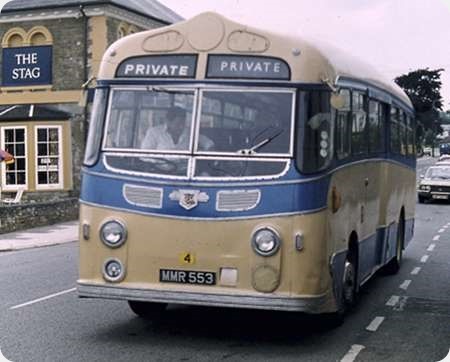
Silver Star – Leyland Tiger Cub – MMR 552/3 – 10/26

Silver Star – Leyland Tiger Cub – MMR 552/3 – 10/26
Copyright Pete Davies

Silver Star Motor Services
1956
Leyland Tiger Cub PSUC1/2
Harrington C41C

Here is a view of MMR552 and 553 fleet numbers 10 and 26, Tiger Cubs with Harrington coach bodies from the dear departed fleet of Silver Star, Porton, near Salisbury. I have seen and photographed both of them on a number of occasions, but this sighting at the "Harrington Gathering" at Amberley on 3rd June was my first of them together. They may be twins, but they are most certainly not identical twins.

Photograph and Copy contributed by Pete Davies

———

31/08/12 – 07:37

My late friend Walter Martin bought two identical Bedford YRQ/Plaxton Panorama Elite III in 1972/3 which were instantly identifiable by several small differences in livery and application – just like these two splendid vehicles.

David Oldfield

———

31/08/12 – 12:34

This picture has made my day! From the age of 9 I grew up in Sale in Cheshire and the Silver Star vehicle(s) doing the forces leave service to Manchester spent their lay-over at the premises of Pride of Sale, often venturing out "on hire" on local excursions. They also sometimes appeared "doubly on hire" to North Western for use on the North Wales and Yorkshire Coast services.
Sadly my personal experience of their fine fleet was short-lived as they sold out to W&D less than a year after I moved to Sale. A brief pleasure, but still vivid in my memory. It’s good to see the pair together again in a recent shot.

Neville Mercer

———

31/08/12 – 14:29

I’m glad you found the view interesting, Neville. One of the Atlanteans, 1013MW, survives as well, but I don’t know of any of the other vehicles from the fleet.
The idea of reaching destination and then running ‘on hire’ to the local operator caught me out on several occasions. The one which sticks out most clearly is a Red & White MW coach which had arrived in Morecambe on a tour and was acting as a PD3 on the L6 Heysham to Lancaster service, on hire to Ribble. Must have been a surprise for the crew to draw that!

Pete Davies

———

31/08/12 – 16:05

I know the feeling Pete – Ribble would seize anything on a busy day. I was always amazed by some of the oddities that would turn up at Lower Mosley Street on X60 duplicates. As I mentioned in my article (on this site) about LMS these included vehicles from East Kent and East Yorkshire which had been commandeered by Ribble staff at the Blackpool end. I also witnessed the arrival of a 36ft Yelloway Reliance/Cavalier on an X60 extra in the summer of 1966 – presumably it had operated a duplicate on their own Blackpool services and then been free for the day for other remunerative work. It also, of course, had the advantage of being able to show both Manchester and Blackpool on its destination blind, but I bet that the Allen family made them pay the top rate for the hire!

Neville Mercer

———

01/09/12 – 08:06

I well remember during busy summer periods working for Southdown at Eastbourne in the 1970′s and 80′s it was a case of anything goes especially with coaches that were staying on a weeks tour on days when they were not out or coaches that were on day trips, on entering the garage the drivers were asked " what time are you leaving" if it was late enough for the coach to be used that afternoon he was asked to please see nothing was left on the luggage racks as the coach would be used, this of course was in NBC days. The favourite tour coaches used belonged to Eastern Scottish which were at different times Bristol LH’s Leyland Leopards and on one occasion a Seddon Pennine VII. another favourite was Western Welsh nearly always a Leopard but among other companies featured was a Crosville Bedford VAM. My fondest memory of these is of taking a school party from Eastbourne to Lewes on one of M&D’s superb AEC Reliance/Harrington Grenadiers a totally blissful afternoon, the different companies vehicles driven when on express services however is a story on it,s own.

Diesel Dave

———

01/09/12 – 10:51

An interesting posting, and I was most amused to read the appreciative comments of some correspondents about these vehicles. I agree with them. Apart from the Leyland chassis and the different treatment around the destination indicators, however, these coaches are pretty well the same design as my recent M&D AEC posting that received rather less fulsome responses. Maybe I’m thick, but I just don’t understand that. I also agree with Diesel Dave about the M&D Grenadiers; superb describes them absolutely.

Roy Burke

———

02/09/12 – 15:35

No, Roy, you’re not thick! It’s taken me a while to work it out, but I think the reason for the difference of opinion about the appearance of the Maidstone vehicle versus this pair is the indicator display.
These two have a modified version of what many regard as the typical Harrington front dome of the period, with two wide indicator displays. That on the Maidstone looks to be much more of a bus indicator, far more concentrated in the middle of the dome, and I’m sure the more usual style would have made it more attractive to many of our readers. A different way of applying the livery, with a lighter top, might have helped, too. I don’t suppose Southdown would have objected if their neighbour (and associate BET company) had used the Southdown style.

Pete Davies

———

03/09/12 – 07:54

Off subject, Neville, but I lived in Ashton-on-Mersey in the late ’70s.

David Oldfield

———

04/09/12 – 08:43

We missed each other by a few years, David. I moved to Nottingham when I was 19 (mid-1972) and from there to the USA for a six year spell from 1974. I blame the introduction of the NBC corporate liveries. Emigration became the only sensible option!

Neville Mercer

———

05/09/12 – 06:54

I can understand that, Neville. Glad you came back, though.

David Oldfield

———

05/09/12 – 08:40

I’m with Pete here: I’m still not a big fan of the design, but the overall styling/livery/destination display works much better (and its "polished-up", which might help!). For me the significant differences are: the fog/spot lights and associated moulding, which when combined with the "pointy" dome tend to accentuate the vertical aspect and narrow the front; and the absence of the above-windows moulding present on the M&D vehicle (which seems to be a throw-back to the 1930′s).

Philip Rushworth

———

06/09/12 – 06:51

I stand by my comments on the M&D Reliance, but as I’ve said before, in the right livery an Orion can look good. This just emphasises how important livery and its application is and reinforces all the comments on this forum about kids in paintbox liveries that we suffer today with current operators. Two identical vehicles can look SO different in different colours.

David Oldfield

———

07/09/12 – 07:25

I agree David – but I think the converse is true as well. Many colour schemes look well on some vehicle designs but not on others. A good livery is one that is sufficiently robust (and perhaps adaptable) to be applied to different types. Even some of the big groups seem to be recognising this. For example, I dreaded the appearance of "splash it all over" washed out green when Arriva took over Cross Country Trains – but they didn’t, thank goodness!

Stephen Ford

———

07/09/12 – 07:25

Well, David, we could have a long discussion about the effect of livery and detailed design differences on a vehicle’s ultimate attractiveness. However – maybe I don’t possess a ‘true’ enthusiast’s appreciation of these things – but to me a basically sound and well-balanced design is not somehow transformed, Jekyll and Hyde-like, into hideous ugliness because of such elements. I can understand how one treatment might appeal more than another, but the underlying balance and elegance of Harringtons’ design on these Silver Star coaches, (‘splendid’ was your own adjective), remains apparent in the M&D vehicles, dated destination indicator screens notwithstanding. I returned to the link showing one in Hebble livery, but that exercise has served only to reinforce my view. We can only agree, perhaps, to differ – and Philip, I guess, would be with you rather than me – on this.
‘Two other points in my final comment on this issue. First, Peter’s observations. I agree that M&D’s destination screen treatment is rather ‘bus’ like. Most of their express services were short distance, on which many passengers would buy their tickets from local agents just before travel. A large, instantly readable destination screen thus made operational sense. I’m not sure I follow his point about Southdown livery, however; after more than a year with that company, I never quite understood what their express livery was, and judging by the inconsistency with which it, (and even whether a vehicle should display a scripted or capital lettered name), was applied, I’m not entirely sure that they did either.
Secondly, while there is no rule that says correspondents must like this Harrington design, I find both the Silver Star and M&D versions infinitely cleaner and better balanced than the Duple coachwork on the recent Black & White posting. While looking at Hebble vehicles, moreover,I came across a Bellhouse Hartwell Landmaster of about the same date as the M&D vehicles. Now for real ugliness…….’

Roy Burke

———

08/09/12 – 07:05

There you go, Roy. I agree with you on your latter points.

David Oldfield

———

08/09/12 – 07:05

We’re back to this ‘beholder’ business again and the matter of comparisons, one with another! I don’t find the BHS vehicle THAT ugly, but this Barton monstrosity is another matter: SEE: www.modelbuszone.co.uk

Chris Hebbron

———

08/09/12 – 07:06

Mention of the Bellhouse and Hartwell coaches reminded me of a comment my friend the late Donald Ingham who had been a driver of these beasts told me. The drivers referred to them as Brabs this being a reference to the giant seaplane the Brabazan that flew in the 1950s. One of these coaches was sold to a old persons home in Derbyshire and had its rear end modified to take wheel chairs and eventually was sold for preservation to a group of drivers at YWD Frost Hill depot. Alas this was an abortive venture and I recently heard that it had passed to Ensign for their heritage fleet but it would appear to be too far gone. .

Philip Carlton

———

09/09/12 – 07:20

Wow, Chris, what a beauty! (Pardon the irony). What is it? There’s some script below the radiator grille, but I can’t make out what it says. (not ‘Bristol’, surely?). Could it be the builder’s name – I’d have wanted to remain anonymous if I’d had anything to do with it. More details from someone, please. I’m intrigued.
Philip’s remark about the Bellhouse Hartwell coaches’ nickname was amusing, too. Very appropriate. I read elsewhere that they were also nicknamed ‘Sabrinas’, for fairly obvious reasons.

Roy Burke

———

09/09/12 – 07:20

Reference to Chris H’s link, Barton’s 657 was certainly no oil-painting, and the normally attractive livery was applied in a rather fussy way. I remember it as one of those quirky members of the Barton fleet – an in-house rebody of, if I remember its sound correctly, a half-cab Leyland TS? In the early/mid 50s it often worked on the route 10, Nottingham – Long Eaton – Kegworth – Loughborough. There were a few similar rebodies, plus the much more attractive style just visible behind, but I think there were only one or two of this particular design.

Stephen Ford

———

09/09/12 – 07:21

Small point, Philip, but if I don’t mention it someone else surely will. The Bristol Brabazon was a large landplane, powered by eight Bristol Centaurus piston engines mounted in pairs driving contra rotating airscrews. The huge contemporary flying boat was the Saunders Roe Princess which had ten Bristol Proteus turbo props. Both were misconceived for the post war air transport scene.

Roger Cox

———

10/09/12 – 07:08

As originally built, MMR 553 also featured the "V" shape front trim but fairly early on presumably had a bit of an accident and for most of the time with Silver Star appeared as we see it today.

Nick Webster

———

10/09/12 – 07:09

If you’re looking for ugly in house re bodies, you need look no further that the Tynesider and Wearsider of Northern General. I think one of them is still around somewhere in the North West area ‘Liverpool?’ but I’m not sure which one it is

Ronnie Hoye

———

10/09/12 – 07:09

You see the safe path I tread to avoid controversy with body designs! I thought, Roy, that the writing said ‘Daimler’, but could be mistaken. And thanks, Stephen, for your thoughts on the body’s origin.

Chris Hebbron

———

10/09/12 – 07:10

I believe the Sabrinas were SUT.

David Oldfield

———

11/09/12 – 06:49

I realise that we have taken something of a diversion but the excellent picture of the Barton BTS1 made me wonder, whilst the body was built in Barton’s own workshops and rightly ascribed to them, I wonder how many components were bought in, such as front wings, front dome and windscreen frames etc. I may be wrong but I can’t imagine all of these being produced by Barton, or any other operators who built their own bodywork. One thing is certain though, these were sound vehicles which gave Bartons good service. They must have been considerably better than some of the offerings from the myriad of post war British coachbuilders.

Chris Barker

———

12/09/12 – 06:54

Discussion on styling should also take into account changing fashion- less so with buses than coaches- as well as functionality. I think the Bridgemaster/Renown expressed a fashion for the square rather than curves, seen in buildings of that era. Liveries/trim were lightened and simplified in the 60′s. Curves were very thirties/forties and in the case of Barton, the "diner" look became a caricature. Then there is the "classic" look like the Leyland/Leyland PD2, and most ECW output, which could seem boring- but the style had to last 10/20 years. Now today… the Optare Spectra already looks dated and those areas of purposeless blind glazing in other, later designs… why?
A CVG6/Roe* takes a lot of beating….(insert your own preference here)*

Joe


Quick links to the  -  Comments Page  -  Contact Page  -  Home Page


Stratford Blue – Leyland Tiger Cub – 2745 AC – 44

Stratford Blue - Leyland Tiger Cub -2745 AC - 44
Copyright Roger Cox

Stratford-upon-Avon Blue Motors Ltd
1959
Leyland Tiger Cub PSUC1/1
Willowbrook B45F

In his comment upon Michael Bishop’s posting of the Isle of Man Road Services Leyland Tiger Cub with a Willowbrook DP41F, Ian Wild refers to the very similar Stratford Blue Leyland PSUC1/1 Tiger Cubs. Pictured in August 1970, this is No.44, 2745 AC, the one with the Willowbrook B45F body – the other four had DP41 seating configuration – and, I think, it is our first picture on the site of a Stratford Blue bus. The early history of the company is rather complicated, but by 1931 it was operating as a Balfour Beatty group business with second hand vehicles, as Balfour Beatty refused to finance new purchases. In 1935 the BET group assumed control, with management passing to BMMO, a situation that continued until the BET sold out to NBC in 1969. NBC set about absorbing its newly acquired smaller operators into the bigger neighbouring companies. From 1st January 1971, Midland Red assumed full control of Stratford Blue, and buses were progressively repainted into the BMMO overall red livery.
Here is a link to read the full history of Stratford Blue.

Photograph and Copy contributed by Roger Cox

———

15/07/12 – 08:08

What a beautiful glossy finish. You don’t see that very often – and you rarely saw it in NBC days. It seems strange to me that some operators manage to keep this sort of finish and others can’t. It can’t simply be the difference between whether vehicles are hand or machine washed.

David Oldfield

———

15/07/12 – 12:44

On that point, David, when I was with Tynemouth and Wakefields, prior to NBC all Northern group buses were hand painted, this involved several coats of primer and paint followed by a final coat of varnish, the drawback was cost and the fact that the whole process took about 10 days, these days much of what you see is just stuck on graphics. cost effective, but no where near as good a finish.

Ronnie Hoye

———

15/07/12 – 12:44

A very nice photo of a small’ish concern who always took a pride in their vehicles and ploughed their own furrow, in spite of being a BMMO subsidiary for some 40-odd years. They were great advocates of Tilling-Stevens B10′s before the war and I recall visiting an aunt around 1949-50 and seeing these strange-sounding antiques. I didn’t fully appreciate them, truth be told.
Later, they were equally keen Leyland users, of which the above is a good example. Peter Gould’s website contains a potted history, taken from the book "Stratford-upon-Avon Blue Motor Services Remembered", by David Harvey. 

Chris Hebbron

———

16/07/12 – 06:28

I can’t help thinking that the picture gives a good impression of how Samuel Ledgard’s fleet would have looked if they had taken similar vehicles.

Chris Barker

———

16/07/12 – 06:29

It certainly does look in remarkably good fettle for an 11 year old bus – one could easily believe that the photo was taken to mark its first day in service.
As Chris states, despite being under the wing of Midland Red, they went their own way – especially regarding vehicle policy. Their BET Federation style PS1′s and Tiger Cubs, and the Northern Counties rebodied PS2′s were more reminiscent of Yorkshire Traction – a company about as far removed from Stratford Blue as I can imagine.
I’ve heard it said that the BET Group retained some smaller outfits such as Stratford Blue, Hebble and Mexborough & Swinton in order to allow junior managers to gain experience and prove themselves on a small scale before being let loose with a larger company.

John Stringer

———

16/07/12 – 12:18

You’re right in what you say, John, whenever United ‘Tilling Group’ took over a company everything was changed to a standard procedure, where as Northern General ‘BET’ allowed companies to retain their name, different livery, and a certain amount of independence, in some cases this even went as far as vehicle spec, take the PD3′s for example ‘livery apart’ although outwardly the Orion bodied examples all looked the same, but the Percy Main vehicles were totally different from the rest inside, and the Sunderland District ones were Burlingham bodied. This all changed with NBC, the ‘Corporate Image Brigade’ stepped in, the names went one by one, and some splendid liveries were cast aside to be replaced by drab poppy red or vomit green dependant on where you live

Ronnie Hoye

———

16/07/12 – 18:20

Only one word to say about the photo – stunning, absolutely stunning! That’s three, but who’s counting. As others have said, a beautiful livery – strange how something as basic as blue and cream can look beautiful, but it did – immaculately presented on a classic design. In addition ‘Stratford-upon-Avon Blue Motors’ has such a wonderful ring from a more elegant age.
And Ronnie, I agree with every word you say about Northern Group liveries. I was sad when Gateshead adopted green and cream in 1964 thereby making them look the same as Tyneside; I may have been in a minority in loving the old maroon/brown and cream but I thought it was really smart and it was distinctive.
In mentioning the end of separate liveries with inception of NBC you might also have mentioned the revolting yellow which got slapped all over buses based in Tyne and Wear soon afterwards; strange how Newcastle Corporation’s yellow and cream looked really smart and yet Tyne and Wear’s didn’t seem to look good on anything!

Alan Hall

———

17/07/12 – 06:55

Another well-kept vehicle in a small fleet despite, as others have said, being a division of Midland Red for so many years. Looking closely at the picture reminds me that Stratford Blue were among a very small number of (usually small) operators who used the service number box to display the name.

Pete Davies

———

17/07/12 – 06:56

I may be mistaken, but I think Stratford Blue were wound up after pay/conditions were brought into line with BMMO – there was a strike about this issue. Why the company couldn’t have been allowed to continue with staff on an equal footing with the parent escapes me, but then around this time NBC was intent on wrapping-up its smaller operations – were there administrative costs, such as posting of accounts, involved in running subsidiary companies?
Whatever, it was a shame to have lost a "blue company" – although NBC’s (lack of!) policy on corporate blue liveries would have seen to that in due course anyway. Red "Statford Blue"?: reminds me of when Western National was split by NBC and Bob Montgomery had those members of his new North Devon operation – trading as Red Bus [sic] – which were still in Leaf Green lettered as "This is a RED BUS" (as opposed to the "RED BUS" fleetnames on the red members of the fleet). "This is still a STRATFORD BLUE bus" (on Poppy Red vehicles) doesn’t have the same ring though. Although with NBCs policy of shortening fleetnames – Cheltenham District/Cheltenham, Bath Services/Bath, Maidstone & District/Maidstone (on coaches), Mansfield District/Mansfield – red "Stratford" buses wouldn’t have been so silly.
Back to the bus though – the whole thing’s just right isn’t it? livery, vehicle design/proportions . . . and a nice linen destination blind – class.
But does anybody know why Stratford Blue was "allowed" to pursue a Leyland-based vehicle buying policy? One assumes that the Directors were all senior BMMO officers, so why didn’t they insist on purchase of BMMO products? Was it because the Leyland purchases by Stratford Blue provided a bench-mark against which BMMO products could be judged, as I’ve read? – but then they weren’t being operated over comparable routes and BMMO operated Leyland vehicles in its own fleet anyway; or was it because BMMO couldn’t meet its own requirements from internal production and Stratford Blue had, of necessity, to look elsewhere?

Philip Rushworth

———

17/07/12 – 06:57

Alan, I prefer not to think about the NBC version of T&W yellow, and the PTE went on a very expensive experiment with various layouts of Newcastle Corporation’s original livery only to end up with something not a million miles from where they started, in fact I would be surprised if most of the population of Newcastle knew the difference.

Ronnie Hoye

———

17/07/12 – 08:19

…..but just be thankful that you didn’t end up with something like South Yorkshire’s "Coffee and cream"! Even when the coffee was strengthened, it wasn’t a patch on Sheffield’s cream with blue livery and it only became vaguely bearable with the eventual addition a red.

David Oldfield

———

17/07/12 – 12:41

Yes, the right combination/shade of blue and white/cream do make a very attractive buss. My Western Travel post shows a dual-purpose Gloucester Bristol RELH6L in similar guise, although their bog-standard all-over blue with thin white stripe between decks looked uninspiring.

Chris Hebbron

———

17/07/12 – 12:41

Chris B – how right you are with the Ledgard comparison – in fact there was once an edition of an Ian Allan publication which featured a Stratford PD2 and I for one had to glance again quickly, thinking that it was a Ledgard view. I can’t just recall whether it was a "Buses Illustrated" or one of the annuals.

Chris Youhill

———

28/07/12 – 08:36

A lovely picture but it would be a mistake to think this is representative of how Stratford Blue buses looked in their later years – what it does show is No. 44 fresh from the paint shop in the blue and white livery that replaced the earlier blue and cream from 1969 onwards. In their later years the Tiger Cubs were unreliable, unloved and often unkempt, and consideration was given to replacing them with used buses from elsewhere, but it never happened. There were 14 Tiger Cubs in the fleet, with Willowbrook, Park Royal and Marshall bodies. They all passed to Midland Red on 1 January 1971 but were withdrawn by May, despite two of them having been repainted red – mostly replaced by the newly delivered Ford R192s. As to Stratford Blue’s quasi-autonomous existence the answer probably lay with BET headquarters rather than with Midland Red, but it has never been fully explained and probably never will be. Although Stratford Blue bought Leylands almost exclusively from 1948 to 197 (82 in total), Midland Red bought more in 1952/53 alone, with their 100 LD8-class Titan PD2s. Final comment on this photo is that Warwick was rarely seen as a destination on a Stratford Blue bus – the hourly 90A from Stratford to Leamington passed through the town, but very few journeys finished there. This was most likely a schools journey.

Bob Telfer

———

2745 AC_lr Vehicle reminder shot for this posting

———

28/12/12 – 13:48

Stratford Blue

Just to say Kineton depot of Stratford Blue used white ticket rolls as did Stratford unless on local service then we had to change to pink.

Bill Floyd

———

29/12/12 – 18:13

I may be imagining this, but there looks to me to be a conductor on board who is in the process of winding the destination blind – this would explain the ‘unlikely’ destination and the fact that it appears badly set. The ‘PAYE’ sign doesn’t look to be illuminated.

David Call


Quick links to the  -  Comments Page  -  Contact Page  -  Home Page


All rights to the design and layout of this website are reserved     Old Bus Photos does not set or use Cookies but Google Analytics will set four see this

Old Bus Photos from 11:53 Saturday 25th April 2009 to 06:29 Wednesday 19th June 2013