Old Bus Photos

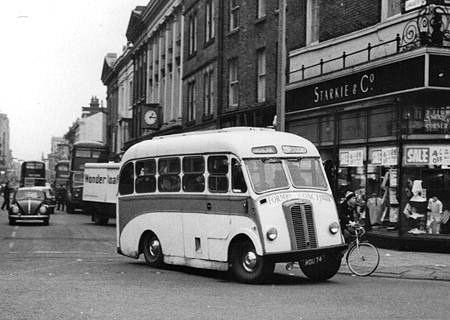
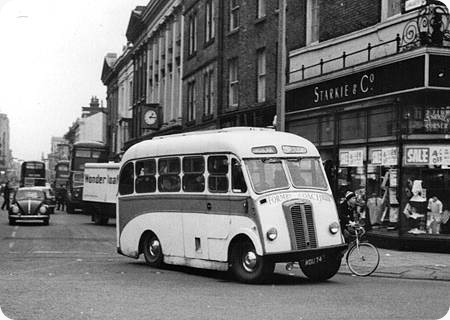
Formby Coach Company – Karrier – MDU 14

Formby Coach Company - Karrier - MDU 14
Copyright Alan Murray-Rust

Formby Coach Company
1953
Karrier
Reading C14F

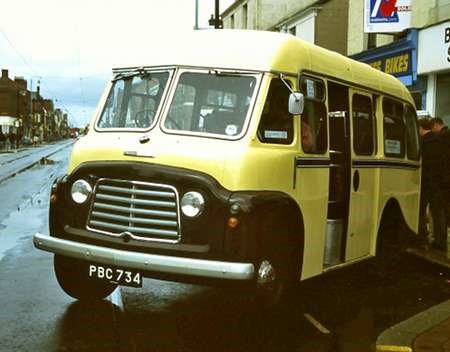
After the demise of the W-type trolleybus, the Karrier name remained dormant until the Rootes Group revived it for this compact little 14-seater coach. It was clearly based on Commer units, and according to John Gillham’s ‘Buses and Coaches 1945-1965′ used a 4-cylinder petrol engine. It appears to have been marketed as a complete vehicle with Reading bodywork from the outset. No chassis type is indicated.
This example was owned by the Formby Coach Company, although this was clearly not its original owner, as it has a Coventry CBC registration. I have no information about its previous owner(s); the name in the nearside destination opening is indistinct but could be either Bibbys or Kirbys.
The shot was taken in January 1967 at the corner of Lancaster Road and Church Street in Preston, known locally as Starkie’s Corner from the clothing store behind (these words can just be made out on the corner window above the prominent ‘SALE’ sign). Note also the three Preston Corporation deckers in the background, all in the older maroon livery. The building with the clock is the Transport Department offices.

Photograph and Copy contributed by Alan Murray-Rust


17/03/13 – 09:59

Thanks for posting, Alan. There is still a Formby Coaches (based in Formby) appearing on the web, although it probably isn’t the same one.
Looking at the background, don’t those Preston buses in the old livery look dismal? The blue and cream gave a much-needed boost to the impression. And a WONDERLOAF delivery van – remember???????

Pete Davies


17/03/13 – 15:48

This is lovely ‘action’ photo (leaning round the corner) of a Karrier Q25 chassis and an early Reading body of the type called Lilliput. It was exclusively built on Karrier chassis and ‘Karrier/Reading Lilliput’ was a registered trade mark. They were made throughout the fifties and sixties and sold to many well-known companies such as Frames Tours, these examples looking outstanding! The GPO ordered a lot of (modified) ones for outside broadcasting duties. I recall them well in this role. They were a nice little earner for Reading – the cost of them as luxury coaches at that time was around £1250!

Chris Hebbron


17/03/13 – 16:54

Many thanks for the very complete expansion of the details of this – in my opinion – rather neat little vehicle; I was a bit frustrated by the rather scanty info in JCG’s book, although at least there was something there to work on. I also have a photo of a similar combination, but clearly of later date, with the horizontal grille, with Safeway of South Petherton (600 GYC). Presumably that would have been marketed under the Lilliput brand as well?

Alan Murray-Rust


18/03/13 – 06:33

You’re right, Alan. Later on, Reading & Co put stylish Lilliput bodies on the Karrier BFD chassis. Here is an example of one such vehicle: http://tinyurl.com/bpr5tdp  
Reading was very much into producing bespoke bodies and Lilliputs came in all shapes.
Plaxton was another company who built bodies on the Karrier chassis, but I think that the Karrier/Reading partnership had a large market.

Chris Hebbron


18/03/13 – 11:27

The photograph of Karrier/Plaxton 2677 NW of T.H.Parkinson of Heckmondwike reminded me that the vehicle in question was painted lemon yellow and later it was replaced by a newer model painted blue. Besides running the coaches the firm ran taxis and were booking agents for West Riding for the daily service from Wakefield to Blackpool that passed through Heckmondwike.

Philip Carlton


18/03/13 – 13:10

Further to my earlier posting of 2677 NW. Bruerian mentions on his Flicker Postings that in fact the registration number was in fact 2677 WW. There is probably a grain of truth in this. NW was a Leeds registration and a vehicle registered in Heckmondwike would have been registered in the West Riding of Yorkshire which had their offices in Wakefield. It would appear Plaxton made a mistake on their official photograph.

Philip Carlton


Quick links to the  -  Comments Page  -  Contact Page  -  Home Page


Safeway Coaches – Dennis Lancet – ASV 900

Safeway Coaches - Dennis Lancet - ASV 900

Safeway Coaches - Dennis Lancet - ASV 900
Copyright all shots Ken Jones

Safeway Coaches
1949
Dennis Lancet III
Reading C33F

It’s not often that you find a vehicle built in 1949 which until recently has had only one owner. This Dennis Lancet 33 seat coach was acquired new by Safeway Services of South Petherton in Somerset, which was ownedASV 900_sign and operated by the Gunn family. It was re-registered in 1985 to ASV 900 its previous registration was ETP 184 why it was re-registered I know not. I also shot this interesting sign from inside the coach.
In the early part of this year Stephen Morris of Quantock Motors purchased this vehicle from Vernon Gunn. He brought it to the West Midlands to attend a bus rally and not only was I lucky to photograph it, but also to be its only passenger to the rally. The vehicle has since returned to its base in Somerset.
I recommend the information about the company given on this very good website www.countrybus.co.uk

Photograph and Copy contributed by Ken Jones


19/09/12 – 07:19

Ken’s comments in respect of this magnificent vehicle raise another point. Never mind why the registration change, but why would a Somerset operator buy new a coach registered in Portsmouth? Could it be that the body builder registered it on the owners’ behalf? In those days it would have been remarkably unusual!

Pete Davies


19/09/12 – 07:20

This Reading (of Portsmouth) – bodied coach — hence the original Portsmouth registration was new to Safeway Services of South Petherton, the domain of the legendary Veronica Gunn. Following withdrawal in 1969 the coach, by then re-registered ASV 900 (did this stand for A Safeway Vehicle?), was retained in preservation by the company, and it is said that Miss Gunn even used it to go to Buckingham Palace to collect her MBE in 1987!

Philip Lamb


20/09/12 – 07:15

Found this reprinted article from 1947 at www.dennissociety.org.uk

Ken Jones


20/09/12 – 07:16

We should be grateful that this coach has survived and within a caring environment, too. It really is in superb condition and a tribute to the coachbuilder, of Portsmouth. Coaches of this era were really the swansong of ‘tween war art deco design. This coach oozes it in spadesfull.
For such a small coachbuilder as Reading & Co., we now have three examples of their craft on the website; The wartime austerity-bodied Provincial AEC Regal/Regent, this one and the 1964 Guernsey Nimbus. The firm lasted longer than I thought, showing that it was not just used for distress purchases. Does anyone have/know of, a history of Readings? I’d love to know more. Incidentally, coachbuilder Portsmouth Aviation was only just down the road from Readings.

Chris Hebbron


20/09/12 – 07:17

Quite a number of Reading-bodied coaches were registered in Portsmouth prior to delivery. The same was true of Wadhams at Waterlooville. Many were supplied through Sparshatts, a local agent which acted for a number of chassis manufacturers including Dennis. Sparshatts probably arranged for the vehicles to be bodied as well — a complete service for the small operator!

Philip Lamb


21/09/12 – 07:04

Picture of Portsmouth Aviation bodied half cab can be seen on this site under galleries / BVBG / The Bristols. Here is a quick link to view. 

Ken Jones


21/09/12 – 07:06

A History of Readings entitled ‘First and Last’ was published by the Provincial Society in 2009. See www.provincialsociety.org/shop.htm

Philip Lamb, Ken Jones, Andrew Goodwin & Pat Jennings


22/09/12 – 06:40

ASV 900_lr_2

Further to the posting of ASV 900, here is a view of the offside, taken at the Southsea rally in June 1990.

Pete Davies


22/09/12 – 06:42

Thx, folks, for the Reading history information.

Chris Hebbron


04/02/13 – 10:54

This lovely old coach is now owned by Quantock Coaches in Taunton. My step dad Vernon Gunn, nephew to Veronica Gunn MBE retired and did not want to just park the vehicle up. It is now still in its colours with Quantock.

Andy Blackwell


Quick links to the  -  Comments Page  -  Contact Page  -  Home Page


Guernsey Railways – Albion Nimbus – 14626 – 72

14626
Copyright Pete Davies

Guernsey Railways Co Ltd
1964
Albion Nimbus NS3AN
Reading B35F

Here is a view of an Albion Nimbus, registration 14626. She is in the green and cream livery of the Guernsey Railways fleet and has a Reading body, with fleet number 72. The Guernsey Motors vehicles were a dark red (quite near the Northern General or Ribble "cherry") while Guernsey Railways vehicles were in this green and cream. She’s at Le Gouffre during a refreshment stop on a morning drive. At least, my ticket was for a morning drive, but the blind is set at Island Tour. Given the size of the island, I’ve never discovered the difference! Did the afternoon drive have a different route? The date is 15 September 1972.

Photograph and Copy contributed by Pete Davies

———

15/09/12 – 07:26

EBW 112B_lr

Here is its twin number 173 (14651) at the centenary rally in Usti-nad-Labem on 19/06/1999.
It had travelled from Wareham to the Czech Republic under its own power.
It was even blinded for the "Morning Drive".
What a superb event it was, we attended on ex North Western Road Car 413 (JMA 413L) a Bristol RE/ECW.

Dave Farrier

———

15/09/12 – 08:43

Am I being unrealistically demanding in thinking I’d have expected something a little more fancy than a stage carriage Albion Numbus for a scenic trip?

Roy Burke

———

16/09/12 – 07:19

No Roy. I would have baulked at the regular use, by Ribble, NWRRC (and friends) of service buses on their X2/X60 type services. I had a very enjoyable ride around the Isle of Wight last month on a B10M coach – and also later on open-topped Olympians! SUT, Yorkshire Services and the local indies always gave us coaches in Sheffield.

David Oldfield

———

16/09/12 – 07:20

So, MORNING DRIVE did exist on the blind, then? I suppose setting it for ISLAND TOUR covered most eventualities!!! I see that Dave’s note was posted 40 years to the day since I captured the scene.
Yes, Roy, most folk would expect something a little more grand for a tour, but I don’t recall seeing anything like that. This, after all, is somewhat more upmarket than the Albion CX or Bedford types elsewhere in the Guernsey fleets at that time.

Pete Davies

———

17/09/12 – 07:08

Until the advent of second hand Bristol SUs and LH in the eighties these were the last passenger chassis bought by Guernsey most of the Bedfords being based on lorry derived chassis The older Albion CXs had high backed coach type seats

Chris Hough

———

17/09/12 – 07:09

In response to Roy and David’s comments: Guernsey is quite small and distances short; and traffic very thin – I assume that economics dictated, and geography allowed, the use of buses on tour duties. Could Guernsey Railways/Motors have justified the purchase of special narrow-bodied coaches – and wasn’t the Guernsey width limit 7’4"? – which would have "laid up" out of season?. Its quite a different proposition to the use of buses for coaches on the mainland. Anyway, perhaps this was the Nimbus’s finest moment: tootling around impossibly narrow lanes, providing a "big bus" service where only truck-derived Bedfords followed . . . (until the Trafalger years).

Philip Rushworth


15/02/13 – 05:59

Not sure why people are referring to Albion ‘CX’ vehicles when they never operated on Guernsey. If they are referring to Victors (FT and earlier PH models), from 1950 the bodywork they carried (which was developed by Heaver and Guernsey Railways), was effective classed as ‘Service Coach’ standard, to be used on both stage carriage and island tours, etc. We would today classify this as Dual Purpose.
The Abion Victors (the chassis of which was also sold as the FT3 truck range) were followed by the Nimbus model, the style of body being adapted by Readings of Portsmouth), which was an underfloor engined Albion Claymore lorry chassis marketed under a different name for PSV use.
Guernsey’s final ‘standard’ vehicle to use this style of curved waistrail ‘Service Coach’ bodywork was the J4EZ1 model, which was derived from the Bedford truck range but popular for PSV and coach use between the OB going out of production and the VAS being developed.
Guernsey’s buses were no less inferior for their use of HGV derived chassis, nor were the many hundreds of Bedford J2 coaches used throughout the UK in the 60′s and 70′s. Of course the VAS chassis, designed for bus and coach use also ended up carrying truck bodies such as mobile library’s, etc. From an engineering point of view rural bus chassis and truck chassis were all but identical from the turn of the 20th century right up to the end of the 60′s, essentially being the same 3, 4 or 5 ton models, marketed under different names.

John


Quick links to the  -  Comments Page  -  Contact Page  -  Home Page


All rights to the design and layout of this website are reserved     Old Bus Photos does not set or use Cookies but Google Analytics will set four see this

Old Bus Photos from 11:53 Saturday 25th April 2009 to 00:01 Wednesday 22nd May 2013