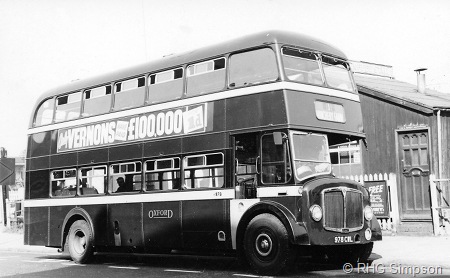
City of Oxford - AEC Regent V - WJO 947 - H947
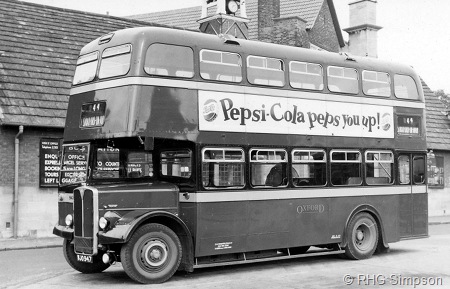
The City of Oxford Motor Services
1956
AEC Regent V MD3RV
Weymann H30/26RD
City of Oxford I think were one of AECs most loyal customers. According to my 1963 British Bus Fleets South Central book it states that as from 1927 apart from a batch of 5 Dennis Loline Mark IIs delivered in 1961 with AEC engines by the way, all their vehicles were AECs. Interestingly enough the next batch of vehicles ordered after the Lolines were AEC Bridgemasters. What I find strange, and I hope someone can explain why it was that the Bridgemaster had been available from 1956, why wait until December 1961 to take delivery of their first batch. Not to mention the fact that they took delivery of 15 lowbridge Regent Vs as well as the 5 Lolines in the 56 – 61 period. As a matter of interest they also took delivery of 30 highbridge Regent V MDs and 16 LDs in the same period of which the vehicle in the above shot is one of the first. It was chassis number 29 of the MD variant and had as can be seen an exposed radiator rather than the more recognisable concealed version more associated with the Regent V. All City of Oxford 27ft Regent Vs were MDs (Medium Weight) having the smaller AEC AV470 7.68 litre six cylinder diesel engine. But they were not quite so loyal when it came to body builders Park Royal and Weymann were the norm for the double deckers, apart from a batch of 5 Regent Vs and the Lolines that had East Lancs bodies and the first batch of front entrance Regents that had bodies by Willowbrook. I am afraid that is where my information ends but if you know something that maybe of interest to others your comments are more than welcome.
A full list of Regent V codes can be seen here.
I think you’re a little unfair about loyalty with bodywork. When you buy one
car or bus at a time you can be loyal to one maker. When you bulk order you have to be aware of the
capacity of the supplier - which is why most large operators (even London Transport) dual sourced.
At least COMS managed fidelity to AEC - with which I would fully concur - and the two bodybuilders
were among the acknowledged best at their craft at the time. [Lolines were only available late in
Weymann’s life but maybe they were arguing with Dennis for an AEC option when the body style and
finish of the Bridgemaster was truly dreadful.]
Whatever the reasons; maroon, cream and
duck-egg green AECs - that is the heyday of a superb operator.
David Oldfield
P.S.
Re-reading Alan Townsin’s chapter on the Bridgemaster in his "Blue
Triangle"…..
The original version was attractive with curved profile and aluminium
body but BET were likely to be the model’s biggest customer. They wanted steel frames and single
skin domes, like the MCW Orion, and a wholesale re-think had to be made.
Very few of the
original Crossley built Bridgemaster’s were made before it was totally retooled and production moved
to Park Royal from whence came the uglier production model. This probably helps answer why COMS
didn’t buy Bridgemasters before 1961 - that and being on the end of a queue which would involve PRV
vehicles for other customers. The Bridgemaster was now firmly based in London and would, or could,
not be sub-let to Crossley or Roe.
I don’t know who took this photograph but I know the setting is Gloucester
Green Bus Station in the heart of Oxford.
Oxford Bus Co’s livery was absolutely gorgeous,
restrained and stately but still gorgeous!!
George Taylor
23/03/13 - 08:02
Eventually this ended up with Wallace School of Transport as a driver trainer bus - I took my PSV test on it in 1970
Brian Lamb
23/03/13 - 12:28
Coming from a Leyland/Daimler Orion bodied stronghold on my visits to Oxford
with my father in the late 1950s/early 1960s I always thought this batch had a certain refined air
about it. Again, coming from the a place where the Orions were coated in acres or red or green the
Oxford livery was to my eye very attractive.
A few words on the Bridgemaster. Alan Townsin is,
of course, correct regarding the BET demands for the Bridgemaster. The original bodies were
developed from a specification drawn up at Park Royal but the final design and build was by Crossley
at Errwood Road using the basic outline and many of the panel sizes of the then current Park Royal
design it was also building. It is interesting to see that a few of the design touches of the
original were incorporated into some orders throughout the production run see: www.brindale.co.uk/
Whilst Graham Hill’s information on the
site is a little suspect e.g. his contention that the Lodekker (sic) had saturated the market
leading to poor Bridgemaster sales, the pictures show well the versions of the final design though,
as it is a Park Royal site, omit pictures of the Crossley version shown here: www.sct61.org.uk/
I was told by an ex Crossley employee who
was there to the end that the transfer of the Bridgemaster to Park Royal, which was pretty much the
final nail in the coffin of Crossley, would not have been so final had there been a commercially
viable demand from non BET operators who would have specified the original body, leaving Park Royal
to deal with the BET revamped design. As it was, no significant interest was shown and the shut down
went ahead.
Regarding Oxford’s order, whilst BET companies could deviate from group policy, at
the time the group was pressurising its constituents to take the Bridgemaster. With a very much AEC
dominated fleet Oxford found it hard to resist unlike Ribble, North Western and other fleets which
had either a Leyland dominance or a more diverse fleet.
Phil Blinkhorn
26/03/13 - 06:38
While the redesigned Bridgemaster is widely regarded as a styling disaster, it is often forgotten that some of the rear-entrance examples were nothing of the kind, as is well illustrated by the photos of the Sheffield buses on Graham Hill’s site (see Phil’s brindale link above).
Peter Williamson
30/10/16 - 06:28
Watching a 1963ish Youtube video on the Outwell and Upwell Tramway I saw a
familiar sight: a 1949 City of Oxford AEC Regent III with 56-seat highbridge Weymann bodywork
stopping to pick up a lady—and here’s the less familiar bit—who was standing on the
railway track. The by then diesel-hauled farm-produce trains that ran along the roadside made only a
handful of trips a day so using the tracks as a bus-stop posed little danger.
I couldn’t make
out an operator’s name, but I’m sure someone here knows!
ps.
I should have said that the film is Huntley Archives no 521. OFC 383 here
appears to have platform doors, which I thought were fitted by Smiths of Reading on acquisition.
Could this bus have passed from Smiths to a third life on the Fens? If so, that would date the
picture to about 1966-67.
Ian Thompson
30/10/16 - 14:41
I think that the Regent III is OFC 390 which was acquired by Smith (Bluebell) of March in February 1962 and was fitted with doors for them. It lasted until March 1966.
Nigel Turner
30/10/16 - 16:21
I thought that the Oxford "Country Buses" - out of town services like Kidlington - of that eras had doors from new?
Joe
Quick links to the - Comments Page - Contact Page - Home Page