Old Bus Photos

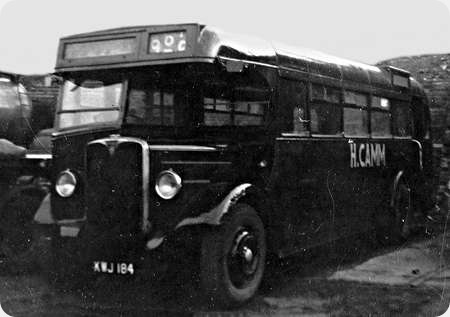
Sheffield Corporation – AEC Regent I – BWE 526 – 208

Sheffield Corporation - AEC Regent I - BWE 526 - 208
Copyright R H G Simpson

Sheffield Corporation
1935
AEC Regent I
Weymann H56R

Another R H G Simpson photo which I think is worth sharing. Sheffield livery as you’ve never seen it before? Although many vehicles were taken into stock in 1935, this one was not part of a batch, and is possibly the only bus to appear this way in the fleet.
It would appear to be an attempt at streamlining, indeed the front seems to be raked back more than usual, that might just be an illusion caused by the livery application.

Photograph and Copy contributed by Les Dickinson


05/04/13 – 05:59

A similar AEC Regent also with Weymann body albeit fully fronted was exhibited at the 1935 show in Leeds livery. This was later converted to half cab and was lent to London in the second world war.

Chris Hough


05/04/13 – 05:59

This was one of a pair – the other for Leeds – with this streamlined design which were, I believe, also show exhibits. This Sheffield example, at least, was originally full fronted but Sheffield had it converted to half-cab for the obvious and usual access reasons before it entered service.
Weymann’s first double decker in 1931 was a demonstrator which became Sheffield No66 in 1932. 85 Regent/Weymann deckers followed until 1940 (208 a one off, the rest related to and culminating in the well known classic style). Apart from penny numbers from Park Royal, 10 Cravens and 19 from the Corporation Tramways works at Queens Road, all AEC Regents pre-war came from Addlestone. 197 post war Regent III and V came from Addlestone – along with 102 PD2s.

David Oldfield


05/04/13 – 09:01

…and then we complain about modern liveries! I suppose it was a one-off, but it does suggest that the continuing Hull livery came from another era.

Joe


05/04/13 – 15:34

Joe:
It certainly wasn’t a one-off. Manchester for a period went the same way, and the influence persisted in the standard liveries of Huddersfield Corporation and Rochdale.
In practice, we were very fond of swooshes back in the 1940s and 50s. Virtually every coach builder had their own pattern of shapes which allowed us to recognise whose body it was; of course in those days we simply called it ‘trim’. The ultimate development of livery application that bore no relationship to the lines of the body undoubtedly came from the Yeates works!
I think we can get too rose-tinted about the liveries of that era. Where I grew up as a child – north Somerset – buses all looked the same, and as we took early holidays down in Cornwall there was no difference there either. Nothing really to arouse the interest, so it wasn’t until many years later that I started to develop an interest. Even then – I had moved north by that time – there was Crosville on the doorstep . . .
I do feel that our affection for the old liveries is as much a longing for the variety of those years; the individual liveries were often themselves pretty boring – Liverpool, Manchester all red, London – but they did distinguish the operators from their neighbours. We used to admire those operators who took the trouble to continue to use a separate colour on the beading between the main colours, or apply the odd gold lining, but is this really any different from the way bits of colour are applied in today’s liveries?
A post elsewhere makes the point that today’s young people will doubtless grow up with the same attitude towards the style of today as we did 50 or so years ago.

Alan Murray-Rust


06/04/13 – 07:35

Perhaps "streamlining" was an attempt to bring the new science of lowered wind resistance from planes, cars and even trains…. to the appearance of buses. We even had streamlined buildings, looking like ships. The fifties brought a new functionalism, but this, as you say, was lost on some municipalities, so intent on making a swish transition from the front of the bus to the sides… but wavy lines? I suppose it’s all a bit dorsal fin: but in 1935 that was in the future with vinyl, half tones, ads covering up windows and route branding….. at least we don’t paint the doors in fluorescent colours (much- or only the drivers?) …yet: but wait till the helfansafety experts get there.

Joe


06/04/13 – 16:45

As well as the Weymann bodied "streamline" AEC Regent in Leeds colours with a livery application very like the Sheffield one but in dark blue and turquoise Leeds also had a Roe bodied "streamline" bus at the same show. This too was painted Blue and turquoise but looked very different to the Weymann example with an almost tear drop shape and very stylised appearance.
We forget today how big an impact the railways had on style at the time both LNER and LMS were starting to run streamlined locos like the Gresley Pacifics and such styling was common in both Europe and the USA.

Chris Hough


07/04/13 – 07:53

Like many of us, I also abhor the meaningless modern vinyl "imaging" on today’s buses and applaud the attempts by some 1930s operators and builders to try to make their buses look "modern". However, I can’t think of any instances where trams had these "go faster" liveries applied. Some, of course, didn’t need them as they were superbly designed to look modern (eg. Glasgow’s Coronations, Liverpool’s Green Goddesses, etc). The master of industrial design at this time was Raymond Loewy whose US company opened an office in London in the mid-30s. Did Weymann approach them I wonder?

Paul Haywood


07/04/13 – 07:55

Joe, OK they weren’t fluorescent but LT painted entrance doors on dual door buses yellow until late 80s(?), and in the run up to the formation of WYPTE Leeds painted Atlantean 447 and Swift 1065 in an experimental "Leeds District" livery incorporating yellow entrance doors and red exit doors.
The 30s streamlined liveries may not always have fitted the lives of the buses to which they were applied – but what I think makes them forgivable is that they were identifiably local/distinct, and they used strong/bold/deep colours unlike the flat and/or wishy-washy pastels used by two of the big groups today. But, picking-up on a point Alan made, I’ll stick my neck out and say that gold lining-out was just too fussy once rocker-panels had ceased to be a feature of bodywork.

Philip Rushworth


07/04/13 – 07:56

Joe Although not florescent London Transport painted entrance doors yellow for many years.

Chris Hough


07/04/13 – 09:52

Paul, I know I’m biased, but for me the mention of ‘modern-looking’ trams really has to start with the Sheffield Roberts ones.

Les Dickinson


07/04/13 – 16:54

Point taken, Les – yes, the Sheffield Roberts cars were smart indeed and I enjoyed riding on them in their final years, but for me, being four-wheelers, they lacked the majesty of the streamlined bogie cars. The whole 1930s period (before my time) fascinates me. For many, the sight of a streamlined tram or bus, or a visit to an art deco cinema, represented a vision of the future. We’ve all seen those early artists impressions of "How we will be living in twenty years" etc. where travel by monorail, gyrocopters and airships was assumed. When this bus was built, those visions would still be valid. The quest for increased speed on land, sea and air influenced designers throughout this period and this bus is a wonderful example.

Paul Haywood


07/04/13 – 16:54

I personally like the look of this bus. Did you notice the wind down windows. I only noticed these on a few Weymann AECs, (which also had a "booming" exhaust) on the 101 Arbourthorne route, climbing the very steep hill up East Bank Road, & some PD2s on the 69 route to Rotherham. The PD2s also had a complete destination & route number in the same big oblong route destination board. I have seen similar on other companies buses. They may be pre 1950s, with all Leyland bodies.

Andy Fisher


08/04/13 – 15:20

Andy, the PD2′s with the one destination box for route number and destination were the three so-called ‘stock sale’ PD2′s, that Leyland built on spec. for quick delivery to operators willing to forego their regular requirements such as standardized destination layouts in order to obtain buses quickly. The three that Sheffield managed to get, 601-3 (LWB 301-3), were put to work on the 69 service to Rotherham when it was decided not to relay the tramlines on the new road bridge at Tinsley, and thus abandoning for good the Sheffield-Rotherham tram service. The Sheffield trams ran no further than Vulcan Road after that, while the Rotherham single-enders ran only to Templeborough, and even they finished six months later, in November 1949.
City, Sheffield, Templeborough and Rotherham, with the applicable route numbers, were, I think, the only destinations that the trio had on their blinds, so they were more or less route-bound to the 69 or the 169 to Templeborough. A friend has told me that apparently one of them quite often showed up to run a ‘cinema-extra’ to Nether Edge late of an evening, when the picture houses were turning out (before the days of television!) before running into the garage after working on the 69 all day, but just what it showed on the blind I’m not certain. I’ve got a photo of one of them on a stand in Castlegate showing just ‘City’ in big letters, but I don’t know what route is would have been on.

Dave Careless


09/04/13 – 06:41

And while we’re on the theme of streamlining in the 1930′s, let’s not forget those Flying Bananas on the Great Western Railway. For a railway that remained strongly wedded to steam traction, this batch of AEC (and later BUT) engined diesel railbuses had a charm and character all of their own.
I know this is a bus blog, but I’m sorry, I couldn’t help myself from eulogising about these splendid rail buses !

Petras409


14/05/13 – 07:57

Andy. Only the first post war Regent III/Weymanns (527 – 536) had half drop windows. The others (1947/8) had sliders.
Petras409. Strictly speaking, DMUs had underframes built by BUT with engines supplied by either AEC or Leyland – and in a minority of cases Rolls Royce.

David Oldfield


14/05/13 – 17:22

BUT (British United Traction) was a joint sales organisation set up by AEC and Leyland for the purpose of supplying railway and trolleybus equipment, in order to give the companies a more realistic presence in what were quite limited markets. It was a similar arrangement to that of MCW, formed by the one-time totally independent companies of Metro-Cammell and Weymann.
As far as railway equipment goes, the BUT contribution was almost invariably engines and transmissions – but these were always proprietary (or suitably modified proprietary) items, BUT never having had any manufacturing plants. The engines supplied (for use in DMUs and railbuses) were manufactured by AEC, Leyland, or (in at least one instance) Albion – itself owned by Leyland at the time.
The exception to the above appears to concern early DMUs 79740-50, given as of BUT manufacture. If this is correct, the underframes and bodies must have been built somewhere (there were several likely locations within the Leyland or ACV – parent of AEC – groups). Oddly, Park Royal (itself part of ACV) supplied the bodies for some DMUs and railbuses, apparently independently of BUT.
As for Rolls-Royce engined DMUs, it may be that BUT was given the task of supplying the entire driveline and itself sourced the engines from Rolls-Royce – this is the impression given by the wording of current internet descriptions of the various DMU classes.
The supply of trolleybus chassis by BUT effectively continued the erstwhile AEC range, and trolleybus chassis building at Leyland was dropped.
As BUT was created in 1946, and the last GWR railbuses were constructed in 1942, it could not be said that there was any BUT input to the latter. The original engines were definitely of AEC manufacture, but replacement engines fitted later may well have been considered to be BUT, rather than AEC, products, of course.

David Call


19/05/13 – 15:28

Thanks for the update on the windows & route box. I am just an observer, not really knowledgeable. Now I have taken much more interest in researching Sheffield buses, I do appreciate your knowledge on these matters. You may find some of my comments a bit silly, but it is my lack of knowledge. I also do not come online that often, so you may not get an immediate thanks from me.

Andy Fisher


21/05/13 – 15:01

Following on from your information, I had a look in my tram book. The last tram from Sheffield to Rotherham was in 1948 , so presumably, these PD2s must have been of 1948 vintage. There was another PD2 all Leyland in the book, on another route. It had normal layout destination board, but with opening front upstairs windows. Can any of you people identify it for me please? I must confess to being an AEC fan, Leylands were not local untill the 1960 tram replacement tin fronts. That is unless we visited my auntie at Southy Green. The 97 & 98. They were also all Leylands. One had rounded ended opening lights, with interior lights covered in round, fluted lightshades, really smart. The other route was standard PD2s all Leyland design. They must have been 1940s buses, as it never was a tram route, so must have always been serviced by buses. I think the estate was built just after the war. Any help in identifying these busses would be appreciated.

Andy Fisher


22/05/13 – 07:21

The PD2s with opening windows would have been 656 – 667 – 1952 all Leyland PD2/10s. The three odd PD2s were indeed 1948 and doubly strange for being standard Leyland bodies in among Faringtons.

David Oldfield


24/05/13 – 14:04

light fittings_2

Andy Fisher – regarding the smart interior lights with round fluted covers, I assume you mean like this – in this instance fitted in the preserved Crosville AEC Regal with Strachans body (seen here at the 2010 Kingsbridge running day). This sort of light fitting was also virtually universal on Trent’s many Willowbrook bodied double deckers.

Stephen Ford


Quick links to the  -  Comments Page  -  Contact Page  -  Home Page


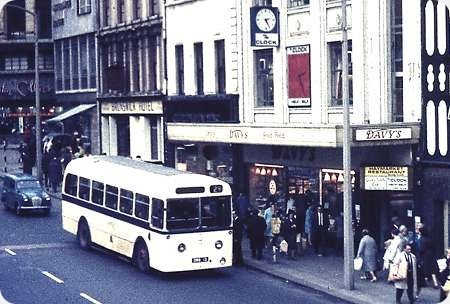
Sheffield Corporation – Leyland Titan – LWE 123 – 623

Sheffield Corporation - Leyland Titan - LWE 123 - 623
Copyright Dave Careless

Sheffield Corporation
1949
Leyland Titan PD2/1
Leyland H30/26R

The scene on the parking area at Pond Street bus station in Sheffield, in August, 1959, featuring a line-up of Sheffield vehicles, including one of the NCB bodied Crossley DD42/5’s, put to work as a driver trainer after withdrawal, and painted in the reversed livery of the service fleet. Nearest the camera is ‘A’ fleet (Corporation owned) 623 (LWE 123) a 1949 all-Leyland PD2/1, in the ‘Farington’ style livery with dark blue window surrounds, at the time operating from Greenland Road garage, and next to it is ‘B’ fleet (ownership shared by the Corporation and British Railways) 178 (SWE 278), an MCW bodied Regent III dating from 1954, and working from Bramall Lane garage, seen here resting after working in from the delightful Derbyshire hamlet of Castleton, famous for its limestone caves, on service 72.

Sheffield Corporation
The other two are both ‘A’ fleet buses, next to 178 being one of the 1948 Roberts bodied AEC Regent III’s, 327 (KWB 927) working from yet another of the Sheffield garages at the time, this one on the roster of Herries Road depot. Between 327 and the Crossley trainer is an unidentified FWA-registered Regent I dating from 1938, one of the eleven of a batch of fifteen vehicles (395-409) that were rebodied by Roe in 1952. These rebodied AEC’s somehow managed to retain their rugged pre-war appearance despite the much newer, stylish bodywork from the Crossgates works. On the radiators of the three Regents can be seen the sheet metal tabs that were often noted attached to the grilles of Sheffield buses, reading, as I recall, “STD – Do Not Drain.” !

This photo was taken as my mother and I were hurrying through the bus station on our way to the Midland Station to catch a train to London, on our way back to Canada after a summer holiday, having emigrated there the year before. I was just eleven years old at the time, and noting the magnificent line-up, implored my mother to take out the family Agfa and snap a quick shot! Not always quite so eager to please, she obliged on this occasion, and in so doing provided me with what was undoubtedly the first colour photo in my Sheffield collection, which has grown significantly since then! However, due to the circumstances in which it was taken, not one of the other views stirs the same poignant memories for me as this one does.

Photograph and Copy contributed by Dave Careless


19/03/13 – 14:31

A very nice addition to the "Sheffield" page, Dave. Thanks for posting.

Pete Davies


19/03/13 – 14:47

Incredible Sheffield line up and, as usual, your comprehensive knowledge fleshes out the detail. [Two small points: Regent IIs were post war and Castleton is a village - hamlets have no church.] Do you ever get back these days?

David Oldfield


19/03/13 – 15:54

Thanks, Pete, glad you liked the picture. I realised a short while after I’d captioned the photo, David, that those FWA-Regents weren’t Regent II’s, I should have had my first edition of BBF No. 2 beside me for reference when I wrote it!!
Yes, I do get back from Nova Scotia from time to time, but probably not as often as I’d like. I was back for the 50th London Transport trolleybus event at Carlton Colville last May, (couldn’t possibly miss that) and spent a few enjoyable weeks in Sheffield as a guest of long-time friend and fellow Sheffield enthusiast, Paul Fox.
Remarkably, my aunt still lives in the same house in the east end of the city where I stayed during that summer holiday in 1959, and for the record, father’s old Agfa camera that took the picture, that he brought back with him from Germany after the war, apparently still exists in the care of the Photographic Society of Memorial University in St. John’s, Newfoundland!! What a pity that the buses it was pointed at on this overcast summer’s afternoon don’t exist along with it!!

Dave Careless


19/03/13 – 17:10

I don’t get back as often as I would like, Dave, and I only live in Surrey. I know of Paul, and have met him a couple of times – once when he brokered a second hand copy of Charles Halls book for me. Paul is better known by my closest school friend, Ian Manning.

David Oldfield


20/03/13 – 06:11

That’s interesting David, I wasn’t aware of the connection. I know Ian a little bit, he gave me a splendid run around Paisley one evening many years ago in a Clydeside Scottish Routemaster, truly expertly driven, one of the best RM rides I’ve ever had. Happy times!

Dave Careless


20/03/13 – 08:18

A great picture Dave. There were line-ups like this every day of the week. Different combinations all the time. Today’s wheeled boxes will never compare. Hope you have more to follow. Thanks for posting.

Les Dickinson


20/03/13 – 08:55

Well said, Les. Like the wheeled boxes. No sane person would "bad mouth" the (generally) well run and well kept fleets in London, Manchester or Birmingham. They were however, to quote a friend, boring in their ultra standardisation. Sheffield did have standard buses in that they had (the usual) dual sourcing policy from preferred suppliers. For many years this was Leyland and AEC – latterly Daimler when AEC deckers were no more. Weymann was a standard supplier until they folded in 1963. Alongside were Leyland and Craven pre WWII and then Roe in the ’50s. The interest was in the constant "odd" purchases and those unique to the JOC B & C fleets. The standards were still as high, if not higher than those in the standard fleets.

David Oldfield


20/03/13 – 10:04

Perhaps we’re biased David, but I loved the variety. I had a piece in Buses Yearbook 2012 about some of the unique and unusual buses in the fleets at Sheffield. Nothing too technical, just a layman’s notes really. Things like the Mann Egerton deckers, Strachans, Cawood, Craven bodies all added to the unique character. ECW bodies in a "municipal" fleet, Alexander bodies on 30 foot Regent Vs, Regent V fronts on Regent IIIs. Nostalgia ain’t what it used to be?

Les Dickinson


20/03/13 – 12:33

Enjoyed your piece in BY 2012, Les. I’m not going to apologise for being biased.

David Oldfield


20/03/13 – 12:34

I’m not convinced by David’s statement that the Manchester fleet suffered from ultra standardisation.
Between 1950 and 1964 (the end of front engined, rear entrance deliveries) there were no less than 3 basic designs from MCW (Post War Standard, Phoenix and Orion) plus Atlanteans and Fleetlines and the Orions alone had 3 different versions – 4 if you want to be picky – plus umpteen variations of window vents making many individual vehicles look different, not to mention two versions of Cave Brown Cave heating/cooling.
In addition there were 2 different Northern Counties body styles, 2 versions of the standard Leyland body and Manchester’s modified Burlingham bodies on Leyland and Daimler, each looking different.
Add in the trolleybuses, Post War Standards of two body widths on Leyland, Daimler and Crossley and anyone on the street in Manchester would be faced with a wide variety.
By 1964 Manchester had also changed the front end of its rear engined vehicle deliveries and it was only 4 more years until the Mancunians arrived adding to the variety.

Phil Blinkhorn


20/03/13 – 16:19

Excellent – taken before my time in Sheffield, but the LWE and SWE batches were still active in 1965.
I came through Castleton on Saturday, and the 72 bus is recognisable as the 272, now running every hour.

Geoff Kerr


20/03/13 – 16:28

I think its safe to say that the only Yorkshire municipal operator who had a standardised fleet at that time was Todmorden with all Leyland Titans, all the others had something different. Bradford rebodied second hand trolleys. Doncaster trolleybus bodies rebuilt for motor buses. Halifax a very mixed fleet triple sourced chassis plus the odd Loline and Albion saloon for good measure. Huddersfield no corporation motor buses until the sixties the JOC had Guy saloons. Hull dual door trollies a big influx of second hand deckers to ease the way to one man operation. Leeds a very odd collection of saloons three chassis types for eight buses triple sourced chassis polished bonnets. Middlesborough ECW bodied Leylands and Guys Dennis Lolines. Rotherham single deck trolleys all rebuilt to double deck. Sheffield has already been discussed and the aforementioned. Todmorden and the companies were just as exiting even THC owned WYRCC ran pre-war Bristol Ks until well in the sixties. Now we have the ubiquitous Wright bodied deckers and little of real interest to those of a certain age!

Chris Hough


20/03/13 – 16:36

Les, the variety you mention that was so much a part of the Sheffield scene back then was, as you say, very much in evidence every day, and I needed to go no further than the bottom of the small cul-de-sac where my aunt lived, which ran off Owler Lane, to witness it.
Not only were there PD2′s like 623 here, on the 17 service, which had only just supplanted the trams, and themselves replaced the following year by first generation Atlanteans and then again later by the magnificent Roe-bodied PD3′s, there was a steady stream of Cravens, Roberts and Weymann bodied Regent III’s on the peak hour workers services, shuttling between the large housing estates of Southey Green and Parson Cross and the miles of giant steelworks at Brightside and Templeborough.
And just a few yards down the road were even more wonderful Regents, turning every few minutes at the Reform Chapel to head back along Petre Street to the city, and out the other side to the more fashionable suburbs of Graves Park and Hollythorpe Rise. On Saturdays, just to liven things up, the new 30-footers would often get on there as well, both Weymann and Alexander ones. To sit there on the stone wall and watch it all go by was really quite magical.

Dave Careless


20/03/13 – 17:45

My maternal grandmother lived on Woodhouse Road (Intake) and we saw her every Saturday. My little stone wall was by the shops at the junction of Woodhouse Road and Mansfield Road, Dave. AECs on the 95 and 41, lowbridge Orions on the 15/19/21, various PD2s on the 23. [Not to mention EMMS 3 and 46.] Even half an hour, free of the family, on the stone wall was bliss.

David Oldfield


20/03/13 – 17:46

In my run down of the Yorkshire municipals and their oddities I forgot to mention Teeside Railless who pinned their hopes on the trolleybus for their entire existence and beyond, they rebodied many trollies and had some ex Reading ones at the very end. Equally their motor bus policy was a straight Leyland/Roe one unlike their immediate neighbours Middlesborough who quickly went to Fleetlines with NCME bodywork.

Chris Hough


21/03/13 – 06:14

To follow on from Chris’s recent post, around these parts (which I shall call "Youhill-land") I find that the attire of the staff now provides more interest than the vehicles: "high-vis" or not; jeans or uniform (?) trousers; baseball cap – First (and who decided that a baseball cap was appropriate uniform issue?) or random – or not; woolley hat – see previous – or not; there seem to have been so many changes of uniform over the years that I can’t actually work out whether uniform or "smart casual" is being worn, but the permutations/combinations seem endless; tinted sunglasses/mirrored sunglasses of myriad styles – even in sunless winter; and whoever might be accompanying the driver – offspring, girl/boy-friend, wife, friend, "random pick-up" – draped over front dash.

Philip Rushworth


21/03/13 – 06:17

Dave Oldfield, you forgot the Chesterfield contribution of Titans on the 62/4, also passing your look-out post on the wall, and what about the Sheffield Regent III’s on the 25 Beighton, 26 Killamarsh, 30 Eckington. That wall must have seen much excitement over the years. Were you still there when the EMMS Alexander Lowlanders started passing by?
Happy Days.

Les Dickinson


21/03/13 – 10:54

Yes, Les, I had forgotten – but it’s fifty years of decline (mine and the buses) which has passed in the interim. Lowlanders? Not sure. The sojourn on my wall ended after my translation to (the original) King Edward VII School. …..but Oh the memories.

David Oldfield


21/03/13 – 17:30

David, another strategically placed stone wall was at the bottom of Burngreave Road, at Firvale. There was all kinds of activity there, including Tracky, West Riding and Yorkshire Woollen buses on the 65 group of services, but best of all the KWA-PD2′s pounding up the hill towards the city every few minutes on the 150/151. The trams shuttling between Meadowhead and Sheffield Lane Top made for a spectacular sight at this location as well, not to mention the full range of splendid sound effects.

Dave Careless


22/03/13 – 07:44

…..and Burngreave Vestry Hall could almost combine both of them – but I’m not convinced there was a suitable wall upon which to perch.

David Oldfield


22/03/13 – 07:46

I well remember the KWA registered batch of PD2s on the Shiregreen services. My Grammar School was at the top of the long climb from Pitsmoor and I decided that the 150/1 to Bridge Street was a better bet than the almighty crush to board a tram into the City (who says we schoolboys were better behaved in those days? – at least we didn’t use the foul language commonplace on school journeys nowadays – probably didn’t even know it!) Back to the buses, the initial 537-557 batch of PD2s had green rexine across the top of the lower saloon front bulkhead whereas the later ones had this area painted cream. Just a small detail but it somehow made them that much more different. Later when I started work I was placed for a time at Ecclesfield which involved journeys on Yorkshire Traction’s PS2 rebodies and later PD3s on the 65 service.

Ian Wild


22/03/13 – 09:09

Firth Park, Ian? Had an interview there – but no-one in Sheffield wanted me and I started my teaching career at Stretford Grammar School. Before then, often enjoyed the delights of Tracky PD3s when visiting relatives in Barnsley and also regularly visited a friend of my father at Pitsmoor/Firshill at the top of the hill between Firvale and Burngreave.

David Oldfield


22/03/13 – 10:18

The inclusion of 178 (SWE 278) in the picture raises another point. This was one of thirty-six similar buses delivered in 1954. Twelve for the A fleet were straight forward, ie 724-735 (SWE 424-435). The others were two for the C fleet, 1154/5, and twelve for the B fleet, 178-199. The registration plates were not issued in line with fleet numbers. SWE 254/5 were issued to 188 & 199, whilst their expected plates (SWE 288/99)went to 1154/5. Presumably this was due to delivery dates vs their "needed on fleet" dates. Can anyone give a definitive explanation of this anomaly please?

Les Dickinson


22/03/13 – 16:29

Can’t help Les, but your maths is shaky. 179 – 199 is twenty-two, not twelve. It was these I was most used to in the Greenhill/Lowedges area.

David Oldfield


22/03/13 – 16:30

I might be able to, Les. According to friend and long-time Sheffield observer and enthusiast, Keith Beeden, due to their long-distance work, it was decided to fit the two ‘C’ fleet examples, 1154/5, with saloon heaters to provide some passenger comfort in winter. Problem was, somebody at Queens Road made a mistake and the heaters accidentally got fitted in the wrong buses, 188 and 199!! Rather than mess about with the heaters any more, the simpler solution was to swap the two buses that had received them with the two actual ‘C’ fleet examples, which ended up in the ‘B’ fleet, bearing the numbers of the two which had been switched out.
Which just goes to prove that if you look long and hard enough, you’ll find there’s usually a reason for everything!! Towards the end of its life, SWE 299 made a memorable last trip to Bradford, organised by local enthusiasts, and once it got into its stride, acquitted itself very well despite its advancing years, and the jeers and taunts from the crews of other buses on the service that it encountered along the way!!

Dave Careless


22/03/13 – 16:31

I used to be a pupil at firth park Grammer from 62-67. It was on the way home where I learnt the skill of jumping off the bus as it went from Haymarket onto High St. It was a Policeman on point duties at the time, no traffic lights. The tram replacement no 75 (via Burngreave to Sheffield Lane Top), were AEC 5 Regents, Roe & Alexandra bodies. Many were garaged at Brammall Lane. I remembered them being delivered. The no 17 to Sheffield Lane Top (via Attercliffe & Page Hall Road) were all Leylands with Roe bodywork. There was a fatal accident on Page Hall Road, no 475 I think. The picture in the paper at the time showed no damage to the bus!

Andy Fisher


LWE 123 Vehicle reminder shot for this posting


23/03/13 – 07:38

Has anyone any info. on the BWB reg. TD5s with Craven bodies?

Jim Hepburn


23/03/13 – 07:39

David O – no, I went to De La Salle Grammar on Scott Road at Firshill.

Ian Wild


23/03/13 – 09:05

Deep apologies, Ian. Taught at a Catholic Public School down here in Surrey and discovered that the father of two of my pupils was a De La Salle boy. [A friend, Old Edwardian, is Head of Music at Notre Dame. Was it deliberate to have them as far apart as possible at either end of the city?]

David Oldfield


23/03/13 – 16:06

Going back to Chris Hough’s comments about standardisation, particularly the TRTB bus fleet: Although it is true that all purchases from the late 1950s onwards were the Leyland/Roe combination, the all-Leyland buses (4 PD1A, 12 PD2/1) that formed the immediate post-war fleet renewal formed more than 50% of the bus fleet until the arrival of the 1965 Leopards. As late as 1967 they could still be found doing duty on the ‘T’ service into Middlesbrough. Add the pair of Dalesman-bodied coaches, and it was far from being an uninteresting fleet in the mid-60s!

Alan Murray-Rust


23/03/13 – 17:50

I went to De La Salle as well Ian, as you know and for shame was one of the mob of boys fighting to get on to a tram at the end of Scott Road for a while.The same tram transported me across the city to Abbey Lane where we lived back then. When the trams were replaced by buses on the 61/63 services instead, between Abbey Lane and Shirecliffe, I used to walk to and from Burngreave Road and could avoid the crush at Scott Rd. Also the tram replacement buses were the Roe bodied Leyland PD3s which I always thought were quality vehicles, even with their tin fronts. The other attraction, as noted elsewhere was the proximity of the bus stop to Burngreave Convent school for Girls! In reply to David O, if it was policy to keep us boys and girls apart it didn’t work as my wife was a student at Notre Dame, but we’re getting away from the subject here.

Stan Zapiec


Quick links to the  -  Comments Page  -  Contact Page  -  Home Page


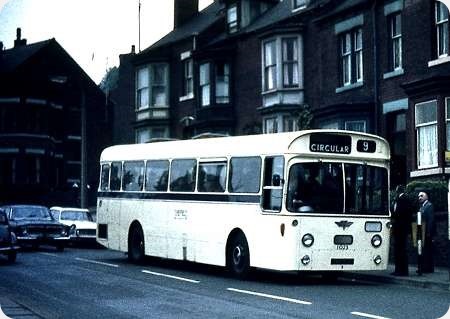
Sheffield Corporation – Leyland Tiger – MWA 757 – 57

Sheffield Corporation – Leyland Tiger – MWA 757 – 57
Copyright R H G Simpson

Sheffield Corporation
1950
Leyland Tiger PS2/1
Strachan B34R

Despite the low fleet number, 57, this was a B fleet vehicle. The computer hadn’t taken over yet. This was one of a batch of eight delivered in 1950. Seen here in Pond Street Bus Station before the concrete and glass version. It could be cold and breezy then but us northerners are made of stern stuff. Ready for service 6 to Kiveton Park in this view but I remember boarding one of these to Eyam on one occasion in the dim and distant past. Photo bought from R H G Simpson many moons ago.

Photograph and Copy contributed by Les Dickinson


10/02/13 – 08:06

Sheffield bought hoards of PS1 Tigers from 1947 but only eleven PS2s. These were a last (half-cab) gasp, the three Weymann examples had been delivered earlier. Apart from the PS1s, there were Weymann/Regals and apart from Weymann PS1s there were five Wilkes and Meade and ten Cawood, already seen on these pages.

David Oldfield


11/02/13 – 07:10

These used to my favourite Sheffield half cab single deckers. I always thought they looked really elegant-but that was from the frontal aspect. This photo shows them to have deep side skirt panels with correspondingly shallow saloon windows. A childhood impression shattered in one photo!!! The 6 to Kiveton Park would be converted to double deck operation in the mid 50s with the arrival of the lowbridge Weymann bodied AECs.

Ian Wild


11/02/13 – 10:19

Yes Ian, but with the 0.600 they would shift…..

David Oldfield


11/02/13 – 10:21

Nice view, Les, but you seem to have caused distress to at least one reader. Go and sit in a darkened room for a week, Ian. You might feel better! I had similar thoughts years ago about a particular steam locomotive. After first seeing it, I spent many years under the impression it was an A4, but it wasn’t . . .

Pete Davies


12/02/13 – 07:03

Yes David, superb performers on the 48 to Manchester

Ian Wild


12/02/13 – 07:04

Going "off piste" mention of A4, I was surprised when I saw a photo of the controls lay out of the recently built "Tornado", that the controls were exactly the same as the 2-6-2 LNER, Doncaster built tank engine No. 498 which usually pulled our school train to Hamilton (which we sometimes rode illegally on the footplate)

Jim Hepburn


12/02/13 – 10:42

Oh the joys of living pre Health & Safety, Jim.

David Oldfield


12/02/13 – 14:49

On the theme of pre Health & Safety, my friend John Whitaker and I had the free run of climbing into the drivers’ cab of any of the buses at the Bradford Corporation Ludlam Street bus depot on a Sunday morning when it was quiet and there were no bosses around. We were given this freedom by a good neighbour who was a mechanic there, but with the strict instruction not to press the starter button of any of the buses which we pretended to drive. We were still about 11/12 years of age at this time, but what wonderful freedom and trust given by our parents and our neighbour Tony.

Richard Fieldhouse


12/02/13 – 14:50

Ah but never forget, even pre-Health and Safety, it was officially "strengst verboten"! OK Pete, you can’t keep us in suspense any longer. What was the quasi-A4 really and where did you see it? One of the streamlined "East Anglian" B17s or the seemingly jinxed W1 rebuild?

Stephen Ford


12/02/13 – 17:01

An A3, actually, Stephen! 60095 FLAMINGO, at Carlisle in about 1960 or 61. I am supposing it had come off the Waverley route. Looking at views of the two types now, I can understand where I went wrong! It was because of the shape of the firebox. Ah, well!

Pete Davies


Quick links to the  -  Comments Page  -  Contact Page  -  Home Page


All rights to the design and layout of this website are reserved     Old Bus Photos does not set or use Cookies but Google Analytics will set four see this

Old Bus Photos from 11:53 Saturday 25th April 2009 to 22:02 Friday 24th May 2013