Old Bus Photos

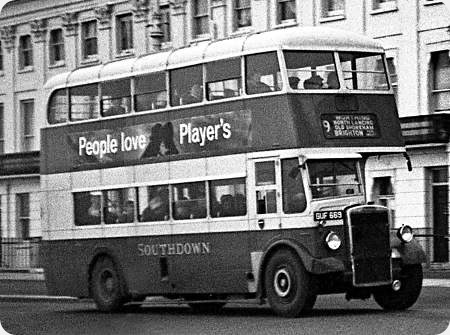
Tynemouth and District – Guy Arab – FT 9412 – 212

FT 9412 
Photograph by ‘unknown’ if you took this photo please go to the copyright page.

Tynemouth and District
1956
Guy Arab IV
Park Royal H35/28

Tynemouth and District had eight of these – FT 9408/15 – 208/15, but I’m not sure if they were in addition to, or part of the 28 ordered by Northern General Transport. Unlike the Orion bodied Arabs, these beauties were popular with both passengers and crews alike and suffered from none of the constant knocks bangs rattles and squeaks of their predecessors.
The superbly engineered Guy Arab IV was arguably the best chassis of its generation, it was well built, well behaved and reliable. They were a delight to drive, and although not as fast as either the PD2 or 3 for me they were a better vehicle, the combination of the Guy chassis and the very handsome Park Royal H35/28R body made them an act that was extremely hard to follow. But how much better would they have been were it not for the outdated attitude of NGT? The depot Forman at Percy Main once said to me "Leylands are reliable plodders but nothing exiting, AEC’s are thoroughbreds but can be temperamental, but with the right engine you will never beat a GUY". The drawback with these was NGT’s stubborn reluctance to move on from the Gardner 5LW, they were huge fans of it, and over the years they must have used literally hundreds of them. With its unmatched record of proven reliability it was probably their first choice, however, it was designed in an age when PSV vehicles were smaller, lighter, and carried fewer passengers, but as good as it was, by 1956 it was showing its age and the performance was barley adequate for vehicles of this size and weight. Alternative units were available, and the obvious choice would have been the equally reliable but considerably more powerful 6LW. In my opinion, the 6LW would have changed these handsome beasts from what was undeniably a good bus, and turned them into possibly the best half cabs NGT ever had. In my experience with HGV’s, a larger engine with power to spare uses less fuel and is more efficient than one which is being continually pushed to its maximum design limits and has nothing in reserve. I know Southdown had some similar vehicles, but I don’t know if they were 5 or 6LW, I would be interested in comments from anyone who has any knowledge of them.

Photograph and Copy contributed by Ronnie Hoye


28/04/13 – 08:27

Well Ronnie, we’re seeing eye to eye again. A respected Commercial Motor journalist friend also said that Leyland are the reliable plodders and AEC the thoroughbreds – a comment with which I entirely concur. My driving instructor – who got me through the advanced test and was a part-time driver for Sheffield United Tours – always said that there is no substitute for cc s. Again, a sentiment with which I am in full accord. I couldn’t agree more with you about a preference for a 6LW powered Guy (or Bristol) over a 5LW. [.....but just ponder that Eastern Counties in their parsimony put 4LWs in single deckers!] …..and as for the body? Yes, a beauty and a classic.
Isn’t it strange, though, how inefficient the industry could be? Roe were as good as, if not better than, their ACV partner PRV and were entrusted with building PRV style metal framed bodies – often on sub-contract to PRV when they were busy. [Tracky's PS1 rebuilds were almost identical to this splendid beast.] …..and yet these Guys went down to London before going almost as far north as possible in England. How much did that add to the cost? We can all think of many similar examples.

David Oldfield


28/04/13 – 08:27

PUF 647

The 48 examples delivered to Southdown in 1955/6 were all fitted with 6LW units. The Park Royal bodies fitted to these were based on the RT design, but were 5 bay construction.

Roy Nicholson


28/04/13 – 09:29

Same body, though built by Crossley, but look how much more heavy Stockport’s PD2 looks with its tin front and draught/drip strips www.sct61.org.uk/  
Northern General and its associated companies had one of the most interesting mixed fleets in the country in the late 1950s and early 1960s and the Guys with their traditional radiators, even those with the Orion bodies, gave added interest at a time when the Guy marque was declining in the face of what one Guy enthusiast remarked, many years later, was the unholy trinity, i.e. AEC, Daimler and Leyland.

Phil Blinkhorn


28/04/13 – 13:51

PUF 650

Here is another picture of one of the 6LW powered Southdown Arab IVs with Park Royal bodywork, shown in Pool Valley bus station, Brighton. I have always regarded these machines as the possibly most handsome buses of all time, and for my money, the Arab IV was "the ultimate thoroughbred" in the conventional front engined double decker category. For sheer economy, engineering dependability and smooth operation it beat much of the opposition hands down. East Kent was another devotee of the Arab/Park Royal combination for very many years until it switched to the AEC Regent V in 1959, possibly because the BET group removed Guy from its list of approved suppliers in the mid 1950s, though by that time the Guy concern was experiencing financial problems anyway.

Roger Cox


28/04/13 – 15:12

The year following the delivery of these Guy’s, NGT took delivery of a further 10 vehicles with RD versions of the handsome PRV bodies, but this time they were on a Leyland PD2/12 chassis, VUP 761/70 1761/70; the order had been placed by Sunderland District, but they were diverted to NGT for use on the longer routes they shared with United.

Ronnie Hoye


29/04/13 – 08:13

PMT had 30 Daimler CVG5 coincidentally also dating from 1956. By the late 60s, over half of them had been upgraded with 6LW engines. The difference between the two engine variants was noticeable, the 6LW versions being much smoother as well as being more powerful. Age was the only reason that all were not fitted with 6LWs, by this time the rear platform layout was outdated compared with the large numbers of Atlanteans and Fleetlines.

Ian Wild


30/04/13 – 05:51

The posting of the Tynemouth Guy Arab with Park Royal body which I thought was one of the most elegant, stylish and well built of it’s time set me thinking that I had something similar among my own photos.

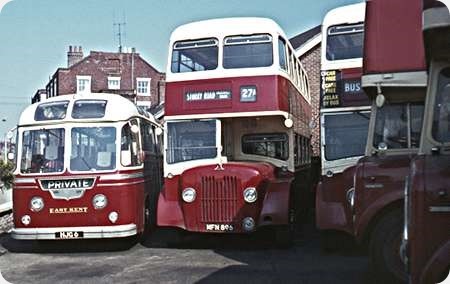
MFN 886

I found this one of an East Kent Arab IV taken in Folkestone bus station around 1970 but this is fitted with Guy’s full front bonnet which I quite like. Despite being a Southdown man all my life I must admit that the 4 bay style looks better than Southdown’s somewhat non-standard 5 bay style, I have no idea why they specified that design, 547 one of those shown was the only one of either batch to have a sliding rather than folding doors and is now in preservation.

Diesel Dave


30/04/13 – 08:47

I prefer 4 bays myself but did Southdown specify 5 bays to make them fit in with the PD2s (5 still being the norm for Leylands) not to mention the Beadle/Park Royal clones.

David Oldfield


01/05/13 – 06:58

This is a perfect example of the difference between BET and Tilling Group Companies. Tilling would order X number of Y type vehicle, depending on where they would be based, some would have doors whilst others were open platform, engines would be either Bristol or Gardner, subject to availability, and the livery would be either green or red, but essentially they would all be pretty much the same. Here we see three BET companies who have ordered what on the face of it is the same type of vehicle, a Park Royal bodied Guy Arab IV, doors apart, look at the differences, Gardner 5LW Vs 6LW, exposed radiator or tin front, four bays or five, and the interiors would all be to individual speck as well.

Ronnie Hoye


01/05/13 – 11:47

…unless they happened to be Midland General/Notts and Derby Traction, in which case the livery would be blue, the seat back tops would be curved instead of straight, the destination layout was non-standard and the only KSWs they ever had would have a cord bell-pull downstairs instead of “push-once” buttons! But I think you are right, Ronnie. MGO were the exception that proved the rule, and not many others got away with it!

Stephen Ford


Quick links to the  -  Comments Page  -  Contact Page  -  Home Page


Maidstone & District – AEC Regent V – VKR 35 – 6735

Maidstone & District - AEC Regent V - VKR 35 - 6735
Copyright John Stringer

Maidstone & District Motor Services Ltd
1956
AEC Regent V MD3RV
Park Royal L30/26RD

During the mid to late 1950′s a number of BET operators seemed to switch their double deck allegiance to AEC Regent V’s. Though Maidstone & District had bought a number of AEC Regal single deckers before and just after the Second World War, their preference in double deckers had been for Leyland TD’s, Bristol K’s, then Leyland PD2′s and Guy Arab IV’s.
In 1956 they bought a number of VKR-registered Park Royal-bodied Regent V MD3RV’s, with the smaller AV470 engine, synchromesh gearbox and vacuum brakes. Some were highbridge, some lowbridge – all with platform doors.
I recall when I was a child in the late 1950′s one of the highbridge variety used to appear each year in my home town of Halifax – parked on the spare ground off Broad Street opposite the then new Crossfield Bus Station – on a countrywide tour promoting holidays in Kent.
This lowbridge example was snapped on 13th July 1970 in Bexhill-on-Sea whilst I was on a family holiday staying in Pevensey. It had originally been numbered DL35, but by this time was renumbered 6735.
A couple of years later my own local operator Calderdale Joint Omnibus Committee surprised everyone by acquiring four of these Mk. V’s – lowbridge VKR 36 & 37 and highbridge VKR 472 & 479 – to temporarily augment the fleet after the merger with Todmorden J.O.C. All retained their M&D livery, the lowbridge pair being allocated to Todmorden where their livery fitted in reasonably well. Sadly the last survivor – VKR 479 – was withdrawn just as I passed my PSV Test so I never got to drive it. A pity – the sound effects were wonderful!

Photograph and Copy contributed by John Stringer

A full list of Regent V codes can be seen here.


08/02/13 – 13:24

Lovely shot, John. As AEC’s biggest fan, I have never been a fan of medium weights (particularly deckers) nor a big fan of the troublesome wet-liners but M & D’s vehicles always looked magnificent in their superb, dignified traditional livery. Some people stuck very happily with (heavy) Guys but M & D and East Kent moved, initially, to medium weight AECs – although both graduated to heavy weight AECs – as did Aldershot and District from Dennis to AEC. Was the initial move part of the paranoid race to medium/light weights in the ’50s only to accidentally discover the delights and benefits of AECs?

David Oldfield


09/02/13 – 07:09

The reason East Kent moved from Guy to AEC was that their Chief Engineer thought that the 6LW engine was not powerful enough for 30 feet double deckers. In typical Gardner fashion they neglected to take their customers into their confidence and let them know they were developing the more powerful 6LX. Guy did not know this and neither did East Kent and so AECs were ordered.
All is revealed in an article by John Aldridge in Buses Annual 1980.

Paragon


09/02/13 – 07:10

Many years ago at Sandtoft trolleybus museum, preserved VKR 37 was present at an event. I can’t remember why, but I was invited to drive it with a full load of visiting enthusiasts on a circuit of the place and thoroughly enjoyed the experience. It was of course reminiscent of the identical chassis of the six Samuel Ledgard Regent Vs (1949 – 1954) in which I’d driven and conducted many thousands of miles – each – and was a happy case of "deja vu."

Chris Youhill


09/02/13 – 12:16

Thanks Paragon.

David Oldfield


10/02/13 – 07:49

I have always found the AV470 and AH470 to be remarkably potent for their size. "Perky" is the word I’d use. Devon General’s Regent Vs in particular seemed to take everything in their stride – and they had a lot to take!

Peter Williamson


10/02/13 – 07:50

At the time this photo was taken I was working for Southdown at Eastbourne, the destination of the 99 route, but I have to confess I was totally unaware that any of the lowbridge Regent V’s ever operated from M&D’s Hastings or Bexhill garages although several of the highbridge version were operated especially when they were new in 1956. I always thought that they were amongst the best looking buses around at the time as I immediately liked the AEC full front and the elegantly proportioned Park Royal bodywork finished in the superb livery was near perfection.
As a point of interest the 99 route did not require low height buses, coincidentally one of the areas low bridges under the Hastings to Eastbourne railway line known as Sackville arch is to the right of the picture and the junction the bus has just crossed

Diesel Dave


10/02/13 – 10:57

I agree Peter W about the valiant "perkiness" of the AV470 engines – but with one important proviso !! Their performance depended on the fuel policy and settings of the particular operator. I personally had quite a comprehensive experience of the engines with many operators. Samuel Ledgard, Wallace Arnold and others rightly believed in running them on adequate supplies of diesel and on other favourable settings – the same applied to the ex South Wales Regent Vs bought by Ledgard and those particular four had a phenomenal and delightfully noisy performance. In contrast the one hundred and fifty "light" Mark Vs bought by Leeds City Transport were just impossible – seemingly running on an even greater proportion of fresh air than LCT’s usual policy of "cutting down" they were a frustrating embarrassment and time keeping with them was impossible. On a good day the odd one might be capable of slightly exceeding 30 mph and on any kind of gradient, heavily laden in particular, they were the personification of that famous little saying "Wouldn’t pull the skin off a rice pudding." Throughout my career I was always happy to see the good points of any model but as an exception I have to say that I loathed 760 – 909, especially the last fifteen which were eight feet wide and it showed in every way.
Just in case this prolonged rant has given the wrong impression may I just reiterate that the 470 engine was a fine power unit in general and when properly treated, which fortunately it usually was.

Chris Youhill


10/02/13 – 12:24

I can well understand, Chris Y, your frustration of driving a vehicle whose normal lively performance you were fully aware of, but which was dumbed-down in the interests of economy and possible maintenance advantages. But did those ‘advantages’ really come through, if the engine had to be ‘flogged’ mercilessly to achieve any sort of acceptable performance???

Chris Hebbron


10/02/13 – 13:22

I know what you mean Chris H, but in the case of the LCT batch (for batch read enormous class) there was no possibility of flogging the engines – not that I ever would as I didn’t believe in such abuse – as they were governed to such a degree. The misguided policy was nowhere better demonstrated than with the huge number of air operated preselector Mark 3 Regents (9.6 litre) that we had. The abuse of these by a large number of self opinionated and arrogant "fast men" was heartbreaking to suffer. The standard practice of these twentieth century Luddites was to leave the accelerator hard down at all times while slamming the gearchange pedal down and back at full revs. Any, debatable, fuel saving was far outweighed by constant expensive damage to gearboxes, prop shaft joints and diffs and bodywork by these dreadful and unpunished "drivers" many of whom sported lapels full of "safe driving awards" – which in the case of those individuals meant that they’d managed year after year to avoid hitting anything while slinging the conductors and passengers around the bus like rag dolls. This state of affairs was in no way helped by the practice of having regular crews who worked together all the time – while some were conscientious there were far too many "Bonnie and Clyde" types who were expertly adept at early running ("Time pinching") and every other variety of avoiding work. Not content with this deplorable attitude, they reinforced their "championship status" by constantly loudly sneering and jeering at any of us who were seen as "always late" – because of course we were doing the job as properly as conditions allowed. Once, as a one man operator, I handed a bus over several minutes late to one of the chief offenders who loudly bellowed "I thought they must have altered the timetable Chris" – I replied, equally loudly, "I didn’t think you knew what a timetable was" – a look of shocked silence was all he could manage to that !!
This may seem like dramatic exaggeration but I assure the reader that if anything its an understatement.

Chris Youhill


10/02/13 – 14:32

A lot of the problems with rear engined buses with semi-automatic gearboxes could be ascribed to the same gung-ho attitude that Chris mentions in respect of the Leeds preselectors; it became far too easy to change gear without paying attention to engine revs. It also coincided with a period when recruiting bus drivers was difficult, and the calibre of staff taken on was distinctly lower than ideal.
On the question of timetable adherence, while I was at Reading we had one (long-service) driver who was renowned for running late, in the hope that an inspector would regulate him and provide him with an unscheduled break while waiting to resume service at a correct time. Unfortunately, he also had the reputation of being able to catch up time if necessary – he was never known to be late at the end of a shift – so he was generally left to his own devices. The public of course suffered from an erratic timetable.

Alan Murray-Rust


11/02/13 – 07:06

I recall the Portsmouth Corp’n Daimler CWA6′s being abused by treating the greachange pedal as a clutch, but suspect this was because only nine buses in the fleet were like this and drivers were not trained on the unique vehicles.
In the late 1980′s, as an admin bod, working for BT, I needed a side-loading van and all that was available was a Commer/Dodge 15cwt PA van with a petrol low compression 1.7 litre engine, developing 49bhp. For half the day, it had a full load, then was empty. Said to reach 70mph, but actually about 63, it never reached more than 53mph and my foot was on the floor all day. If you went round a bend at any speed, however, the front wheels, which were closer together than the rear one, make the vehicle dig in, initially quite scary. Fuel consumption was terrible. My son, also working for BT, asked if I would not park the vehicle on our drive overnight as his mates would laugh at him! When I took the vehicle back the next day, I asked the MT Workshop when it was last serviced – they said they’d done it especially for me! They then asked me if I’d kindly park the vehicle in the scrap lane, a wise decision!

Chris Hebbron


11/02/13 – 07:07

Chris Y is correct about the Leeds lightwieght Regents which flattered to deceive being quite attractive buses externally.
Not only did they have little or no pulling power but from a passenger point of view were amongst the most uncomfortable buses to run in Leeds.
The seat squabs were wafer thin with little filling while the interiors were a monument to the lets get as many as we can on it school of management.
As they aged the windows gave off a most un-syncopated rattle when idling that made normal conversation next to impossible. Being lightweight they had an alarming tendency to lean in the opposite direction to travel on corners in at least one instance depositing me on the floor!

Chris Hough


11/02/13 – 10:14

Chris Hebbron – you are quite right in saying that abuse of the spring operated gearboxes in Daimler CW vehicles was widespread. In the particular case of Portsmouth lack of familiarity may well have been an acceptable explanation, but certainly not elsewhere. However, as opposed to air operated gearboxes, the spring system had a "kick back" trick up its sleeve – both metaphorically and mechanically !! Any wear in the linkages from the cab quadrant to the gearbox, or failure to set the quadrant accurately, could and often did result in the pedal flying back under full pressure to twice the normal "resting" position, causing painful and often nasty foot and leg injuries. Nevertheless the "fast men" would still subject the transmission and body components to the same abuse as suffered by the air models.
I never drove a Commer/Dodge van. As a bystander though I often reflected on how attractive they looked, and also on how the very obvious narrow front wheel track looked decidedly dubious !!

Chris Hough – how very well you put the situation of the lightweight Leeds Mark V Regents. In the list of their awful shortcomings I’d forgotten about the dreadful seat "cushions." The behaviour of the buses on corners and roundabouts was terrifying to any level headed driver – for in addition to passenger discomfort there was no proper seat for the driver either !! If I remember rightly – its a long time ago – the seat cushion was adjustable fore and aft, but not for height?, and the meagre "backrest" was permanently fixed on the cab rear bulkhead. I’m not narrow minded, but the front nine passengers in the lower saloon were subjected to what amounted to an obscene (must have been JUST legal I suppose) lack of knee room. The rearward facing seat for five and the front two forward facing seats compelled occupants to "interlock" their knees to an unacceptable extent – mind you, this at least meant that they could all sway as a solid congregation – "safety in numbers" – on the bad corners and cambers. Perhaps the worst site of all may have been Westgate roundabout on the Park Lane junction – this roundabout was dangerously wrongly cambered for all vehicles, and it was common for the "Toy Mark Vs" when in whatever hurry they could muster to scrape first the platform edge followed after a terrifying lurch by the offside rear corner panel.
I remain convinced, as do many others, that the dreadful October 1969 accident in Harehills would not have occurred with any other type of bus. The vehicle was descending the gently sloped Stoney Rock Lane with a full load of 68 souls when the nearside front wheel caught up a "Road Works" "A" board which had blown down in the wind. The wheel jammed the board into the mudguard and – this awful scenario takes some imagining – the vehicle immediately turned sharp left 90 degrees into a side street of terrace houses, attempted to overturn, and did so by slithering down the front walls of the houses, crushing the top deck to half height on the way. I believe that every passenger was injured, many seriously. This type of incident just shows how potentially dangerous were the old uncovered light bulbs which protruded into the saloons. Once again, this topic has veered away considerably from the Maidstone and District subject, but justifiably I hope in a general discussion of the model’s various versions.

Chris Youhill


14/02/13 – 10:49

VKR 479

Here is the highbridge version VKR 479 masquerading as Calderdale J.O.C. 362. Still in its former owner’s livery and looking rather down at heel – especially with its adverts ripped off like that – it it seen parked up at the bottom of the old Cross Field Bus Station in the Spring of 1973, not long before its withdrawal from service. These were not at all popular with conductors because of the platform doors which had to be operated by them by a button above, and so required them to be there at every stop – as of course they were supposed to be according to the rules, but rarely were in practice !

John Stringer


15/02/13 – 05:54

I’m a bit surprised about the door controls John, on the PMT Daimlers of the same year, the driver controlled the doors from the cab although there was a set of door controls on the platform for the conductor to use if necessary.

Ian Wild


15/02/13 – 08:42

Any doubledeck bus with a Manual set of Rear Platform doors would also require the conductor to be present on the platform at each stop, or am I missing something here

Andrew Beever


15/02/13 – 12:02

As I said in my original caption, I obtained my PSV licence (both Driver’s and Conductor’s) just after these had been withdrawn so never actually worked with one, and cannot say whether there were controls for the doors in the cab or not. It was just what others told me. All Halifax’s back loaders had been open platformed, and maybe in the interests of safety and legality there may well have been a notice posted forbidding drivers to operate the doors, and insisting that only the conductor should operate them from the platform. (I’m just clutching at straws here really) The trouble is now that amazingly there is hardly anyone to ask who was driving at that time – there are only to my knowledge three drivers with longer continuous service now than me. Phew, that’s a frightening thought !
What Andrew is ‘missing’ is perhaps an appreciation of the difference between what the law required, and the reality of what many employees actually thought should happen !

John Stringer


15/02/13 – 13:22

Picking up on Johns point of the difference between law and what actually happens. Not long after I started at Percy Main we had an industrial dispute. It was decided we would work to rule, so this meant an overtime ban, and you then have to work within two sometimes conflicting sets of rules, i.e, Company and Road Traffic Act, but where there may be a conflict the RTA takes precedence. The RTA states that the conductor can only give the driver the signal to start from the platform, whereas the company would expect them to do it from any convenient bell push on the vehicle. Working to rule, if the conductor is upstairs, he/she would then have to return to the platform before they can give the signal to start, once on the platform, the company would then expect them to look out for intending passengers, so does that little old lady just leaving the shop want to board my bus? I’d better wait and see, result? chaos and timetables completely out of the window.

Ronnie Hoye


15/02/13 – 13:23

This is just anecdotal since I had no first hand experience but I think on some half-cabs with platform doors there was a switch to open them from the cab when the vehicle had stopped but the conductor had to close them.

David Oldfield


15/02/13 – 17:58

Dredging my memory after almost half a century, I seem to recall that the rear (electric sliding) passenger door on the Aldershot and District Loline I was operated from the driver’s cab, and duplicate buttons were installed on the platform for conductor operation as necessary.

Roger Cox


16/02/13 – 07:21

The rear platform doors on the preserved South Yorkshire Albion could be operated by either the driver or conductor. The master switch for them however was in the cab well out of reach of the conductor

Andrew Beever


16/02/13 – 11:20

Ronnie, the sensible RTA ruling on starting signals was, to all intents and purposes, universally ignored out of sheer necessity. To obey the ruling would have resulted, as you rightly say, in scheduled timings being completely unachievable even at quiet times – and passengers would soon have become tired of being bashed about as conductors strove to reach the platform at each stop. The only times where, as a driver, I NEVER pulled away when a conductor rapped on the cab rear window with a coin or, even worse stamped on the cab roof from the front of the top deck. I was occasionally treated to abuse or sulkiness by those who tried this practice, but as far as I was concerned they could put their foot through the floor and it would have made no difference – just think of the size of the witness audience in the event of a platform accident !!

Chris Youhill


20/02/13 – 13:28

My memory as a passenger on many front engined vehicles with power doors (including M and D, Southdown, East Kent, as well as the Green Line RMCs and RCLs is that two sets of equipment to open and close the doors was always provided: in the cab and on the platform. Irrespective of any legal niceties, normal operation in practice, as I remember it, was for the driver to operate them almost all of the time to both open and close, with conductor operation being a rarity. The only exception to this in my experince was the Green Line vehicles where with much less changeover of passengers and thus less ticket work for the conductors, they often did operate the doors.

Gordon Mackley


15/04/13 – 07:32

DL35 and DL40 were sent to Hastings to work the increased 99 summer frequency (from one and a half hourly to half hourly) of 1970. I lived in Bexhill at this time. These vehicles were pretty rare to find, the crews disliked them and they were often ‘defected’ or whatever. I only managed to get a short town journey on one of them. They arrived in July and were only in service for barely a few weeks, if that. DL40 was being used as a training bus in the August. Other vehicles were received to work the 99. The photographer was fortunate to snap this picture considering the small amount of use these two had on this route. I got a rear view after one was defected at Bexhill garage and parked in the car park of the West Station opposite.

Roy Simmons


15/04/13 – 08:36

I am somewhat puzzled as to why the crews should dislike these vehicles sufficiently to invent defects in order to have them substituted. I have come across this immature conduct at most places where I’ve worked and I just don’t understand it. We all presumably have our favourites, mine being the Leyland PD1, but provided that there is no real operational or safety defect with any vehicle then un-necessary changeovers should not be tolerated.

Chris Youhill


15/04/13 – 10:53

I agree Chris. I hate Mk 1 Nationals, Bedford YRTs and Dennis Javelins – but I drove them without demur when I was allocated…..

David Oldfield


11/05/13 – 08:19

There are lots of derisory comments about fast drivers, I was considered a fast driver and being a ex conductor new all about rough drivers, there is a difference between fast and rough. Conductors always enjoyed having me as there driver and there were lots of good comment’s from my passengers about my time keeping as well as my standard of driving.

Michael Crofts


11/05/13 – 08:56

True, Michael. Fast and bad are not necessarily the same thing.

David Oldfield


12/05/13 – 07:03

As a former part-time bus and coach driver I agree that fast and bad aren’t the same thing: the key "things" are to be good (safe/smooth) and on-schedule. But really "fast" (or "slow") just shouldn’t even come into it – maintain the schedule and do it safely/smoothly. Unfortunately, I think some of today’s demands (and I’m thinking of two very recent trips on Blackpool-Preston route 75) in terms of timing/scheduling/recovery-time mean that to keep schedule involves overly-fast driving to an unacceptable degree – and that is a shameful position in which to put drivers (I couldn’t have got through gaps at speeds which those chaps on the 75 did – mind you, I learned on a PD3, and perhaps Solos have better brakes).

Philip Rushworth


12/05/13 – 09:04

Couldn’t agree more, Philip. As another part-timer, I refused to drive a route for a friend who ran a tendered service for county which had ridiculous timings – and specified vehicles far to large for the rural roads. [Yesterday, I saw the operator who now runs the route using an even bigger (12m) vehicles. Madness.]
I’m now off to drive an RML at the Slough running day. Now that WILL be fun.

David Oldfield


12/05/13 – 11:35

I agree entirely with all these mature comments about "fast" driving. Sadly, there exists a very strong ethic that the ONLY criteria of good driving is to be on time, or early, no matter how unreasonable the schedules, the traffic and – someone has to dare to say it – the sabotage (intentional or otherwise) of any possibility of punctual running by a sizeable proportion of the passengers. Like many of our friends here I always totally refused to drive badly or to abuse the vehicles (even the odd ones which I loathed) and was therefore "always late" – but I was not a slow driver at all.
Many "honourable and customer concerned" operators are hypocritical to a criminal degree, and as a result of the ethic I mentioned are able to take advantage of drivers who dare not stand up and say "Its unsafe and it simply cannot be achieved with safe and legal driving."

Just two examples I can give from many hundreds in my own experience :-

At one time it was necessary, for engineering reasons, to close Crown Point Bridge in Leeds for around eighteen months. The bridge was on the main route from the south into Leeds bus station. On our services 410/411 from Doncaster to Leeds the running time from Pontefract to Leeds (14 miles and extremely busy) was a ridiculous an inadequate forty minutes. The road closure however meant an extra mile each way right through the entire centre of the congested City – this could easily take fifteen minutes at peak times. SYRT was still a private concern at the time, and the other main operator over the Bridge was the Caldaire Group (West Riding). Friends, please don’t try to guess how much extra running/recovery time was granted but let me astonish you – not one second, and not one extra vehicle !!!! This scandal was enjoyed with glee no doubt by the hypocritical operators and was, of course, facilitated by the glorious and very misguided "fast men." We’d better say nothing about all the "ring the bell once and remain seated until the vehicle has stopped" and all the other desirable but impractical measures.
The second case which beggars belief was in my coaching days for a highly respected concern in Leeds. At the time the speed limit for coaches was 40 mph anywhere, and there were no motorways and few bypasses and, crucially, no M25. I did a tour from Leeds to Eastbourne involving three meal stops – coffee, lunch and afternoon tea. The latter was thirty minutes in St. Alban’s including discharging and reloading 40 passengers in the middle of the town and their consumption of their tea and their comfort visits – and no parking facilities for the coach – I had to pay a dear old chap 2/6d to park in the yard of the London Transport garage nearby – and of course no tea for me. Now to the crux of this incredible saga – which will be all the more astonishing to those who know the Greater London area. Assuming prompt departure from St. Albans (quite impossible of course) the time allowed to reach the Sea Front hotel in Eastbourne was TWO HOURS via Central London. Luckily I knew the area from personal experience – pity any driver who didn’t and I had had no route learning or warning at all – but nevertheless arrived over two hours late to face the understandable wrath of the Proprietress – a splendid lady who ran an immaculate establishment with Swiss watch efficiency.
I could write a series of books about these scandals which, since 1986 De-regulation, have become increasingly widespread particularly in the local bus service sphere – all of course in the interests of "greater choice and quality for the customer."

Chris Youhill


13/05/13 – 07:26

Chris, just write a book . . . any bloody book! I’ve read so many of these "busman’s books", and they’ve all been fascinating . . . but I just feel that yours would be something special. Can I take issue with one point raised in previous submissions to this thread? Running late on a high-frequency urban service (which I know must have been your experience at LCT) is quite different – from the passenger’s perspective (my perspective in the context of my previous comment) – when running (15+) minutes late on an hourly service . . . "is it coming, isn’t it?". (And I won’t even tell you what fun I had just trying to work out from where in Blackpool the 75 left from – and we wonder why passengers deserted buses . . . )

David: I’ve just noticed your post – I trust you had fun. I’ve only once driven an RMC [sic]: at the Chiswick open day in 1984(?) – whilst the cab was basic everything seemed just properly "set up", a real "driver’s bus". God! what a shock Midland Fox’s ex-Harper PD3 was – though not as much a shock as their ex-LT DM/Ss were . . . nice high driving position, but a manual parking brake in 1972? and that suspension? but it would never have occurred to me to "fault" any bus. But it was a hobby, fun – if I’d had to do it day-in-day-out would I? although clearly Chris Youhill would have.

Philip Rushworth


13/05/13 – 11:21

Yes, Philip, its was fun, running on networks of routes from the 1950s and ’60s. Slough on a Sunday in 2013 is like Monday to Friday rush hour in the ’60s (and you didn’t have to allow for photo opportunities then). I just ploughed on at a safe speed. One journey I picked up at each stop into Slough, the next I made up time with no-one between Slough and Langley. Then to Beaconsfield where I was meant to connect with another vehicles. He was over 15 minutes late and we left 10 minutes late – but again made up time on the open road to Slough. It was meant to replicate the ’50s and ’60s with a fully timetabled network of routes. It certainly does. All credit to Peter Cartwright and his team for yet another successful day.

David Oldfield


14/05/13 – 17:20

Thanks indeed Philip for that humbling vote of literary confidence – I often thought of writing the book you suggest, would love to have done so and should have done – but it would be a lot to take on, timewise, now at "this stage in the ageing game !! However I did help my friend Don Bate with his ten year exhaustive research which culminated in his superb book "Beer and blue buses" about Samuel Ledgard. Don being on the engineering side of the Firm I was able to provide him with much information about the traffic and public side of the operation, and to compose many of the captions for the pictures.
I can well understand how you feel about whether or not you would have done the job as a regular occupation – you are of course spot on in stressing that I wouldn’t have had any doubts, and I didn’t.
Although my knees were knocking with terror and stage fright, I would gladly go back to that Friday teatime at 4.43pm when I stood in Burley in Wharfedale waiting to take over my first ever double deck service bus for a busy late turn – I was sure that all the passengers would know full well that I was on my first trip and would be waiting for me to make a hash of it. As the bus arrived, an unavoidable ten minutes late due to the Leeds traffic etc, my mixture of fear and excitement mounted – I had two minutes in which to travel three busy miles to Ilkley, turn round, and set off for the peak period in Leeds. Always a PD1 devotee I shall always be so thankful to ex Bristol ECW bodied LAE 12 – it must have known my predicament and pulled out all the stops to save the day, performing even better than its usual commendable speed and pulling power – and the gearbox was like silk. After the two hour round trip, during which we (the bus, me, and the conductor as a team) pulled back all the deficit we arrived in Ilkley on time for our meal break. My life’s ambition had been achieved and I doubt if I’ll ever be as happy again.

Chris Youhill


15/05/13 – 07:35

Chris, from what I can work out you’ve been: conductor, WYRCC; conductor, Ledgard; driver, Ledgard; driver, LCT; Inspector, LCT; then I don’t read much from you – was it all too painful? – so, I’m guessing, Inspector, WYPTE; then to South Yorks, driver; and finally Arriva, driver. What a journey! Your passion as both an enthusiast as a professional shines through your every contribution, as does your ability to write. If you haven’t got the time to write it all down then just dictate your thoughts into a "Dictafone" (showing my own age here) and somebody will knock them out. Whenever I drove a bus the thoughts going through my mind were: the brakes are poor/the brakes are fierce/where are the gears?/I can find the gears and stop nicely! and bonus… nobody is drunk/threatening to hit me. That’d be about the limit of my book – everything else just got lost amongst the fug of keeping going/stopping/staying alive. I’m a teacher: what attracted me into teaching? – "Please Sir" (yes, really). What attracted me to buses . . . you’ve worked this out: "On the Buses". LWT has a lot to answer for.

Philip Rushworth


19/05/13 – 12:06

Well Philip, you won’t be surprised to hear that I can remember my whole career "On the buses" quite clearly, so here it is in full.
SAMUEL LEDGARD Conductor
WYRCC Conductor
MURGATROYD’S Coach driver (a few weeks only by mutual arrangement)
SAMUEL LEDGARD Conductor and driver.
WALLACE ARNOLD Bus, coach and tour driver and Traffic office.
LCT later WYPTE Driver (crew and OPO) Inspector (Road and garage)
SOUTH YORKSHIRE OPO and COACH DRIVER (all one rota)
CALDAIRE (WRAC)
BRITISH BUS
COWIE
ARRIVA (These five operators all owning Pontefract depot in rapid succession of course)
The above were all full time jobs, but in addition I did much part time contract, private hire and tour work for Independent Coachways of Horsforth, which was founded by a close friend of mine – with a Ledgard Reliance/Burlingham Seagull UUA 791 and considerable support from former Ledgard clients – my friend had worked at SL before the closure of the Company.

Chris Youhill


20/05/13 – 07:11

Chris, your storey now seems even more interesting: if you don’t share it with us, just share one thing for now – where exactly (by today’s building plan) was Ledgard’s "Moorfield" depot, and where was the WYRCC depot. OK that’s two things!
So. AEC produced a medium-weight Regent. What set it apart from the "heavy" Regent? for how long did it last? and why did it "fade away"? . . . and why didn’t Leyland produce a medium-weight Titan, or – for that matter – Daimler a medium weight CV/CC/CS?

Philip Rushworth


20/05/13 – 09:03

At the risk of treading on Chris’s toes. The MD2/3RA medium Regent had the AV479 (7.58 litre) engine; the heavies were successively the D2/3RV with the 9.6 litre A218 engine, the 2D2/3RA with the 9.6 litre AV590 and the 3D2/3RA the 11.3 litre AV691 engine.

David Oldfield


20/05/13 – 11:33

PS: Why didn’t Leyland or Daimler build a medium weight? The devil in me says they had more sense – but I’ve always preferred the heavy option. [Low stress on mechanical parts and long service intervals.] Mind you, strictly speaking Daimler did produce a medium weight. The CV5G wasn’t common. but there were enough around. I never went for the medium weight options on Bristols and Guys either – far better the Bristol engines or the 6LW or even 6LX, never 5LW. I thought that was false economy. Leyland’s medium weights were single deckers like the Tiger Cub whose engine was admired, but noisy, but lacked torque and long life. It became better when it gained the 0.600 and morphed into the Leopard L1/2.

David Oldfield


20/05/13 – 16:38

Philip, I haven’t totally ruled out the possibility of a book, but I do face the fact that time has gone by and that if I am to tackle the project I shall have to move quickly, and clear a lot of other pressing matters out of the way first. It is something I have always felt that I’d like to accomplish I must admit.
The Ledgard depot at Yeadon was at the head of a very short and narrow thoroughfare – little more than an access lane really – called Moorfield Drive. The facility was taken over when the Moorfield Omnibus Company was purchased in 1934, and the name remained in use officially but not publicly right to the end of the Ledgard operation in 1967. The original Moorfield largely wooden premises succumbed to a severe gale in 1947 and were replaced by a new brick building, The site is now occupied by the inevitable "desirable residences". Moorfield Drive is still so called, and is off the A 658 Bradford to Harrogate road close to the junction with Yeadon High Street.
The West Yorkshire Yeadon depot was bought in 1929 with the bus business of the Yeadon Transport Company and remained in use until 1957 when it was closed and sold to the Council. It was not purpose built and was located in some rather incongruous (for WYRCC) former mill premises, just off the upper eastern side of the High Street and adjoining the lovely Yeadon tarn – hence its name "Waterside Garage." Incidentally my conducting days with WYRCC were at Ilkley depot, on the site of which to the inch is now a superb Wetherspoon’s pub/restaurant – my occasional enjoyment of refreshments in there is enhanced by happy memories of how the depot was in every detail – I’ve seen other customers looking my way as if to say "That poor old soul’s not with it, he’s on another planet" – well they’re quite right of course.
I’ll really surprise them one day by ordering Bristol broth, followed by Lodekka lasagne, and finishing off with Tilling trifle.
David, no need my friend to worry about "treading on toes" as I’ve been wearing steel toecaps for years, and don’t mind at all as any information from kindred spirits is always very welcome.

Chris Youhill


20/05/13 – 16:39

Gentlemen Daimler did try a light weight version of the CV this was the CLG variant which was tried by PMT and Birmingham at least This used a 5 cylinder engine and was given a special light weight MCW body.
The comment about medium weight Regents fading away would certainly refer to their less than sparkling performance on gradients were they struggled. Leeds bought 150 of them and they were probably the worst AEC Regents in the fleet.

Chris Hough


20/05/13 – 17:57

You’re so very right Chris H – its not like me to loathe a model per se, but I have to admit that I couldn’t stand the 150 to which you refer. The first 135 7′ 6" ones were bad enough, and frighteningly unstable as well as being lifeless, but the final 15 which were 8′ 0" wide were even number mind you at least they were slightly less terrifying on corners etc. Its only fair to AEC to say though that the pathetic performance was the fault of LCT to a large extent – they seemed to think that buses would run economically on fresh air, which they won’t, and paid the price heavily in "hidden" abuse of major components, very particularly with the preselector Mark III Regents. The modus operandi of many of the worst drivers, with both models, was to set off in first gear and to leave the accelerator wide open continuously until the bus was at full speed in top gear – passengers, conductors and loose coinage were flung up an down the saloons mercilessly by the self styled "fast men" who were proud of being "always on time." Many’s the uniform lapel I’ve seen festooned with annual "safe" driving award bars – worn by some of the worst drivers simply because they’d never actually hit anything !! Just to recap, and to balance the discussion, there was little wrong with the 7.7 AEC engine’s performance provided it was given enough "oats and water" by its owners.

Chris Youhill


21/05/13 – 07:34

On the subject of fast drivers, the instructor who got me through my PSV test ‘three weeks after my twenty first birthday’ used to tell all his pupils that "you don’t have to be a slow driver to be a careful one, but speed for its own sake belongs on a race track" as for time keeping, our chief inspector used to say "there are a thousand and one reasons why you can be running late, but there is no excuse for being early"

Ronnie Hoye


21/05/13 – 10:31

Hebble, after buying 13 of the 9.6 engined Regent V between 1956 and 1960, inexplicably opted for four of the mediumweight MD3RV model in 1962. These were nice looking buses with Northern Counties forward entrance bodies with very pleasant interiors, and they sounded really well, though the earlier growling exhausts were a thing of the past by then. Unfortunately – though I would have thought, predictably – they were completely useless at hill climbing, something that Hebble buses were required to undertake rather a lot. After a while they tended to be used as much as possible on the Halifax-Leeds service which, once they had tackled the first three miles to Shelf, was less severe and once on the flat they could motor along quite reasonably. But why on earth they bought them in the first place I’ll never understand. They quickly reverted to the AV590 version after that.

John Stringer


22/05/13 – 11:05

I used to drive VKR 480 on a school contract before I went to school myself (I was a teacher!). It had been bought by John Lewis Coaches, Morriston, Swansea from Roslyn Coaches in Parr, Cornwall for a specific girls school contract. It was the first double decker John Lewis owned. It had door controls in the cab. I had no attendant on the school contract. After the last bus stop, I would close the doors until I reached the school. It was a dream to drive and have very fond memories of that vehicle!

Mike


23/05/13 – 07:47

Ronnie, my late father would have agreed with your sentiments. For quite a number of years he was a driver at West Yorkshire’s Harrogate depot, and took great pride in his driving and time-keeping. He used to say something similar about running late, but said if you were going to run early, you may as well not have bothered running the service in the first place. On the subject of time-keeping, I remember some years ago waiting for a West Yorkshire Harrogate 36 bus at the side of Lewis’s department store in Leeds. A young woman came up to the adjoining stop and looked at the timetable for her WYPTE bus. On then looking at her watch, a ‘Leeds Loiner’ waiting in the queue said "Ah wun’t waste yer time lookin’ at that love – tha’d be better off wi’ a calendar!"

Brendan Smith


VKR 35 Vehicle reminder shot for this posting


26/05/13 – 07:58

The Daimler CLG5 lightweight wasn’t quite the dead end that it may appear from the fact that only two buses so designated were ever built. Some of the lightweight features were then incorporated into subsequent CVGs, sometimes (for example Manchester CVG5 4490) to the extent that these were mistaken for CLG5s. Having experienced the Birmingham CLG5 as a passenger, I get the impression that, rather than a prototype for an intended production model, it was more of an experiment in pushing boundaries, to see what they could get away with and how much weight could be saved.

Peter Williamson


28/05/13 – 07:33

Re Following on from John S. and the Hebble 7.7 Mk Vs, they also had in 1965 a batch of Reliance/Park Royal DP39F buses used mainly on local services with ZF 6 speed constant mesh boxes. Another unusual purchase.

Geoff S


28/05/13 – 09:00

Sorry Geoff. We’ve rehearsed this argument elsewhere before but the 6 speed constant mesh box in medium weights was an AEC unit, not a ZF – which was syncromesh and only used in the heavyweights.

David Oldfield


Quick links to the  -  Comments Page  -  Contact Page  -  Home Page
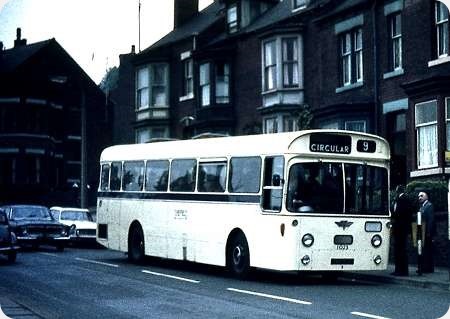


Walsall Corporation – Sunbeam F4 – ADX 191 – 353

Walsall Corporation - Sunbeam F4 - ADX 191 - 353
Copyright Tony Martin

Walsall Corporation
1950
Sunbeam F4
Park Royal H30/26R

On a snowy day in February 1967 Walsall Corporation trolleybus 353 is on a short working to Leamore. The vehicle was an ex-Ipswich Corporation Sunbeam F4 with Park Royal body which was acquired with seven others due to the closer of the Ipswich Trolleybus system in 1962/3. In the background is the Carl Street entrance to Birchills depot.
But don’t worry, the Summer of Love is just around the corner! (Not that it ever reached Walsall…)

Photograph and Copy contributed by Tony Martin

———

04/01/13 – 06:49

The Ipswich destination box was an odd shape and it is strange how Walsall retained it, even going to the trouble of having blinds made to fit. With Walsall’s flair for bodywork rebuilding one would have thought they would have rebuilt these to their standard layout.
Accommodating the long word ‘Wolverhampton’ on these blinds meant writing the word diagonally.

Philip Halstead


Quick links to the  -  Comments Page  -  Contact Page  -  Home Page



All rights to the design and layout of this website are reserved     Old Bus Photos does not set or use Cookies but Google Analytics will set four see this

Old Bus Photos from 11:53 Saturday 25th April 2009 to 19:14 Wednesday 19th June 2013