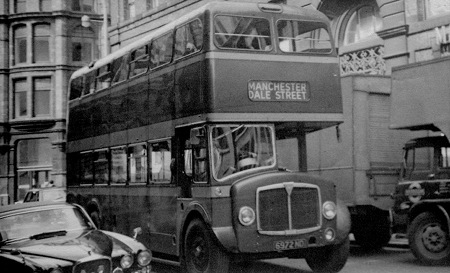
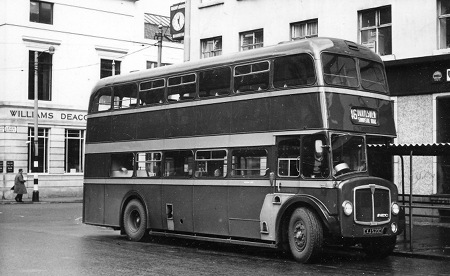
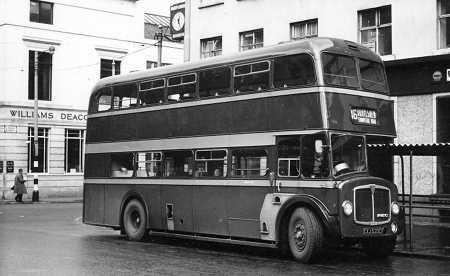
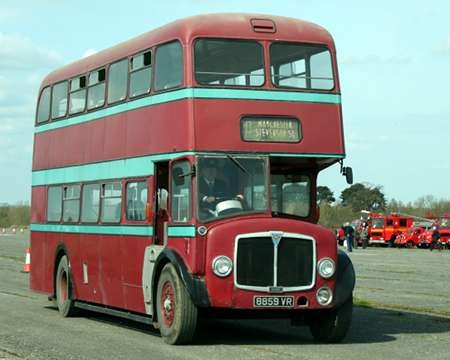
A Mayne & Son - AEC Regent V - 8859 VR
A Mayne & Son
1964
AEC Regent V 2D3RA
Neepsend H41/32R
8859 VR was an AEC Regent V 2D3RA with a Neepsend H73R bodywork originally with A Mayne & Son of Manchester. She was built in 1963 and delivered in January 1964 and is seen at the Wisley rally on 5 April 2009. Rumour has it this bus was exported to Japan for use as a sight seeing bus, not sure if that is true.
Photograph and Copy contributed by Pete Davies
18/08/14 - 06:55
"Rumour has it . . . ." Well, I didn’t know of that one. Our editor must have added that to my caption! Updates, anyone?
Pete Davies
18/08/14 - 12:01
Apparently it went to Japan about two years ago. This is how it looked last year. www.bus-and-coach-photos.com/picture/
David Call
18/08/14 - 12:02
Picture of it in Japan with new registration number EYY 787B at www.flickr.com/photos/
Ken Jones
20/08/14 - 06:12
So, another bit of our heritage gone overseas!
Pete Davies
20/08/14 - 14:21
………and looking decidedly ropey, Pete!
Chris Hebbron
20/08/14 - 14:22
At least it’s still got its roof on !
Petras409
20/08/14 - 14:22
Happily sister vehicle 8860 VR is in the care of Manchester Transport Museum.
Chris Hough
21/08/14 - 07:02
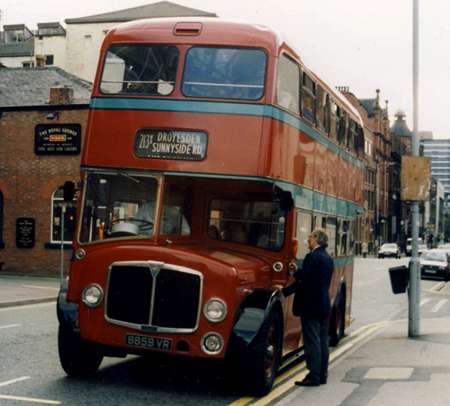
This shot came in without name or comment. I presume it was taken when 8859 VR was in service with Maynes, it is on route 213x to Droylsden Sunnyside Road and the pub behind is/was ‘The Royal George’ which was a Vaux pub at the time, can any of you Manchester chaps confirm if I presume correctly.
Peter
21/08/14 - 08:14
The photo of 8859 VR is on Lever Street in Manchester where the direction of flow of the one-way system had been reversed. Hence the terminus had to move from its original location in Stevenson Square which is just behind the bus.
David Beilby
21/08/14 - 12:42
The picture has come from the SCT61 site, it was taken in October 1995 by which time this bus was in preservation, it was running in connection with some sort of GMTS museum/Maynes joint event. Vaux did not acquire its Manchester pubs until long after Maynes had withdrawn their Regents!
Michael Keeley
21/08/14 - 15:26
oops 8859 VR the shot without a comment, it was me !! sorry the comment seems
to have floated away somewhere.
Sadly this fine vehicle was indeed exported to Japan early
2013 approx.
She was retained by Maynes and stored for many years at the Ashton road garage
(now an Aldi supermarket) also at the Stuart street coach depot nearby, I visited the yard many
times and stated it would be wonderful to see the bus on the road and actually was prepared to
purchase the bus, Stephen Mayne told me the bus was his baby!! and would not be sold on. The bus
spent some time at Maynes Warrington depot in the open and then on loan to the North West museum of
transport at St Helens. She was looked after by a dedicated group of drivers and was cleaned and
polished up and overhauled to take part in the 75th anniversary of Maynes running day she performed
well only failing once. The photo I have submitted was taken on Lever street Manchester October 1995
whilst in service on the running day, I then jumped back on board ah that symphonic AEC gearbox and
engine !! Sadly she went back into store as mentioned above and following the sad passing away of
Stephen Mayne it seems the remaining directors had no interest in retaining a piece of company
history such as the respected Dalaine family at Bourne, and the Goodwin family in Manchester. The
bus was sold from St Helens to an enthusiast near Basingstoke I believe, finally ending up with bus
dealer Mike Nash and exported to Kobe in Japan, she was used advertising a children’s charity
initially, the plan was to use the bus as a London tour bus on Rokko island, she is most likely
painted red by now!! But I have no further information to date, a sad loss if I had been aware she
was for sale she may well still be here.
As mentioned sister bus 8860 VR is there for all to
see owned by lifelong Maynes enthusiast and expert Brian Lomas well done Brian for saving here,
check out his amazing views of both vehicles on his Flickr page 8860 Brian.
I have had an
interest all things Mayne for many years (its an illness we all have this bus lark …but thanks
to this amazing old bus photo site we can all chat and submit our photos, and information to benefit
and enlighten us all many thanks) however I am desperate to view any photographs of F & H Dean of
old church street Newton Heath bought out by Maynes circa 1960, but continued the Dean fleet until
1967 help please anyone!!
Mark Mc Alister
17/01/15 - 06:08
Maynes 8860 VR is in Manchester Transport Museum for all to see. //www.gmts.co.uk/
Mike Ramsden
Quick links to the - Comments Page - Contact Page - Home Page