Southern National - Dennis Ace - YD 9533 - 3650

Copyright Roger Cox
Southern National
1934
Dennis Ace
Dennis B20F
Few of us realise just how major the task of bus preservation can be in terms of effort and expense. Back in the late 1960s I was a member of a group that bought 1934 ex Southern National Dennis Ace YD 9533 with Dennis B20F body, which had by then suffered the indignity of serving as a mobile fish and chip shop. The work and costs became increasingly prohibitive, even for this small vehicle, and, as Brian Lunn with his South Yorkshire Titan also discovered, those prepared to roll up their sleeves for hard graft became conspicuous by their absence. Ultimately, we sold YD 9533 to another owner, and, happily, this delightful little vehicle is now a regular on the rally scene in superbly restored condition. Here it is, as it was when bought in 1969, on the forecourt of Reigate LT (CB&C) garage, alongside face lifted Green Line RF 61, LYF 412.
Photograph and Copy contributed by Roger Cox
22/06/12 - 07:06
Roger, did you take this bus on the HCVC London Brighton run about 1970? I
used to go every year with Geoff Lumb and his 1938 Llandudno Guy Wolf JC5313 and one year we were
parked next to a Dennis Ace. All I can remember is that I think it was painted all over white and
had large pieces of plastic sticky tape over a rust hole on the rear offside corner.
Or am I
thinking of something else? It comes to my mind, as I type this posting, that perhaps it was a
forward control half cab version of the Ace. (Mace perhaps)?
If this isn’t going too far off
topic (grin), can anybody confirm what is a fading file in my "memory banks"?
Eric Bawden
22/06/12 - 07:07
Perhaps a little more refined and not so open to the elements, but this Dennis seems to have a bit of a French influence about it, i.e. the driver is behind the engine but the wheels are set back from the front, not exactly the norm for UK vehicles
Ronnie Hoye
22/06/12 - 11:19
I think the idea was to shorten the wheelbase as much as possible to make them
more manoeuvrable in tight country lanes. The Ace was as a result absolutely ideal for these
situations.
The set back front axle on commercial vehicles was quite the fashion in Britain
for a while in the 1930’s, even heavyweights like AEC, Leyland and Albion joining in. Often almost
the entire bonnet was ahead of the front axle, protruding like a long snout and looking really odd.
Then the reason was to provide better engine accessibility and removal/installation, but it was
short lived, though Dennis persisted with the idea well into the postwar period on the Pax model (of
which I seem to recall Jersey Motor Transport had a few as buses). But that’s another topic
really.
John Stringer
22/06/12 - 11:20
I wasn’t at the event, but this sounds like the Dennis Mace that returned to the UK for preservation after service with Joe’s Bus Service on Jersey. Memory is failing me here, and I can’t find a published source, but I think that it was a former ENOC machine and ended up being scrapped after the restoration task proved to be too much for amateur enthusiasts to handle. Another loss of a significant asset while hundreds of thousands of pounds are lavished on scores of identical London Transport types. Even for the pleasanter LT types such as the RT and the GS (yes, I hate Routemasters!) their ridiculous over-representation in the ranks of preserved vehicles is little short of a self-indulgent disgrace. Are there any Maces left??
Neville Mercer
22/06/12 - 15:08
That does make sense, John, on the subject of manoeuvrability on narrow roads, some years ago I seem to remember reading an article somewhere about some second hand buses being sold to an operator on the Channel Islands, but before he could use them they had to be split lengthways and made narrower, can anyone confirm if that’s right, or is my memory playing tricks?
Ronnie Hoye
22/06/12 - 15:08
There is a photo of a preserved Southern National Mace BTA 59, taken in 2007, at this site: //www.bus-and-coach-photos.com
John Stringer
23/06/12 - 05:41
Ronnie, I seem to remember reading the same report, but I can’t quote chapter and verse on it .
YD 9533 appears in the new PSV Circle listing of preserved buses.
Pete Davies
23/06/12 - 05:44
Eric, whilst the Ace was in our care, it was never repainted, so I think that Neville has hit upon the answer. Dennis specialised to some degree in small buses for one person operation (formerly known as OMO) during the twenties and thirties, introducing a bewildering array of models - G, GL, Dart, Ace, Mace, Pike, Arrow Minor, and (ultimately) Falcon, which superseded all the earlier designs and re-emerged post war. John is right about the reason for the set back front axle on the Ace/Mace, but this feature did not appear on the other small Dennis buses, though it did on the post war Pax goods model, a few of which were bodied as buses. Post war the maximum capacity for an OMO vehicle was raised from 20 to 26 seats, but, with the eventual legalisation of OMO operation on standard sized single deckers, the market for small buses withered away, and with it the Falcon. The standard power train for the "Flying Pig" Ace was the 3.77 litre side valve petrol engine coupled with a four speed gearbox, which, in usual Dennis style for the period, worked upwards from right to left. To further increase the fun, the Ace had a centre accelerator. A very few Aces were fitted with the early Perkins "Wolf" diesel, and it was also offered with a Dorman diesel option. I am glad that I played a small part in saving this little gem for posterity. Today it is immaculate:-
Roger Cox
23/06/12 - 05:45
I think that the vehicles Ronnie Hoye refers to were a number of Bristol LH’s which came from Western National or associated fleets. As they started out as 8ft wide they were indeed split down the centre and reduced to 7ft 6in width, I think in fact they went to Guernsey.
Diesel Dave
PS. The LH’s I commented about were in fact fitted with Plaxton Elite coach bodies.
23/06/12 - 05:47
Ronnie, I too seem to have a hint of this long ago, and Guernsey springs to mind - or what’s left of the old mind !!
Chris Youhill
23/06/12 - 05:48
Following on from Neville’s question, Eric B’s memories and John S’s link, I seem to recall that this Mace was rescued from its life as a caravan, painted white. I believe it’s the only survivor. From some front angles, the Mace looked decidedly odd, with the radiator seemingly off-centre, which I’m sure it wasn’t. However, I do recall two wartime RAF Dennis military lorries, mouldering with snow ploughs on their fronts, having their metal grill radiator covers definitely off-centre. There was also Dennis military lorry, with a snout like the post-war Falcon, seen here: //miliblog.co.uk/?cat=441
Chris Hebbron
23/06/12 - 05:50
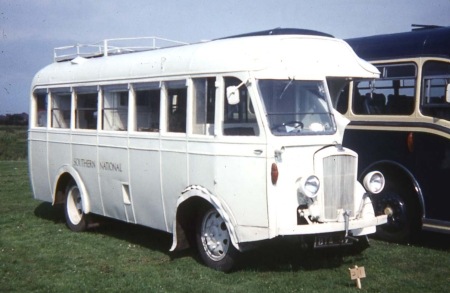
This photograph shows BTA 59 as it looked about 1970 so you can see if it
rings any bells. It’s fair to say it looks a lot better now, although I haven’t seen it in the
flesh!
If I can dig out my early rally programmes I’ll see if I can confirm whether it was
likely to be this or another one.
David Beilby
23/06/12 - 10:17
David B, your photo of BTA 59 almost certainly confirms in my memory that this was the one we were parked next to in Brighton around 1970
Eric Bawden
23/06/12 - 14:26
Whilst I agree with Neville that there seems to be a disproportioned number of RM’s and RML’s in preservation, that’s hardly surprising ‘with the possible exception of some Bristol/ECW’s’ that particular chassis/body combination was probably built in far greater numbers than any other half cab, it should also be remembered that by the time the Routemaster was finally withdrawn from service half cabs of any type had become a distant memory in most area’s, consequently you have a whole generation of youngsters living outside London who’ve never been close to a half cab, much less ridden on one. We can all think of examples of things that were once produced in vast numbers that we just took for granted and sadly no longer exist, that’s why places such as Beamish in this area, Chric, Sandtoft, Bealieu and many others too numerous to mention, should all be looked upon as educational assets rather than curiosities. I apologise if that seemed to be a bit like a sermon rather than a comment.
Ronnie Hoye
23/06/12 - 21:14
Yes, well Ronnie, I’m glad you made that point. I’m a fan of Neville but I’m also a big fan of the RM - having driven many and regularly still driving a preserved RML. I do have to agree with Neville, in one sense. I am actually more of a coach fan and lament the fact the are not half so many preserved coaches as buses. I am, however, painfully aware why. Until recently, composite construction was the norm and many have/had frames that had rotted away. Because of the minority interest, not so many people are/were willing to put in the painstaking work that has gone into so many superb bus restorations. I always felt, as a kid, that the standard of build and finish of LT buses was above the norm - cf 1966 RM/RMLs and Sheffield Park Royal bodies could have come from totally different origins, so different was the finish. Add to that, as Ronnie says, the size of the gene pool and it is quite understandable, if regrettable, that there are so many LT vehicles in preservation.
David Oldfield
23/06/12 - 21:16
Chris H, the Dennis Lancet II and III, and the utility Max lorry, all had the
radiator slightly offset to the nearside. The slightly eccentric appearance of the forward control
Ace, and the slightly heavier Mace that superseded it, is an optical trick that results from the
effect of the standard normal control radiator that marries up rather incongruously with the front
dash panel. The forward control Falcon has a similar odd appearance.
Stepping (cautiously) off
subject on the question of preserved London buses, Ronnie has hit upon a matter that continues to
influence certain opinions today. Many times I have come across the view that the Routemaster was
"the best bus ever built". In part, this (almost exclusively Metropolitan) opinion derives
from the fact that, as Ronnie points out, the RM was for many years the sole representative of the
half cab double decker, and was thus, in the eyes of many, a unique type of vehicle. Those holding
this view have no knowledge of Titans, Regents, Arabs, Lodekkas et al. To my mind, the RM was simply
a competent half cab that was designed to be dismantled like Meccano to suit the Aldenham overhaul
system. The London Routemasters were rebuilt regularly to achieve their long service lives. The
Northern General RMFs, which were notably purchased to match the passenger acceptance standards of
the United Lodekkas, and which did not receive the expensive cosseting from Aldenham, achieved a
service life of some 15 years, consistent with other types of half cabs.
Roger Cox
24/06/12 - 05:20
I don’t begrudge the preservation of any number of the RM family. Obviously it was the last of the half-cab breed and was therefore eminently worthy of all the preservation efforts that have taken place. I only regret that we didn’t all wake up a bit earlier and preserve some other stuff too - vehicles that were perhaps more nationally representative, rather than almost exclusively London. Having said that, I remain amazed and delighted at the number and variety of buses that do survive.
Stephen Ford
24/06/12 - 11:01
My real concern - and one that makes me a bit unenthusiastic and despondent
about the bus preservation movement generally nowadays - is who is going to keep on preserving them
all in future years?
It seems to me that with only a few exceptions, Bus Enthusiasts are a
disappearing breed. It was a generation thing, most that I have ever known were born between the
1930’s and the 1950’s and those who are still around are, let’s face it, getting on a bit. We have
often beeg seen by others as maybe a bit oddball, but we were tolerated. Later generations
increasingly see the transport enthusiast - whether bus, train or plane - as ‘sad’, definitely
having something wrong with them and probably in need of treatment. Just try pointing a camera at a
bus nowadays in any public place and note the looks and hear the rude comments I used to feel a
great sense of relief when I read in ‘Buses’ or the PSV Circle newsheets that a bus had been
secured for preservation. One somehow imagined naively that its future was automatically assured for
ever more.
Lots of vehicles have had many years of hard work and tremendous expense lavished
on them, but will there be similar dedicated people in the future to keep up to them? People who are
too young to remember them running.
The thing about ‘our’ generation of enthusiast was I
believe that although they obviously revered the buses of their youth first and foremost, they had a
broad interest in the periods before and after also.
The younger enthusiasts that do exist
tend, as with most other aspects of life, only to be interested in things that they can
‘relate’ to, and shun everything else.
(A bit of a rant starting now - another
generation thing - I’d better stop !)
John Stringer
25/06/12 - 07:43
Not a rant: a very sound point, well made.
Only this afternoon, I went
to the Stroud RE Meet and Running Day and pondered the average age of the men (and some wives) who
populated the event, not to mention the rides. And like those who keep old rail locos/aircraft
going, their ‘intimate’ skills with their charges are dying off, as they do. Most of the
children were children/grandchildren up to about twelve.
And, unlike cars and the like, the
‘charges’ are big beasts not easily accommodated under cover and ever subject to constantly
encroaching ‘elf’ & safety demands. And even museums are having problems, like the RAF one and
other military ones, where the younger generation don’t have that connexion with WWI or WWII and
have not served in the Forces as National Service and have an affinity. True, road transport
museums/meets are working ones, which keeps more of an interest going with youngsters, but will not
make them give of their time, the vital ingredient.
Chris Hebbron
25/06/12 - 07:43
John. Rant? Generation thing? Yes of course, but sadly you make very pertinent points.
David Oldfield
25/06/12 - 07:44
John, I can relate to everything you say, I’m in complete agreement. It’s a
bit like many of the bus pioneers who were young at the time of the 1930 Transport Act, when their
businesses became firmly established. When the 1970’s arrived, many of them simply wanted to retire
and many didn’t have anyone to pass the business on to. The majority of vehicles in preservation
today are owned by and restored by people who remember them, travelled on them, drove them, but who
will they be passed on to? As you say, the younger enthusiasts will have no knowledge, memories or
experience of such vehicles so will they be able to relate to them at all.
When I visit
rallies now, it’s wonderful to be able to travel on vehicles I remember as a lad, but will future
generations have the same enthusiasm for something which will mean nothing to them. It will be a sad
day when no one appreciates anymore, that we used to make lovely buses in Britain!
Oh dear, I
didn’t set out to spread gloom and despondency!
Chris Barker
25/06/12 - 17:02
Gentlemen..you have all said exactly what I have feared in recent times. Young
people will never relate to "old things" except via a computer screen.
Here in
Bristol we have the recently opened "M Shed" which is an original dockside warehouse that
has housed museum exhibits, mainly transport based for many years. It was old, dusty, atmospheric
and filled with the aroma of the dockside steam railway which still runs, old oil and the
originality of the building and it’s long past. Then came the decision to "restore it"
using Lottery money and after a staggering £27 million pounds was splurged it opened with much noise
and showmanship. However, it is now a big set of cardboard display cards, a few cleaned exhibits and
a host of LCD information screens. It looks like something constructed by infant school teachers and
set up in a shopping Mall. Filled with holidaying, screaming children and "yummy mummy’s"
because entrance is free, the place is nothing like it was as regards history just a theme
park…and in the middle is a rather tired Bristol Lodekka that was still running but now
ensconced in a cardboard display jungle. It made me heart sink to hear someone telling a group of
barely interested children.."It’s an old bus that really old people used to ride on..i’ts like
a London bus but green like you see in pictures"..they then moved on.
I do hope that
there will be better places and many transport museum are wonderful but the message of what the
exhibits meant, how and where they were made, who used them, what they are like to ride on and why
they feel different must be passed on in some way. Sadly with modern Health & Safety and litigation
fears, few children have ever picked up a hammer, nails, spanner, painted anything or been involved
in manual work. We old grey hairs grew up in a different world and now tap these keys as a new skill
but 10 year old Johnny will only seek a museum full of I-pods in 2060 and a surviving Lodekka will
be of very little interest as it sits dust covered and seized.
I don’t have any family but if
you do..spread the word to them AND to their friends..please.
Richard Leaman
26/06/12 - 06:33
About four years ago, I took my grandson to the Natural History Museum in West Ken., to see dinosaurs, which was quite good, mainly through the moving, realistic, models. After, I suggested we went to the adjacent Science Museum, where I’d gone as a child - all sorts of things for boys and model locomotives and other things in glass cases with handles you could turn to see how they worked. About ten years ago, it was still quite good with an excellent ‘steam’ section, both reciprocating and turbine engines doing their stuff, amongst other things. At this last visit, it was as Richard said, all trendy stuff, dark lighting and shallow content. The car section comprised five cars on shelves above each other, that gave you neck strain to survey. Most kids just flitted and my g’son was very disappointed, after my bigging it up! All very sad. I’m waiting for the British Museum to update, with floating fossils and artefacts, amid flashing lasers and fireworks! That’ll grab their attention and educate them!
Chris Hebbron
29/06/12 - 11:23
I have an undated press cutting showing YD 9533 in Southern National livery at the Bristol Bus Rally. Standing with it is Mr Bernard Davies the Assistant Commercial Manager of LCBS who is described as a part owner. Does this add to the history of the vehicle?
Paragon
29/06/12 - 17:10
All may not be lost my 24 year old daughter is a keen observer of the transport scene often texting me with the latest nonsense by our local operator. She also enjoys riding on old vehicles especially the Crich trams indeed she even follows the tramway blog! She also is happy to photograph interesting vehicles for me on her phone.
Chris Hough
30/06/12 - 05:25
In response to Paragon, Bernard Davis (no"e") was one of the group, of which I was another, that saved the Ace in the state as shown. He and I were the only two that put any real work into restoration before it was sold on.
Roger Cox
24/09/12 - 17:33
Pleased to say that there is another ‘Ace’ alive, if not well at present. Ex ECOC/Bickers Ace CAH 923/ECW B20F is in the Ipswich Transport Museum - and started the collection in 1965. Re-restoration has recently commenced with a view to getting the bus on the road for 2015 - its 50th year in preservation…….. Some parts have gone missing over the years and any info on bits and pieces welcome.
Eric Mouser
25/09/12 - 07:07
What Eric Mouser omitted to say in his comment was that the pioneering preservationist who acquired CAH 923 from Bickers of Coddenham in 1965 was a Mr. E. Mouser. I’m sure we all look forward to seeing it on the road in 2015 whether in Bickers green or Eastern Counties red.
Nigel Turrner
25/05/14 - 11:08
The sale and cannibilisation of these buses didn’t finish with their journey
to the ECOC graveyard of Ben Jordan, Coltishall.
A. C. Bickers of Coddenham, Suffolk bought 5
of the remnants and the complete wooden framework of what would have been D20, DVF 520, subsequently
completed as a service lorry.
Alfred Bickers then purchased withdrawn Dennis Ace dustcarts
from Ipswich Borough Council and used the mechanicals to rebuild 4 of the Aces as petrol engined 20
strs.
The later DVF XXX registered buses were about a foot longer, and were 22 strs.
I
first met G. C. Bickers, son of Alfred, in 1965 and bought CAH 923. The body was in poor condition,
so I also acquired the body of DVF 519, which had been bought, but never used by Bickers. The body
was stripped off D3 and the body of D19 re-fitted – which is when we found out the difference in
body lengths!
Initially the restoration went well, but then the Ipswich Transport Preservation
Group had been formed, and a 1939 Leyland Cub Fire Engine, a 1914 R. S. & J battery electric truck,
an Ipswich tramcar body to name but a few came onto the scene.
The collection moved around
various sites before becoming the Ipswich Transport Museum and many other projects took priority
over the Ace. The moves and changes of personnel over the years has taken its toll on the Ace and a
number of vital parts have been lost.
However the 50th anniversary of the Ace in preservation
is rapidly approaching and work to return the Ace to the road has begun in earnest.
It will be
something of a mongrel – long body, short chassis with petrol engine – but it will be painted in
ECOC livery so that we can demonstrate our collection of ‘tin bibles’ PSV Circle records show
pre-war livery as ‘Foochow Red and off white’ as opposed to postwar Tilling red and cream. Any info
or colour pictures welcome!
Eric Mouser
27/05/14 - 06:39
In the 1960’s there was a well known motor cycle scrambler from East Anglia called Dave Bickers. Was he connected with Bickers of Coddenham?
Paragon.
28/05/14 - 07:57
Yes, Dave Bickers is a member of the eponymous Coddenham family. Dave’s exploits took place at a time when we still had a motorcycle industry, when names like Dot and Greeves were ascendant in the competitive world of motocross/scrambles. As one time Scott and Velocette owner, I find the present day offerings of the almost wholly foreign motorbike industry as mind numbingly tedious as ‘modern’ buses.
Roger Cox
28/05/14 - 07:58
Paragon. You must be as old as me! My dad took me to motorcycle scrambles in the 1960s where Dave Bickers was a leading rider. He was and is David G. Bickers of Coddenham, son of Geoffrey C. Bickers of Coddenham and grandson of Alfred C. Bickers of Coddenham.
Nigel Turner
28/05/14 - 15:59
Roger and Nigel-thanks for your replies.Yes, I am three score years and ten
and more!
Roger-I have owned a number of Velos over the years and still have a water cooled LE
on which I purr round the Wiltshire lanes when the sun shines. When much younger I considered buying
a Scott but then sanity prevailed (no offence).
I am not totally against modern buses.There
are some interesting developments with people like GKN and BAE endeavouring to make more efficient
transmission systems.Like you modern motorcycles leave me cold.
Paragon
29/05/14 - 07:49
Among a clutch of motorbikes I owned, when young, was a post-war Velo KSS
which was rather fast! It served me well on my longest ever run, from Portsmouth to Morpeth!
I
agree that, like so many things, character is missing so much from modern things. However, I found
that girls were more attracted to cars than motorbikes and cars were more romantic!
Chris Hebbron
29/05/14 - 09:35
Chris, I had a KSS engine for some years, but never found a frame etc for it. The KSS and KTT were overhead cam machines which, as you say, were fast for the times, but notoriously difficult to keep in tune. Paragon, I envy you. The LE was a superbly engineered sophisticated machine, incredibly quiet and stable, with very good weather protection. The master at my last primary school had one, and sometimes used to run me home on the pillion seat. The Police took a large number, the "Noddy" bikes of fond memory, but Velocette never really recovered the development costs. Having burnt their fingers a bit with that, they then went on to pour funds into the Viceroy scooter, again, well in advance of anything else, but too late and too big for the market. They never got their money back. The story is a bit like Guy with the Wulfrunian, except that the Velocette machines were utterly reliable. When the Goodman family (originally Gutgemann from Germany) decided to stop making motorbikes in the early ’70s, they paid off all their creditors in full. On Chris’s final point, their was once a bus photographer who always endeavoured to include a member of the fair sex in his bus pictures, but his name now escapes me (like at lot else these days!).
Roger Cox
29/05/14 - 11:33
Roger, are you thinking of Robert Jowitt?
Eric Bawden
29/05/14 - 17:45
That’s him, Eric. He must have had rather more charisma than I ever did to entice those attractive "extras" into his bus pictures.
Roger Cox
05/07/14 - 07:17
I am using this thread as a flimsy excuse to return to a more recent one, the
use of megabuses around our streets when bus use is meant to be declining- but yet they carry 50 per
cent more passengers than the old 55 seaters which fitted better into the urban scene.
Arriva
Yorkshire (aka Deutsche Bahn) have just launched what I think are some Dennis Darts with obviously
short wheelbases for presumably town use- in a new livery. One is reminded, you could say, of the
principle behind Ace and Mace? It all comes around…
Joe
08/07/14 - 14:54
Further to earlier comments, I sadly have to report that Dave Bickers of Coddenham passed away on Sunday July 6th 2014 aged 76. His passing was covered in a full page spread in the East Anglian Daily Times and I believe that it also made the local television news.
Nigel Turner
09/07/14 - 07:50
A tribute to Dave Bickers may be found here:-
www.bbc.co.uk/news/uk-england-suffolk
Roger Cox
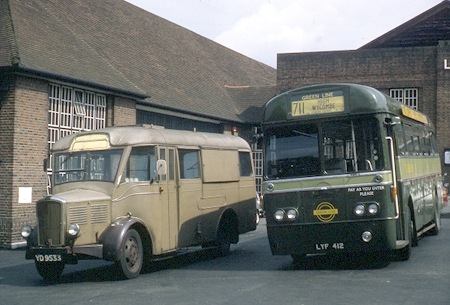 Vehicle reminder shot for this posting
24/07/14 - 06:05
The Dennis Mace refered to above appears to have been preserved. it is listed by the Dennis Society with a photo and another photo link on Google shows it at a show in 2007.
John Lomas
Quick links to the - Comments Page - Contact Page - Home Page