Old Bus Photos

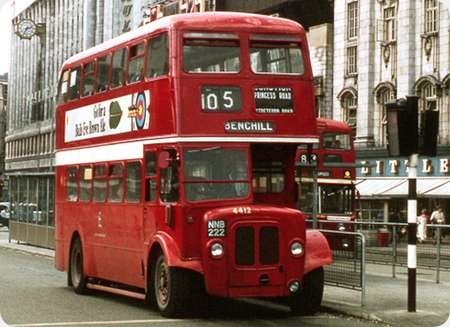
Manchester Corporation – Daimler CVG6 – NNB 231 – 4421

Manchester Corporation Daimler CVG6
Photograph by ‘unknown’ if you took this photo please go to the copyright page.

Manchester Corporation
1954
Daimler CVG6
Metro-Cammell H32/28R

In 1965 Manchester had 398 Daimler CVs all rear entrance. Out of the 398 158 of them had the 7·0 litre 5 cylinder Gardner 5LW diesel engine the rest having the more powerful 8·4 litres, six cylinder Gardner 6LW. They also had one CLG5 registration PND 490 fleet number 4490 which was delivered in 1955 it must of been one of the last of the CL models as production ceased in 1955. The CL was a lightweight version of the CV it was in fact 10cwt lighter but most of its weight saving features were either available or incorporated into the CV so in 1955 it was the end of the CL. The last five in the last batch of front engined Daimlers delivered to Manchester were CCG6s the middle C stood for the Constant mesh gearbox that was fitted, this made a total of 404 it would of been 405 but for some reason GVR 336 – 4034 had been withdrawn, any one know the reason why? Along with the Daimler CVs Manchester also had 160 Crossley DD42s and 570 Leyland Titans all of which were rear entrance vehicles, But at the same time rear engined front entrance Atlanteans and Fleetlines were being bought in large quantities, so the switch to front entrance vehicles did not involve a front engined vehicle. I thought that was a little strange. So I checked out Liverpool corporation they also switched the same way, though they did have one front entrance Regent V which was classed as experimental. On checking Leeds City Transport I think they also only had five front entrance front engined vehicles Daimler CVG6LX-30s which it would appear were bought for one specific route anyway. So the switch from front engined rear entrance to rear engined front entrance double deckers does not appear to be that strange after all, it may have something to do with the size of the fleet!!!

A full list of Daimler codes can be seen here.

———

In 1971 I went up to music college and CVG6s, like the one in the picture, were still very much around. They trundled around the flat-lands of South Manchester and the Cheshire plain with no problem, despite their age – particularly on the 44 to Ringway Airport (Manchester International now) and 46 to Styall (just short of Wilmslow).
They were not as sprightly as the PD2s, nor especially the North Western Renowns, which charged down the Wilmslow Road and Palatine Road. I read recently somewhere that, despite their manual boxes, many drivers preferred the PD2s.
The CCG6s were "foisted" on both Manchester and Salford Corporations in equal small numbers. They had the Guy "crash" box (at a time when Daimler and Guy had been brought together under Jaguar ownership) and were hated as much as the Leylands were revered. They were, however, offered at a knock-down price to sweeten the pill. [Pity, because they had the musical quality beloved of enthusiasts on contemporary Guy Arabs.]
I cannot remember whether it was here on this site, or elsewhere, that I recently read that putting a forward entrance on a front engined chassis caused an unforeseen weakness in body structure not evident with the entrance behind the rear axle. The Liverpool bus mentioned about was part of their experimental fleet and Sheffield had only around 30 forward entrance vehicles. I seem to think the Leeds buses were for the 72 and one of them survives in preservation.
Engineers actually knew what they were talking about and they would talk to each other. Often gricers only find out with the benefit of historical hindsight. [It took nearly fifteen years for Leyland to get the Atlantean right with the AN68! That was probably another, better reason, to stick with the "old".]

David Oldfield

———

The five Leeds forward entrance Daimlers were originally intended for and were employed on the 72 service to Bradford, jointly operated with the latter Corporation, where they were of a similar layout to the blue vehicles on the route. When Bradford went "rear engined" the Leeds buses were firstly used on the services to Garforth, Kippax and Ledston Luck which had been taken over from Kippax and District (Wallace Arnold). Later the Leeds five saw more general use, although predominantly on the services from Moortown and Meanwood via City to Morley. Immediately after the formation of the WYPTE all five were transferred to Huddersfield (Kirklees) where they "fitted in better" and I took a picture of one in Longroyd Bridge Depot boasting the idyllic destination "Salendine Nook." One of the five is indeed in preservation but I believe not yet fully restored.

Chris Youhill

———

The 5 Leeds front entrance Daimlers were CVG6LX-30 models and were bought for the joint 72 Leeds Bradford service, Bradford were using AEC Regent Vs with MCW bodywork at that time. The Leeds buses were later used on the Garforth services. Following the advent of the PTE they moved to Huddersfield

Chris Hough

———

Chris Youhill is normally reliable in everything he says, so maybe there are two! The Leeds Daimler I refer to was, until recently, running – resplendent in Huddesfield livery – in Steve Morris’s preserved fleet at Quantock Motor Service. [I drove for last year's Minehead event where it performed all day.] I think it is one of those which was up for sale because of his downsizing.

David Oldfield

———

Although Manchester 4490 was often described as a CLG5, later wisdom has it that this was a model that never actually went into production. Either one or two prototypes were completed (in Alan Townsin’s book on post-war Daimlers, ‘The Best of British Buses No 11′, the text appears to conflict with the photograph captions on this point), but operators were not happy to accept all of the features. As a result, a number of experimental lightweight CVs were built with some but not all of the features of the CL prototypes, and it appears than 4490 was one of these.

Peter Williamson

———

Thank you indeed to David Oldfield for that most welcome piece of news, as I’m almost certain that the "Steve Morris" one of which I was unaware is not the one I mean. The one that I mentioned has fairly recently been acquired by a Leeds preservationist (a friend of mine who I see very little lately) but I’m pretty certain it had been a playbus fairly near here. I shall ring him at a civilised hour in the morning and find out for sure. So all being well this will be a rise from 20% to 40% in the members of this interesting batch still around. It is to my lasting regret that I was done out of a drive in one of these by a "photo finish." I was spare one day at the LCT central Leeds Sovereign Street Depot (5 minutes walk from town) and the Inspector told me to go quickly to the Corn Exchange where a bus for Morley was waiting with a full load as the relief driver had not turned up. It was "one of the famous five" and I was thrilled, but I was beaten to the cab door by a short head when the absentee turned up. I was just formulating a plan to offer him £10 to disappear for a few minutes when he set off leaving me in the middle of the road like a lemon. So I never did have a drive in a front entrance CVG6LX. Oh, I did once move one around the City centre, empty, when it was out of service for a staff shortage, but that’s not quite the same thing as a live service journey is it ??

Chris Youhill

A follow on from Chris

Excellent news this morning – two of the famous five are still with us !! The one my friend owned – 574 – was sold by him some time ago to a work colleague who was eventually unable to complete it. It is now safe in the hands of the excellent Aire Valley Group at Keighley, who will no doubt fully restore it to a very high standard. The one in Huddersfiled livery – 572 – has indeed been offered for sale and we don’t know yet where it is but presumably it will remain pristine and active in a new owner’s care.
This batch statistic must surely give a whole new meaning to the term "proportional representation.

Chris Youhill

———

Glad to bring the tidings and that there are now two!

David Oldfield

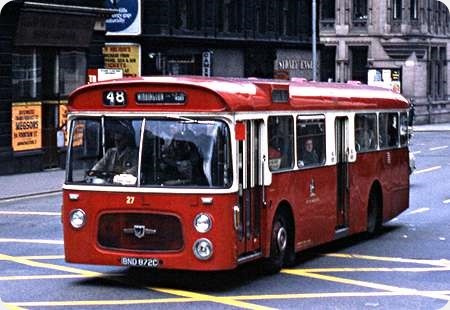
Manchester Corporation – Leyland Panther – GND 87E – 87

Manchester Corporation Leyland Panther

Manchester City Transport
1967
Leyland Panther PSUR1/1
MCW B40D

It may seem barely credible now, but in the early 1960s Manchester Corporation was planning a future without double-deckers. They had realised (possibly before anyone else) that the days of the bus conductor were numbered, but at that time only a single-decker could be operated legally without one. As a preliminary step towards total conversion to single deck one-man operation (as it then was), the Corporation carried out strategic experiments in new methods of fare collection, initially using 20 Park Royal-bodied Panther Cubs, a model created by Leyland at Manchester’s request. These were to have been followed by 30 full-grown Panthers with MCW bodies, but in the event only 29 of these were delivered. The missing Panther had been destroyed by fire at the body builders and was not replaced, because by then it was 1967 and the world had changed significantly. Conductorless operation of double-deckers was now imminent, and the plan for an all single-deck fleet was consigned to oblivion.

Although the Panthers rapidly faded from prominence, and were never very well known to enthusiasts, I was personally very fond of them. They were among the first Manchester buses to revert to red interiors after a dozen years of drab and incongruous green, and for me they produced some of the most pure and thrilling Leyland sound effects of all time.

In this April 1968 photo, Panther no. 87 (GND 87E) waits at the Brookdale Park (Newton Heath) terminus of route 7, a rather rambling inter-suburban service on the north side of the city, which in earlier years had taken me to school by Leyland PD2.

Photograph and copy contributed by Peter Williamson

———

Thanks for showing the photo above, it is becoming more impossible as time goes by to get bus photos, in service of Manchester corporation transport, mainly in the 1950/1960s periods, ie such buses as Crossley, Leyland Titan TD5s etc. Also for many years I have failed in obtaining copies, or even photocopies of Manchester fleet list/allocation lists for years 1946 to 1959, 1952 to 1953 and 1961, makes me wonder if I will ever get them as I am getting on in years now.
Can anyone help please.

Michael Cregeen

———

Answer for Michael Cregeen, regarding Manchester Corporation fleet list.
Try
this link and scroll down to item 88, which lists the Manchester tram, trolleybus and bus fleets, the latter divided into (1) 1906-35, (2) 1936-50, (3) 1951-69. Sorry, can’t help with the photographs. Finally, I don’t want to be personal, but Cregeen sounds like a Manx name. I remember a school holiday to the IOM in 1960, and we were transported around the island on a pair of Bedford coaches from Cregeens of Port Erin (an OB and an SB I think).
Any relation?

Stephen Ford

———

My thanks to Stephen for his very helpful answer but the type of Manchester fleet lists I am trying to get, or photocopies will do show the bus fleet and depot allocations rather than just fleet. These where published by Manchester Corporation Transport themselves. The years I cannot get are 1946 to 1950, 1952 to 1953 and 1961. Also selnec similar lists from 1971 to 1975.
Thanks in hope.

Michael Cregeen.

———

Michael, if you don’t mind black and white, Jaspers has 115 images with prints for sale, buses ranging from 2029 to 4644, at this link.

Peter Williamson

———

Something has confused me for many years. When 4490, 4500, 4509 were transferred from Birchfields Road to Northenden, this was odd in itself, but as far as I am aware they where never used by Northenden on all day service, they were used only on part day and works duty. This despite the rest at Birchfields being out all day. Also similar when 4550-4559 went from Birchfields to Northenden, they where used on part day also, and yet the rest of the batch including a few which went to Princes Road where out all day on the Flixton services. Never got to the bottom of this does anyone know anything?

Also after over 30 years of trying I still cannot get my hands on MCTD fleetlist/allocation lists for the years 1946-1950, 1953 and 1961, even photocopies would do. As regarding selnec/gmt ones from 1971 onwards I give up can anyone help please?

I have not got a computer, I use a library internet connection so not always available.

Michael Cregeen

———

Michael, I am interested in your question about the transferred Daimlers, but you do not say when the transfers took place. If it was well into the Fleetline era, then it may have been for capacity reasons. A few other facts that may be relevant:
1.  Only about one-third of the Manchester fleet, mainly the newest third, was used on all-day duties, and the exact proportion would be different at different depots.
2.  The five-cylinder Daimlers, which included 4490-4509, couldn’t keep up with the traffic on Princess Road/Parkway, which was Northenden’s main radial thoroughfare.
3.  Industrial relations were handled separately at each depot, and Northenden was known as the most militant.

Peter Williamson

———

I have received an email from The Museum of Transport Greater Manchester giving contact details and inviting Michael to get in touch with their Archives department and they feel sure they can help him with his search for MCTD fleet lists. Hopefully Michael will let us know how he goes on.

Peter

——— Top ———