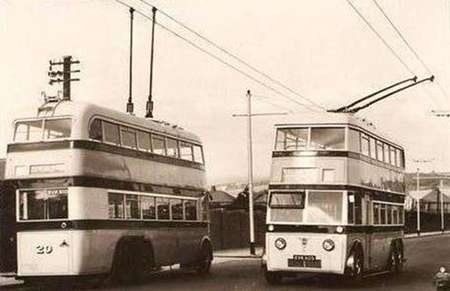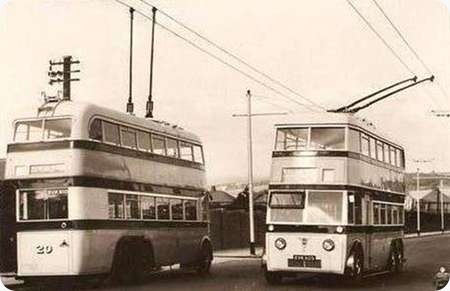
Courtesy of Newcastle City libraries archives.
Newcastle Corporation
1935
Karrier E6A
Metro-Cammell H33/27D
The last Tyneside and Tynemouth and District trams ran in 1930 and 31 respectively, they were replaced
by motor buses, but Newcastle Corporation decided on trolleybus as tram replacements. The Tyneside and
T&D tram networks were small in comparison, so the change came very quickly; however, Newcastle was an
entirely different matter. The first batch of 30 trolleybuses arrived in 1935; the registrations ran in
sequence, BVK 800 to 829, with fleet numbers running from 10 to 39. The changeover was scheduled to take
six years; however, the war intervened so it was not until 4th March 1950, that the last trams were
finally withdrawn:
The two vehicles in the photo are 20, a Karrier, and an AEC; it is a bit
blurred, but possibly 13 or 15.
10/19 were AEC, with English Electric running gear.
20/29
Karrier, with Metropolitan Vickers Company Ltd running gear.
30/39 GUY, with British Thompson
Houston running gear.
On the face of it, all the bodies appear to be the same. They were H33/27R,
had two sets of stairs, doors at the front and an open platform at the rear. However, three different
Coachbuilders were used.
10/14 were built by English Electrical Engineering,
15/19 were -
Brush Electrical Engineering,
and 20/39 were - Metropolitan Cammell Carriage + Waggon.
I
believe Bournemouth had similar vehicles.
Pre war the fleet numbers went from 10 to 124 with no
gaps. In 1942, ten 1931 Dick/Kerr English Electric vehicles were transferred from Bradford by The
Ministry of Works and Transport. One was used as a donor vehicle for spares; the remainder were numbered
1 to 9. About 1944, the fleet was renumbered, vehicles up to 99, became 300’s, and 100 onwards were
400’s, the last being 424. New vehicles began to arrive in late 1944, and started at 425, further
vehicles continued without interruption up to 628
The combined tram networks of Gateshead and
District, and Newcastle Corporation covered a larger geographical area, however, all trams south of the
River Tyne ran on G&D tracks, they were a BET group company, and when their last tram ran in 1951, they
were replaced by motor buses, so that part of the former tram system was lost, and trolleybuses never
ran south of the River Tyne. Consequently, apart from services into Gosforth and Wallsend, all
trolleybus routes were wholly within the Newcastle City Boundaries,
As far as I am aware,
Newcastle was the largest network outside London. At its peak, the post war fleet numbered in excess of
200 vehicles, just over half of which were three-axle type. The largest number of one type were 70 BUT
9641’s with English Electric running gear, and H40/30R MCCW bodies, the first batch of 20, LTN 479/98,
479/98; were delivered in 1948/9, and were identical to the London Q1 type, even down to the LT style
destination layout. Also in 1948/9, they took delivery of 30 Sunbeam S7’s LTN 499/528. 499/528; they had
Metropolitan Vickers running gear, and H39/31R Northern Coachbuilders bodies: The remaining 50 BUT’s,
NBB 579/628, 579/628; were delivered in 1950, although very similar to the first 20, they had the
standard Newcastle Corporation destination layout. Two vehicles have survived into preservation, 628 is
from the 1950 BUT batch, and is located at the East Anglia Transport Museum, appropriately it was the
last trolleybus to enter service, and 501, a 1948/9 Sunbeam S7, has been restored by Beamish Museum.
They were reunited in 2011, for a special event at the East Anglia Transport Museum, photos of which can
be found on their website. None of the two axle versions survives.
29/06/14 - 09:40
A lovely posed photo of the initial Newcastle trolleybus fleet. I have a book
published by Newcastle City Libraries 1985 which describes the two trolleybuses in the photo as No.
15, an AEC 664T with Brush body and No. 20, a Karrier E6A with Metro-Cammell body and the year is
1935 and the location is Denton Bank.
Richard Fieldhouse