Old Bus Photos

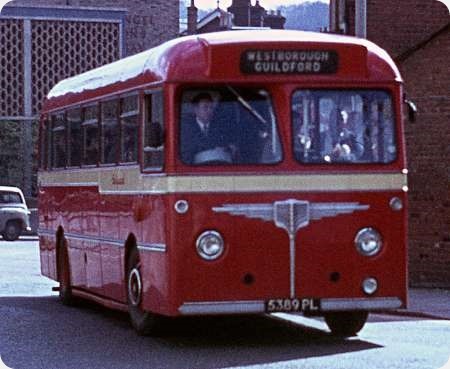
Yorkshire Woollen – Ford Thames 570E – GHD 215 – 871

Yorkshire Woollen - Ford Thames E570 - GHD 215 - 871

Yorkshire Woollen District
1961
Ford Thames 570E
Duple C41F

By the time this picture of a Yorkshire Woollen Thames was taken, it was in preservation. Never my favourite Yorkshire coaches, I found them a little slow and a lot noisy. One of them provided the only occasion I experienced where all passengers had to get off and walk up a steep hill which the Ford had failed to climb, though to be fair, the engine had developed a serious defect during the journey. I could never understand why ‘Yorkshire’ bought them – the rumour at the time was that Ford had thrown in a couple of Transit vans for the engineering department but I have no idea whether there was any truth whatsoever in this.

Photograph and Copy contributed by Bob Hunter


24/05/13 – 06:58

As I said elsewhere on this forum recently, there was a time in the early ’60s when these Fords were the (minority) vehicle of choice for major operators requiring a lightweight motor for lightweight (mainly private hire) duties. Although inevitably pressed into service at busy times for front line duties, SUT’s Fords (and the Bedfords acquired with operators) had their own front line duties – Fishing Trips. These were regular Sunday duties. Did it happen elsewhere? Ford only arrived on the scene in 1958, eventually replacing the Commer Avenger as the number two lightweight. Commer withdrew from the market in 1964 – as did Ford much later in 1985. Ford developed a strong fan base as a fast motor – in many ways overtaking Bedford who never quite regained the reputation gained by the OB and SB. The fact that these were inferior offerings to those of AEC, Bristol and Leyland – as well as Daimler and Guy – was immaterial. Quality independents sold their lightweights after about three years to keep a modern profile. The big boys – especially Yelloway – often kept their Bedfords for only one season, ie months, again often renting or leasing where they bought the AECs and Leyland.

David Oldfield


24/05/13 – 14:06

For some reason, Ford were very popular around Manchester in my time (1971 – 1980). Smiths, Stanley Spencer, Jacksons and Shearings all ultimately came together as Shearings – and were major operators of Fords with a three year replacement cycle. Holt, Fingland, a Davyhulme firm and another Altrincham firm added to the local Ford fleet, as did Fieldsend of Salford and Monk of Leigh. In the case of the above, some were minority AEC operators. [Was there a local dealer that, in the ignorance of youth, I did not know about?]

David Oldfield


24/05/13 – 14:07

I rode on this at last November’s Dewsbury open day and was surprised at the relative narrowness of the seats when compared to those in (say) a late 1940s half-cab coach. Having said that, I’ve not ridden in this type of Vega derivative since about 1974, but I’ve hardly gained any weight in the intervening years. The aisle was (probably) narrower than on a typical half-cab, so where did all the width go? Perhaps Duple was using cavity wall insulation on this model…

Neville Mercer


24/05/13 – 15:20

Interesting comment Neville. I rode on it at the Nocturnal rally at Halifax in October and my thoughts were exactly the same as yours, re the narrowness of the seats.
I think the last time I rode on one would be the late sixties, a Bedford version and don’t remember the seats being as tight as on this. Perhaps the Ford version was narrower for some reason. I know the Ford and Commer versions were about 7 inches taller than the Bedford so perhaps they were narrower.
There again, I’m afraid I have grown somewhat since the late 60′s!

Eric Bawden


24/05/13 – 17:33

They were only 8′ wide – but that wouldn’t explain why they felt narrower than a (7’6") 1940s half-cab.

David Oldfield


24/05/13 – 18:12

North Western bought 8 Bedford SB3s for their Altrincham Coachways subsidiary in 1961 with identical bodywork. Five subsequently went to Melba Motors. When Altrincham Coachways was sold off and Melba Motors was absorbed into the main fleet, the vehicles were painted red and cream, were given North Western transfers and fleet numbers in the 1967 sequence and were employed for just a season.
During their lives they were used on similar operations for the subsidiaries to those where NWRCC employed Tiger Cubs or even Leopards.
As far as the infiltration of Fords into the various Bedford dominated Manchester coaching fleets of the period goes this was, as I understand it, due to an aggressive sales policy at a time when the Bedford OB and early 1950s Bedfords were time expired. With both Duple and Plaxton offering bodies on Fords almost identical to those on Bedfords, the price advantage that Ford offered resulted in a good number of orders.

Phil Blinkhorn


Quick links to the  -  Comments Page  -  Contact Page  -  Home Page


Crosville – Bristol Lodekka – 4227 FM – DFG157

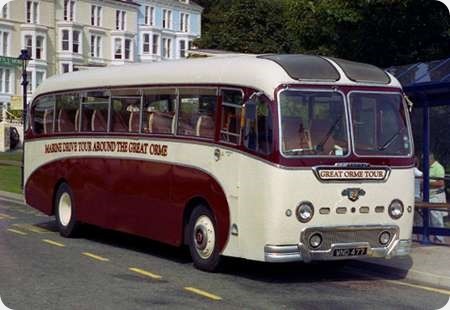
Crosville - Bristol Lodekka - 4227 FM - DFG157

Crosville Motor Services
1964
Bristol Lodekka FS6G
ECW H33/27RD

Here is a Bristol Lodekka FS6G with rear entrance ECW body and dates from 1964. Crosville bought both long and short F series Lodekkas. DFG157 is one of the short ones. It was withdrawn by Crosville in 1977 and is now preserved
Photographed 8/5/2011 whilst in service at The Wedgwood Potteries rally – Take me home country roads.

Photograph and Copy contributed by Ken Jones


21/05/13 – 15:47

I always thought the FS was a more subtle bus than the FLF with just the right amount of side profile curvature, I can never decide whether I prefer this destination indicator layout or the T type as used by West Yorkshire. The bus is a true post war classic especially when fitted with a Bristol engine, although others may differ.

Chris Hough


22/05/13 – 07:30

The Bristol BVW engine and the earlier AVW, like the Daimler CD6, were introduced in part to relax the constraints placed upon chassis production volumes by the limited supply of Gardner power plants. The AVW was a straightforward dry liner engine, and proved fairly trouble free, but the wet liner BVW, introduced in 1957, did give problems in service, and went through a series of modifications. In the 1970s, when the Stokes led Leyland empire dominated the industry, BVW production was halted and spares became very difficult to obtain. Several Tilling group companies re-engined some of their BVW powered Lodekkas with Gardner units in consequence.

Roger Cox


22/05/13 – 08:55

And it’s the "right" shade of green for a Bristol/ECW combination, not that dreadful NBC attempt . . .

Pete Davies


22/05/13 – 09:39

Roger, is of course, right in every respect. What he didn’t say was that there were continuing capacity problems at Gardner’s and British Leyland then offered the O.600 as an alternative to the withdrawn BVW option – which was taken up by Hants & Dorset and Wilts & Dorset.

David Oldfield


22/05/13 – 11:11

And once again Ken, a really superb photo of a preserved bus caught in a timeless landscape looking just as it would have in its heyday, rather than parked in a line up on some car park, all covered in rally stickers, and surrounded by stalls and people in high-vis. Keep up the good work !
I agree with you about the FS, it was a superbly proportioned design. Just ‘right’. Though the Gardner engined Lodekka almost by definition had to be the most reliable and efficient version, speaking purely from an enthusiast’s aesthetic point of view, they just had to have Bristol engines. Along with most AEC’s, the Bristol-engined Bristol was one of my favourite bus sounds ever.

John Stringer


22/05/13 – 17:51

You and me both, John – AEC & Bristol engines. But there were problems with wet-liners with both makes…..

David Oldfield


23/05/13 – 07:58

The whine of a Regent V box always made me think we`re going back to the days of the TD1 !

Jim Hepburn


23/05/13 – 07:58

Ken, thank you for posting a photograph that is beyond superb. This photograph manages to capture the very essence of Crosville, a Bristol Lodekka and a rural scene. I could look at this photograph for hours and never get tired.

Kevin Hey


23/05/13 – 07:59

May I suggest that the date was Sunday the 18th rather than the 8th? I was at the Rally and travelled on this Lodekka. It brought back fond memories of my daily travels from Gresford to grammar school in Wrexham on umpteen Crosville Ks and Lodekkas on the D1 service heading ultimately for Llangollen.
When I filmed the bus at the Rally mid-afternoon, it was displaying ‘Private’ and ‘D45′. Presumably, the destination had been changed to avoid misleading any intending passengers, though an ex-Devon General Atlantean proudly displayed ‘Dawlish’ all day.

AG 6470

This was the first time I’d attended the Potteries Rally and was amazed to see the line-up of elderly vehicles put on show by the Emerton Brothers as ‘Bounty Country Buses’. Seeing a Dennis Ace and two Crossley coaches, among other gems, was a truly heart-warming experience.

Berwyn Prys Jones


23/05/13 – 07:59

A lovely shot Ken, and good to see the bus in Tilling green as Pete says. Also good to see the Lodekka grille and surround as they should be, and not painted green as sadly Crosville appeared to do with so many of their Lodekkas on repaint. (Northern General treated their acquired examples similarly if memory serves correctly). Even if the buses were sprayed, rather than hand-painted, surely there was no excuse for such corner-cutting shodiness. Things didn’t improve with the advent of NBC’s corporate livery, as Crosville along with many other NBC subsidiaries, then painted the mudguards the same colour as the main bodywork as well. Some operators (West Yorkshire, Southern Vectis and Red & White spring to mind) at least attempted to keep some standards under NBC’s somewhat cheapened paint application, by retaining black mudguards front and rear. This did seem to lift the livery on half-cab vehicles, but sadly most NBC subsidiaries did not avail themselves of this.
While the BVW engine did have some problems with the wet liners, the bottom end was just about bomb-proof, and West Yorkshire’s examples achieved some amazing mileages between overhauls. Head gasket failures were not uncommon at one time, but much of the problem was felt to be due to the infamous CBC ‘heating’ system and its airlock-inducing pipework, rather than the engine itself. It is surely no coincidence that as WY steadily converted many of its later CBC Lodekka ‘steamers’ to conventional radiator and heater layout, the boiling and head gasket problems seemed to decrease.
As for Lodekka engine sounds – the induction roar of the AVW, the somewhat more powerful sound of the BVW, the ‘staccato’ bark of the 5-pot Gardner, the purposeful growl of the 6-cylinder Gardner (LW and LX) – I love ‘em all!

Brendan Smith


23/05/13 – 10:12

…..but the music of the "pre-war" whine is part of the attraction of the Regent V. [Posted by a professional musician!]

David Oldfield


23/05/13 – 10:13

I’m glad this picture is generating such positive responses especially as I took it on the move from another vehicle. It’s very pleasing when someone says they could look at it all day. You start to see buildings etc you hadn’t previously noted.
I don’t generally argue about comments as I know next to nothing about buses. I have to confirm the date as 8th May though – it’s on the picture generated by the camera and I attach a calendar for May 2011.
I’ve now been to four of these Potteries Rallies and two at Hanley all organised by POPS. I’ve just donated all the pictures I’ve taken from all these events to their group

Ken Jones

The 8th of May 2011 was a Sunday the 18th was a Wednesday.


23/05/13 – 16:12

David O, I respect your professional musical knowledge, but with regard to the Regent V, I confess that I always felt cheated. My first experience of the type was with the Nottingham variety that appeared about 1956, and although the sound was quite nice, it always seemed to me a cheap and jazzed up imitation of the real pre- and post-war sliding mesh gearbox Regent sound. I am afraid that familiarity bred contempt for the homely soothing pre-selector Regent, that seemed almost universal in NCT at that time.

Stephen Ford


24/05/13 – 15:14

David, I must point out I had high regard for TD1s. Our local company at the time, Chieftain Buses of Hamilton had several second-hand examples in my schooldays.
One of them, which would have qualified for the Ugly Bus page, with a UF registration, so presumably came from Brighton, had the smoothest ride of any bus I have ever ridden on – including modern coaches.

Jim Hepburn


Quick links to the  -  Comments Page  -  Contact Page  -  Home Page


Lancashire United Transport – AEC Swift – NTC 109G – 292

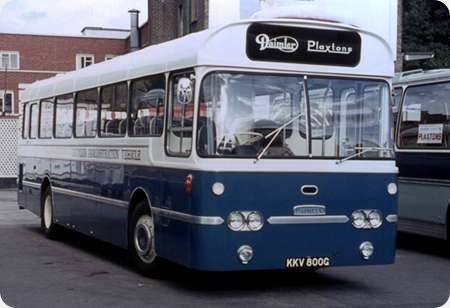
Lancashire United Transport - AEC Swift - NTC 109G - 292
Copyright John Stringer

Lancashire United Transport
1969
AEC Swift MP2R
Alexander B43D

LUT’s single deckers were often a little different from the norm. This AEC Swift was one of three (291-293) delivered in either late 1968 or early 1969 (sources differ) along with some similarly bodied Bristol RESL’s. Their Alexander bodies were based on the W-type, but featuring short window bays, flat glass, V-shaped windscreens, and a plain front roof dome, rather than the more common version with long bays, curved screen and peaked dome. Interestingly they appear to have retained the curved rear screen though.
The Swifts did not find favour and were ‘swiftly’ withdrawn in 1973 and sold to neighbouring St. Helens Corporation, with whom they retained the same fleet numbers.

Photograph and Copy contributed by John Stringer


19/05/13 – 11:31

The Bristols, delivered at the same time, had a three part rear window arrangement including a full depth emergency exit door in the centre. Short window bays also appeared on the Plaxton bodied Seddon RUs and Bristol REs, delivered up to and including 1974.
I always thought the Alexander bodies, with their deeper window line, were better looking than the Plaxton bodied Seddon RUs and Bristol REs. and decidedly superior to the, at best, unattractive Northern Counties LH6Ls delivered in 1969.
The Swift’s short service duration with the company has always been a matter of conjecture. Was it the reputation the type was rapidly gaining in London or, much more likely, the fact that the power plant wasn’t a Gardner or, at a push, a Leyland.

Phil Blinkhorn


19/05/13 – 12:08

As we saw with the DM(S) Fleetlines, failure in London was not necessarily a reflection on the vehicle – more on the rigid London "system". As an AEC man, I would accept that the Swift (& Merlin) wasn’t their finest hour – but wasn’t as bad a the Panther and certainly not the disaster that was the Roadliner. It just wasn’t the RE! St Helens, Morecambe and Leeds – not to mention in a smaller way, Sheffield – gave them full service lives. [OK. I haven't forgotten East Kent.]
I think Phil’s final paragraph has it in a nut-shell. Non-standard – and not Gardner.

David Oldfield


20/05/13 – 07:33

Did Alexander classify these bodies as W-type? I think the more anonymous front front panels, and dome – OK the whole front! – has stood the test of time better than the "classic" W-front (and would probably be cheaper to repair in the case of any lower front panel damage). I think the three-window/smooth dome of the REs probably sat better with this frontal design than the "classic" curved-screen/peaked dome. For me though, the biggest single improvement over the usual W-type body has to be the straight window-line fore and aft. RE/RU/Swift/LH/Plaxton (bus bodywork)/Northern Counties/Alexander/LUT/LT/St Helens – I’d forgive them all shallow window-lines, inflexible practices, less-than reliable offerings etc, just to have them still around . . . I can’t see myself offering opinions on some First/Arriva etc Wright etc thingy 40+ years down the line. Its 44 years – this photograph is closer to 1926 than today!

Philip Rushworth


20/05/13 – 07:34

Four of the Sheffield two-door Swifts were sold to Hardwicks at Scarborough when they were just over three years old, and supposedly even one of those they acquired by default. Story has it that one of the buses they’d agreed to buy couldn’t be persuaded to start when they came to collect it, so they ended up taking a different one instead!
Two of the quartet, TWE 21F/22F got themselves sold on to Stokes of Carstairs a few years later, and when asked about the pair during a depot visit on one occasion, Mr Stokes himself suggested that the only good thing about the two of them was that they kept a fitter in full time employment!

Dave Careless


20/05/13 – 09:08

That quip made my morning, Dave C – don’t you just love black humour!

Chris Hebbron


20/05/13 – 09:09

And a Ribble Lowlander in view: from the (almost) sublime to the ridiculous – please refer to the Ugly Bus Page . . .

Pete Davies


20/05/13 – 11:36

As far as I know, Dave’s story is correct. You need a bit of black humour on a grey and gloomy Monday morning…..

David Oldfield


20/05/13 – 16:56

Glad you enjoyed that one, Chris and David! Again, it’s not only the vehicles, it’s the people involved with them that make this hobby of ours so fascinating and, at times, wonderfully entertaining.
And you’re not alone with respect to the Monday morning weather, it’s equally as dark as the humour here in Nova Scotia also!

Dave Careless


20/05/13 – 16:58

This style of body was also bought by Cardiff also on Swift chassis. Although LUT had bought Marshall bodies with a wrap round windscreen. They reverted to an almost fifties appearance for their Plaxton bodywork on Seddons and Bristols one wonders if this was a cost saving measure as a small two piece windscreen would be much cheaper to replace. The NCME ones were the standard product which was a strange mixture of styles that didn’t gell The next LUT saloons with wrap round windscreens would be a batch of Leopards with Plaxton bodywork which were LUTs swan song as an independent operator.
Despite their outer appearance I always had a soft spot for Ribbles Lowlanders they were certainly an improvement on a "lowbridge" Atlantean

Chris Hough


21/05/13 – 07:37

You’re right about the Lowlander Vs Lowbridge Atlantean, Chris! I have experienced the preserved Silver Star example of the latter style on a number of occasions. It doesn’t look right, somehow!

Pete Davies


21/05/13 – 07:38

Like St Helens, Blackpool also had a fairly large fleet of AEC Swifts which seemed to have full service lives.

Philip Halstead


21/05/13 – 12:40

Portsmouth Corp’n had 12 AEC Swifts in 1971, lasting 10 years. They went with some slightly older Panther Cubs and some slightly newer PDR2/1’s, seemingly part as a cleanout of single-deckers than for unreliability reasons. I seem to recall some of them finishing up with Basil Williams (Southern Motorways), actually owned by White Heather and which, during a rail strike, were used to ferry folk, working in the City, to London every day! Basil acquired quite a collection of Swifts/Merlins in the end. He’d earlier owned ex- London Transport GS’s, of course!

Chris Hebbron


21/05/13 – 15:50

Yes, Chris H, Portsmouth had 12 AEC Swifts (new 1969) with Marshall bodies, and these had wrap-round windscreens, which I always assumed were "BET style" (or similar). The 26 Panther Cubs (14 Marshall + 12 Met-Camm) were similar in appearance. The 12 PDR2/1s that followed in 1971/72 were unusual in two respects – saloon bodies on a d/d chassis, and Seddon as the manufacturer. Pompey began to withdraw the Panther Cubs in 1977, but some of them along with all the rest were still in service in 1981/82 when the MAP project was carried out. The drastic recasting of services saw all the remaining Panther Cubs, all the Swifts and some of the PDR2/1s leave the fleet, along with 14 5-year old Leyland Nationals! As you say, at least two of the Swifts ended up with Basil Williams of Southern Motorways fame. By the time deregulation came in, Williams had some ex-London Swifts/Merlins, too, and repainted them in his original Hants and Sussex red and cream livery, using that fleet name, too. A non-enthusiast friend of mine travelled on one of the ex-London ones said it was a "fantastic vehicle". Make what you will of that, good people – an ex-London bus, around 18 years old, run by Mr Basil Williams, in the opening days of deregulation…

Michael Hampton


21/05/13 – 16:50

Amazing, Michael H, that a generally derided vehicle of such age and with standard London Country bus seats should get such glowing praise. Basil Williams must have had great faith in these vehicles to let them loose on the 150-odd mile return journey to London every day, although he would not have owned them for long at that stage!

Chris Hebbron


22/05/13 – 07:27

Chris, from my own knowledge of the Basil Williams empire, and my personal experience of driving GS 43 (Southern Motorways – Guy GS – MXX 343 – Ex LTE GS 43 on this site), I believe that faith formed a major ingredient of his maintenance procedures.

Roger Cox


22/05/13 – 17:46

Just to clarify the earlier note, my non-enthusiast friend travelled on the ex-London Swift on a local route, not a London marathon. Memory says Williams used route no 451 for a service from Portsmouth to the Emsworth area. Always with grandiose ideas of route numbers, it didn’t clash with the competition!

Michael Hampton


23/05/13 – 07:49

As most of you will know from the cover of a recent issue of Bus & Coach Preservation magazine, the Cardiff Transport Preservation Group has ex-Cardiff Swift/Alexander 512 and it’s still living up to the breed’s reputation as rather troublesome beasts.
Its arrival at last year’s Merthyr Rally all the way from Barry depot brought forth some expressions of surprise and relief from members at its safe arrival but we weren’t allowed to go anywhere on it, just in case!
There may come a day when we use it to go on one of our summer evening runs, but it’s not likely to happen soon.

Berwyn Prys Jones


Quick links to the  -  Comments Page  -  Contact Page  -  Home Page



All rights to the design and layout of this website are reserved     Old Bus Photos does not set or use Cookies but Google Analytics will set four see this

Old Bus Photos from 11:53 Saturday 25th April 2009 to 18:57 Friday 24th May 2013