Old Bus Photos

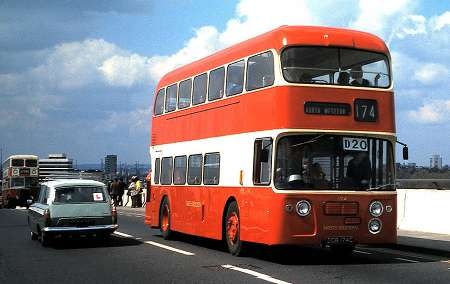
North Western – Daimler Fleetline – JDB 245F – 245

North Western - Daimler Fleetline - JDB 245F - 245
Copyright Ian Lynas

North Western Road Car Co
1967
Daimler Fleetline CRG6LX
Alexander H44/31F

Here we have one of a batch of North Western Daimler Fleetlines with an Alexander body. According to the PSV Circle Publication PX3 Post-War Second-Hand British Buses in North America mentions that two of the batch 245 and 247, JDB 245E and JDB 247E became 213 and 215 at City of Oxford Motor Services. They then went to Ensign a dealer in Grays, Essex. 245 in October 1979 and 247 in February, the following year both being exported to World Square, Kailua, Oahu, Hawaii in April 1980.
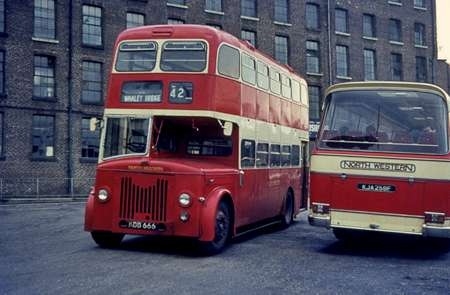
There is a couple of problems with this. First they were F registered (see photo of 245 at Lower Moseley St Bus Station in 1970, about a month before I went to Australia), this of course is most likely a simple typo 
The second problem is that Kailua is not on Oahu (the main island), Kailua is on "the big island", Hawaii in the town of Kona and on a visit to World Square in 2004, there was no sign of either of the two North Western Fleetlines, although one shopkeeper did remember them.
Does anybody have photos of the Fleetlines at World Square on the big island of Hawaii.

Photograph and Copy contributed by Ian Lynas


03/03/13 – 14:19

I’d imagine that, apart from age, the difficulty of obtaining spares for a defunct manufacturer’s product – as is the case for both engine and chassis – at such a distance would have removed the Fleetlines from service well before 2004. Whilst a Cummins may well have been a suitable alternative engine, new or used, it would most likely have been more cost effective to buy other, newer, vehicles.
"Mutton dressed as lamb" or perhaps "All dressed up but nothing to show" springs to mind seeing the photo. 245-248 were painted in coach livery particularly for the X60 in 1970 though they did appear on other services.
Paint doesn’t make a coach and patrons still had to sit on bus seats and the drive train was not re-geared so they were not as fast as the Mk3 Lolines with the 5 speed gear box which had regularly appeared on the X60 without the benefit of masquerading as a coach.
Still anything was better than making the trip on a Willowbrook bodied K5G which regularly appeared as duplicates on the service up until 1964. Now one of those in coach livery would have been something else!

Phil Blinkhorn


04/03/13 – 08:02

Phil makes some interesting comments about North Western’s "pseudo White Ladies" which prompts me to ask:
I know the Ribble, Standerwick and Scout "Gay Hostesses" had upgraded seating, but did they and the White Ladies have alterations to the drive train?
Did the White Ladies (the old Titans or the Atlanteans) have upgraded seating?
Sadly, I don’t have interior views of the preserved PD2 or Atlantean White Ladies, only exteriors.
On from that, I do accept that the ride from Manchester to Blackpool on any vehicle with bus seating will not have been wonderfully comfortable, but it can’t be as bad as an Ambleside Depot HR44 Olympic which turned up at Morecambe Bus Station on the London service one summer Saturday morning in about 1965. No, folks, it wasn’t the luggage hauler!

Pete Davies


04/03/13 – 09:03

As a soft Yorkshireman, and a coach man, weaned on Sheffield United Tours and S J O C coaches, I always went for the idea that even Sheffield – Manchester ought to be run by coaches. I was never impressed by the North Western/Ribble – let alone Yorkshire "J" services – running service buses (often "disguised" as coaches). To see X2 Nottingham – Blackpool with a bus Leopard would not impress me. Bus Leopards, REs or Nationals didn’t impress me when they turned up on the X67 Mansfield – Chesterfield – Manchester workings.

David Oldfield


04/03/13 – 15:08

The original White Ladies bodied by Burlingham and East Lancs had moquette trimmed higher backed than bus seats coach seats, but suffered from the lowbridge layout in so much as the upper deck had four seats across.
The Atlantean White Ladies for regional express services, which were more cream than their ancestors, had coach seats with head rests and individual seat frames. At one period in the late 1960s 1272 used to be an almost every weekday sighting for me as it ploughed a constant furrow on the X43 between Skipton and Manchester. The Atlanteans with 59 seats had a fair turn of speed so overtaking them on the de-restricted sections of the A56 was often a matter of fine judgement

Phil Blinkhorn


04/03/13 – 15:13

David, as a Lancastrian both by birth and by residence, I feel honour bound to point out that Yorkshire companies were equally fond of using standard service buses on completely inappropriate express workings. Examples which spring readily to mind are West Yorkshire (Bristol L type saloons on Leeds to Liverpool timings as late as 1964!), Yorkshire Woollen (various ageing service buses also on the X97/99 whenever better vehicles were needed for private-hire/excursion duties), Yorkshire Traction (Saro bodied Tiger Cubs on their share of the Blackpool services)….need I go on?
As an enthusiast I used to be quite excited to get one of NWRCC’s Bristol K5Gs on an X97 from Sale to Liverpool (this happened to me twice in 1964/65 – their final year in service – and the chassis on these vehicles were pre-war). I must confess though that the other passengers looked less excited.
I agree with you completely about the use of saloons on the X1/X2/X60 interchange. This was little short of a disgrace and all three operators (Ribble/NWRCC/Trent) were guilty of it. I think the ultimate prize for such inappropriate scheduling (apart from the HR44 already mentioned, although from personal experience I suspect that this gave its passengers to something classier at Preston)should go to Boyer – the Leicestershire independent absorbed by Midland Red. They regularly used their pair of Sentinel STC6/44 service buses on their express timings to Blackpool. As much as I love Sentinels this was a step too far!

Neville Mercer


04/03/13 – 17:41

Neville. As I’ve said before, I can be guilty of shorthand language which can be a little unclear. My reference to the Yorkshire J services was my acknowledgement that we were equally guilty on our side. Sorry if I was clear as mud. I only lived in Sale from 1976 – 1981 so missed K5Gs (thank goodness). As one of Bristol’s biggest fans I’m afraid – even in the flat-lands of South Manchester and the Cheshire Plain – only a 6B or 6G would do for me…..

David Oldfield


04/03/13 – 17:42

….And there can be few to rival your knowledge of Sentinels, Neville. Your comprehensive book, with co-author John Howie, on this marque is a masterpiece of research and writing.

Roger Cox


05/03/13 – 06:49

…..or indeed anything Neville turns his hand to…..

David Oldfield


05/03/13 – 06:49

Thank you, Phil. I hope Neville’s correct about transferring passengers from the HR44 at Preston. From what I recall of the Inspector’s answer to a customer, it didn’t seem likely on this occasion.

Pete Davies


05/03/13 – 06:50

Of course, everyone is right about inappropriate vehicles on long distance express services – but actually there were a lot of long routes right across the country that were routinely operated by normal seated buses. At the end of the day it is how long you are sitting in a low-backed bus seat, rather than how far you have travelled, that determines how acceptable it is. I think of the Ribble 555 Keswick – Lancaster service at nearly 3 hours; Western National’s old 18 when it ran all the way from Penzance to St Austell – also 3 hours. I have mentioned before how Lincolnshire often operated the route 3 Lincoln – Cleethorpes (2 hours) with Bristol SC4LK’s. I suspect some of London Transport’s longer central area services also took a couple of hours, though I was never very familiar with them. Obviously, on some of these routes, through passengers would be in the minority – but they were by no means a rarity.

Stephen Ford


05/03/13 – 12:24

I recall that the X60 and other Blackpool services used other operators’ buses on hire in the summer season. In the 1960s, Todmorden JOC used a coach-seated Leopard on hire to Ribble, but if one was not available, the bus-seated version would be used. I’m not sure if TJOC lowbridge Leylands were used previously; if so, they were not that different mechanically from the Ribble "White Ladies" used on the X4 Manchester – Blackpool via Rochdale and Todmorden, which took 3½ hours, although it’s unlikely that many did the full trip.

Geoff Kerr


05/03/13 – 13:48

My thanks to Roger and David for the embarrassing praise! I quite agree with Stephen about the longer stage carriage routes – another one which springs to mind was the 122 from Gravesend to Brighton. Not sure how long it actually took but it seemed endless in a fully loaded ‘decker. I still think that the X2/X60 interchange takes the proverbial biscuit – this clocked in at more than six hours which was a ridiculous amount of time to spend aboard a service bus. Fortunately (as far as I know!) there was no similar scheduling of saloons on the X7/X2/X60 double interchange from Great Yarmouth to Blackpool. But I could be wrong – especially in the case of joint operator Ribble who seemed unable to tell the difference between a coach and a bus. Although I never saw the aforementioned HR44 on the London services I did record a bus-seated PSU3 Leopard at Victoria Coach Station in 1966. OK, it was brand new at the time, but I suspect that the "new bus smell" did little to mollify the passengers who required buttock amputation after the trip. On the other hand the Gay Hostess Atlanteans were not as good as they looked from a passenger comfort viewpoint. Toilet smells tended to permeate the lower deck while those upstairs (even if, like myself, not prone to travel sickness) soon became weary of the pitching and yawing on any road less glamorous (?) than a fully-fledged motorway.
You know I love Yorkshire, David – it’s my second favourite county….

Neville Mercer


05/03/13 – 14:39

I must admit that the thought of travelling on the upper deck of a Gay Hostess Atlantean at 60 mph, even on the relatively empty M1 of the 1960s, fills me with trepidation even now.
I well remember driving at just under 60 mph in my upright Ford Pop (top speed 65, down hill with a following wind) and being thrown off course with one passing me at speed south of Newport Pagnell. When the next one in a convoy of three appeared in my mirror I slowed down!!

Phil Blinkhorn


06/03/13 – 06:48

I don’t have any information as to running times Etc, but one of the longest routes to use services buses must have been the Western SMT route between Glasgow and Stranraer. It more or less followed the A77, which was, and still is for the most part single carriageway, and by the time it went into and out of every village along the way, it must have been around the 90 mile mark from end to end. I would assume the crews would have been on a part way changeover basis, with three or more depots involved. Can anyone give any details?

Ronnie Hoye


06/03/13 – 06:48

Am I not right in thinking that one of Standerwick’s ‘best’ came to grief on its side on the motorway on one occasion?

Chris Hebbron


06/03/13 – 06:50

My worst journey was returning from a holiday in Leven (Fife) to Glasgow in an Alexander owned, Alexander rebodied with a semi-utility lowbridge TD4 body.
The temperature was in the 80s and the bus was packed, with many unhappy young children and parents in need of another holiday!

Jim Hepburn


07/03/13 – 06:42

The mention of operators hiring in vehicles for express services reminded me that many years ago in High Street Heckmondwike I saw one of Bradford Corporations AEC Reliance on hire to Hebble returning from Blackpool.

Philip Carlton


07/03/13 – 10:44

I can help you there, Ronnie. as, in my RAF National Service days, I travelled on it (to & from Cairnryan) several times in mid-1958 to spend weekends in Glasgow. The total distance is about 90 miles. The journey took four hours, with a stop for crew-change, re-fuelling and passenger ‘toileting’ inside Ayr Depot, some fifty miles into the journey. From Stranraer to Ayr, it was very scenic. It was a two-hourly service and Western SMT used new’ish tin-fronted Leyland PD2’s with lowbridge Northern Counties bodies on the route. It was pretty well patronised, but few passengers rode for more than about 25% of the journey. The other long’ish routes I used to do was Southdown 31 from Southsea to Brighton (52) and the A&D (24?) from Petersfield to Guildford (30 miles) and Red & White 73 from Gloucester to Newport (48), originally to Cardiff, later only to Chepstow, now just to Lydney!

Chris Hebbron


07/03/13 – 10:48

In the longest journeys class would be the joint United / SMT routes from Newcastle to Glasgow and Edinburgh; these were stage carriage most of the way, and indeed the only bus service in many parts. I believe they would normally be either service buses or at best ‘dual-purpose’. The 15 from Newcastle to Glasgow took 7 1/2 hours (or 8 including the summer only extension to Whitley Bay)although this did include a comfort break and crew change at Galashiels.

David Todd


07/03/13 – 17:04

Not sure about the Atlanteans but in 1974 one of Standerwick’s Bristol VRL coaches overturned on the M1 near Luton causing 3 deaths and some serious injuries. Incidentally the only time I used a Standerwick Atlantean on the Colne to London service it broke down on the M1. Numerous other trips with Leopards passed without incident.

Paragon


07/03/13 – 17:30

I’d agree with PARAGON on this. I’ve never heard of one of the Atlanteans falling over, but I do recall one of the VRLs doing that trick. Am I right in thinking they moved on shortly afterwards?

Pete Davies


07/03/13 – 17:59

The Standerwick VRL accident arose when the driver attempted to avoid a lamp standard that was leaning across the carriageway resulting from a crash by an articulated lorry just in front of the coach. The VRL and its passengers – sadly 3 killed and 30 injured – were essentially the victims of circumstances outside their control.

Roger Cox


08/03/13 – 07:15

I think it is correct that one of the Standerwick Gay Hostess (i.e. Atlantean) coaches finished on its side somewhere down the M1. This would be the late 1960s, it is my understanding that the driver involved was Burnley-based, and that he was still at that depot in 1970/71 when I was on Laycock’s.

David Call


JDB 245F Vehicle reminder shot for this posting


30/03/13 – 14:09

The Standerwick decker we immediately think of allegedly dropped into the (in those days) soft central strip which led to a few control problems! if it was the same one the story was that he’d taken evasive action to avoid an artic which had, or was in the process of, jackknifing.
In these days of tachos and pedestrian progress imposed by Brussels it is difficult to relate to the speed a Standerwick decker "flew" at, we were scheduled to average 70 on a "Z" you saw a white dot in offside mirror which grew and grew, they then blasted past like you were standing still!
Allegedly, (and no reason to doubt it) they used a full set of brakes in a fortnight, as far as I know they didn’t have retarders, didn’t they come later on in life?
The economics of decker coaches at the time was against them as 51 seaters were just coming in and they could only carry sixty, there were also fun and games in London as they couldn’t ( but at least one tried!!) get through Sammy’s

Pete Bradshaw


Quick links to the  -  Comments Page  -  Contact Page  -  Home Page


North Western – Leyland Tiger Cub – FDB 586 – 586A

North Western - Leyland Tiger Cub - FDB 586 - 586A
Stephen Howarth collection

North Western Road Car Co
1955
Leyland Tiger Cub PCUC1/1
Weymann B44F

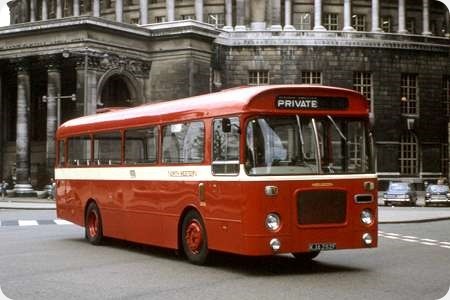
FDB 586 a Leyland Tiger Cub was new to North Western RCC in 1955.
It was converted, along with the rest of the batch to OMO in 1958/9, as denoted by the ‘A’ suffix after the fleet number.
586 is shown here (in rather a grubby state) working the 1 hour 36 minute duration Service 65 from Ashbourne to Buxton. The picture was taken outside the Devonshire Arms Hotel in the picturesque Derbyshire village of Hartington, a view which has changed little over the years. There was still over 50 minutes to go before it reaches the end of the journey in Buxton Market Place.
It was withdrawn in 1968, and passed to Worth’s Motor Service Enstone, Oxfordshire.

Worths - Leyland Tiger Cub - FDB 586 - 586A
Stephen Howarth collection

Taken from their website “Worth’s were established in 1922 in the village of Enstone by Thomas (Dickie) Edmund Worth who started, like a lot of Bus and Coach Companies of that time by repairing motor bikes, bicycles and lawn mowers. He later progressed to running Ford Model T taxis’, and then on to Char-a-Bancs running day trips to the coast.”
This year the company will be celebrating 90 years in business and continues to be run by the Worth family with the motto still being well known as:- "For a rattling good ride".
There website can be found at www.worthscoaches.co.uk
FDB 586 is shown here outside the Garage in Enstone.

Worths Motor Services Garage
Stephen Howarth collection

I have included a modern day picture of the premises, and as can be seen the garage building, unlike the fleet, has altered little.

Photographs and Copy contributed by Stephen Howarth

———

25/09/12 – 16:45

Purely from the "observer" point of view, Worth’s has always struck me as being one of the better operators. Others, of course, may feel or know otherwise! As for North Western, what can one say other than "R.I.P."?

Pete Davies

———

25/09/12 – 18:57

Pete: yes and yes.

David Oldfield

———

26/09/12 – 07:07

The No. 65 doesn’t look overburdened with passengers does it? And to think, until the late 50s this route was paralleled by a railway line, whose stations, on the whole, were nowhere near the villages they purported to serve!

Stephen Ford


Quick links to the  -  Comments Page  -  Contact Page  -  Home Page


North Western – AEC Renown – AJA 127B – 127

North Western - AEC Renown - AJA 127B - 127
Copyright Ian Wild

North Western Road Car
1964
AEC Renown 3B3RA
Park Royal H42/30F

This former North Western bus still in its original livery but with SELNEC (Cheshire) fleetnames is at the Norfolk Arms terminus in Glossop in May 1972 not long after North Western was split between SELNEC, Trent and Crosville. This was one of the second batch of these buses bought by North Western in this case with forced ventilation evidenced by the lack of opening windows. I wonder how effective this was in dispersing the cigarette smog more or less standard on the upper decks of buses in those days. I pass this location from time to time and wonder at how there could have been a busy bus terminus at such a busy location.

Photograph and Copy contributed by Ian Wild

A full list of Renown codes can be seen here.

———

28/08/12 – 15:17

The Norfolk Arms was busy and similar to the LPTB Hounslow trolleys, the traffic signals were controlled by the driver when ready to depart. I think it was mounted on the pole just by the driver’s cab in the picture. This turned the High St W and E, Victoria St and Norfolk St lights to red and then the bus would sweep out. I have it on good authority this led to at least one conductor being left behind. The old North Westerns from Glossop had a few characters.

Mike Franks

———

28/08/12 – 18:03

I felt bereft, as a student in Manchester, missing my AECs from STD, SUT and the local coach operators. Luckily North Western plied down the Wilmslow and Palatine Roads in student land. It might have been a Fleetline or a Loline but my day was always made when one of these Renowns turned up to take me home.
These PRV bodies have, unfairly in my opinion, been called ugly. Compared with Bridgemasters – especially the forward entrance version – these were positively beautiful, and in their own right were better looking than many contemporaries.

David Oldfield

———

28/08/12 – 18:04

When NBC was set up many fleets were shuffled around like decks of cards, and Northern General was no exception. At Percy Main ‘Tynemouth and Wakefields’ we had a number of Daimler Fleetlines sent off to different areas and got all sorts in return, among the number were six Renown’s that came from East Yorkshire’s fleet. I was in the minority but I quite liked them, especially if you got one on the likes of the 306 or 308 where you had some long gaps between stops, but they could be hard work on some of the town service routes that stopped at every other lamp post.

Ronnie Hoye

———

29/08/12 – 07:59

I have to agree with David that this version of the Park Royal body, combined with North Western’s style of applying the livery, is FAR better than the version on the Bridgemaster or on Southampton’s Regents and PD2As. Those things were little better than shoe boxes with windows. It’s not far off the style Oxford had on their …CWL Regents, and it really was quite good!

Pete Davies

———

29/08/12 – 08:00

I agree with David that the Park Royal Renowns were a big improvement on the Bridgemaster but I wouldn’t go as far as to say they were beautiful. The only Renowns that can justify that accolade in my opinion were the East Lancs bodied versions operated by Leigh Corporation. There were both rear and forward entrance versions in a wonderful blue and cream livery. Fortunately one of the forward entrance vehicles is still with us at Boyle Street museum in Manchester.

Philip Halstead

———

29/08/12 – 08:02

Wearing my driver’s hat, I can imagine a Fleetlines’s attraction for stop start over a manual AEC – much as I personally prefer the latter. Significantly, the North Western Renowns had been "downgraded" from long trunk routes, only to be reinstated by Crosville when they had taken over the Cheshire operations. They claimed they were better out on the open road and could maintain "a head of steam"!

David Oldfield

———

29/08/12 – 10:17

Philip. I did say compared with the Bridgemaster. I would definitely agree with you about the Leigh buses. I used them on the Warrington service when I was doing my post-graduate teacher training at Padgate in the mid ’70s. One or two were still in blue and cream but orange and white was the order of the day. [For new vehicles, I think SELNEC/GMT orange and white was actually quite good even though it did spoil older vehicles in "better" municipal colours.]

David Oldfield

———

29/08/12 – 12:24

As I’ve already said I quite liked the Renown’s, but by the time they came to us most of the routes for which they would have been ideally suited had either gone over to, or were in the process of being changed to OPO, as for them having "a head of steam" they could clip on a bit, and unlike the PD3′s, where after a prolonged spell of stop start braking where the brakes become a tad warm and tend to fade, you could guarantee the Renown’s would stop when asked to.

Ronnie Hoye

———

29/08/12 – 12:24

East Lancs also bodied Renowns for Leicester in both front and rear entrance versions on of the front entrance ones regularly appeared on the rally circuit 190 DBC 190C. My own favourite Renowns were the ones owned by East Yorks in their traditional livery complete with modified upper deck window pillars to negotiate Beverly Bar.

Chris Hough

———

29/08/12 – 12:26

Regarding the beautiful East Lancs-bodied Leigh Renowns, Philip Halstead mentions there is a forward entrance example preserved at the Manchester Museum.
Their rear entrance Renowns were always great favourites of mine ever since I saw the front and rear view photographs of one of them in Buses Illustrated when new. In 1976 I bought 28 (1975 TJ) for preservation from GMPTE, but in the 1980′s sold it and it then passed through several subsequent owners – maintaining a very low profile in the process. Only last week I learned that it been acquired by Tony Blackman for continued preservation, and who knows…..maybe operation in his Yorkshire Heritage Buses wedding hire fleet, though I do hope that it doesn’t turn black and white in the process. The beautiful azure blue and cream Leigh livery would be very much in demand by would-be happy couples I would imagine – it would match the bridesmaids’ dresses and floral arrangements !

John Stringer

———

30/08/12 – 06:49

1975 TJ_lr

Leigh 28 at Luddenden Foot, it has been working hard this summer for Yorkshire Heritage Buses. This shot was on her first day in service and as can be seen it is in black & white John.

Geoff S

———

30/08/12 – 07:09

AJA 129B_lr

Here is a picture of fellow Renown AJA 129B in Manchester, en route to Alderley in true North Western days. I have to admit that personally I much preferred the North Western Loline IIIs to the Renowns in both appearance and performance, but it would be nice to be able to detect something of the variety and individuality of the psv designs of those times in the present day crop of tediously indistinguishable bus types.

Roger Cox

———

31/08/12 – 07:33

Thanks Geoff S. for sending the photo. I hadn’t realised its restoration had advanced so far, I may well then have seen it at a distance and mistaken it for the ex-Southampton Regent V. As for the livery……….I’ll say no more.

John Stringer

———

31/08/12 – 09:35

Black marks for the new livery, then, John?

David Oldfield

———

31/08/12 – 09:45

Is black a good colour for a wedding or do they do funerals as well.

Spencer

———

So where have you been for the past year and a bit? Have you forgot how to send emails?

Peter

———

31/08/12 – 12:28

It’s a dual-purpose vehicle, Spencer; white for weddings; black for funerals!

Chris Hebbron

———

31/08/12 – 12:29

Tony Blackman’s "new" livery is in fact that of Lockey of West Auckland, and presumably was prompted by his acquisition of a full-fronted Regent V/Park Royal which (although new to East Kent) had been operated by that famous County Durham independent. That particular vehicle also carries Lockeys titles while the rest of the heritage fleet don’t. We all have a lot to thank Tony for – in my personal case for an unforgettable ride through the Mersey Tunnel on his ex-Halifax Regent III. What a pity that his revived Halifax JOC no longer operates stage services in the original glorious livery!

Neville Mercer

———

31/08/12 – 12:30

I suppose so David, but the thought of how it could have looked in its proper livery leaves me feeling blue.

John Stringer

———

31/08/12 – 12:32

The black and cream livery used by Yorkshire heritage buses is derived from the colours on a former East Kent AEC Regent V which is in the livery of its last owner Lockey of St Helens Auckland I saw the ex Darlington Guy saloon in the livery recently and it looked very good indeed. Better in a livery than a scrap yard!

Chris Hough

———

02/09/12 – 07:10

The trouble with Bridgemasters and lowheight Renowns was that there was no inward tapering at the front, creating a profile that was squat and square. That’s why the Beverley Bar treatment is such an improvement – it adds a much-needed bit of shape. Don’t forget Northern Counties www.flickr.com/

Peter Williamson

———

03/10/12 – 06:07

I used to drive these Renowns, 127b, & 129b, in the 60s at the North Western Altrincham Depot , a nice drive but a bit on the ‘Bouncy’ side!!

Roger Williams

———

AJA 127B_lr Vehicle reminder shot for this posting

———

13/11/12 – 08:44

I was a summer guard with NWRCC at Glossop Garage between 1960 and 1962. It was the guard that operated the lights at the Norfolk Arms terminus and you had to be mighty quick to get back to the platform, clutching Setright and money bag to grasp the platform pole before the driver moved off. Bristol K5G’s were OK but a PD2 was fast off the mark and you held on like grim death for the swing round. Those were the days – swinging loads on the old 125 to Manchester and overloads on the 85 to Buxton on summer days. It was a great company with great mates at Glossop depot. Public service at its best!

Roger Chadwick

———

13/11/12 – 12:57

Roger, be thankful it was a PD2 and not a trolleybus or you’d have been left standing.

Ronnie Hoye

———

23/11/12 – 10:03

Roger, Myself and two colleagues have been researching the North Western driver and conductor duties. Would you have kept any information when you worked at Glossop in the 60′s

Keith Hampton

———

22/01/13 – 06:33

Roger, Being one of the Two colleagues that Keith refers to can you supply any names of staff at all.
All part of an on going, and growing, North Western project of ours.

John Dixon


Quick links to the  -  Comments Page  -  Contact Page  -  Home Page


All rights to the design and layout of this website are reserved     Old Bus Photos does not set or use Cookies but Google Analytics will set four see this

Old Bus Photos from 11:53 Saturday 25th April 2009 to 01:18 Sunday 26th May 2013