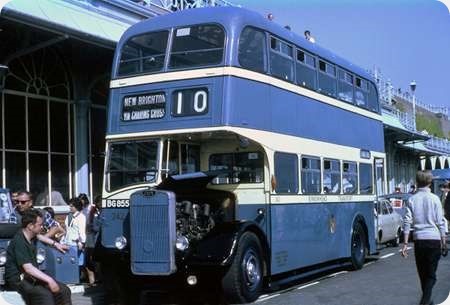
Birkenhead Corporation - Guy Arab II - BG 8557 - 242
Birkenhead Corporation
1944
Guy Arab II
Massey H31/28R
From the mid 1920s up to the outbreak of WW2, Birkenhead Corporation had been a confirmed Leyland aficionado, specifying Massey bodywork for a significant proportion of the fleet since 1931. With the advent of WW2 and the utility bus era, Birkenhead was allocated the Guy Arab II, hitherto unknown in its fleet, the first two arriving in 1943 with Weymann H30/26R bodywork. Thereafter Birkenhead managed to have most of their Arabs fitted with Massey H30/26R bodies of that company’s severe utility outline. BG 8557 was one of Birkenhead’s second batch of Arabs totalling twenty two, that arrived in 1944, all of which had Massey bodywork. A further twelve Arab IIs arrived in 1946 with bodywork shared between Massey, Park Royal and Northern Counties. The robust and dependable Arab clearly impressed the Corporation, for Guys featured in its order book at times right up to 1956. BG 8557 was originally numbered 324, but, in 1953, it was one of fifteen selected for rebodying with new Massey H31/28R bodywork when it received the new number 242. This bus was withdrawn in 1969 before becoming part of the new Merseyside PTE, and went into private preservation. It is seen at Brighton on the occasion of the May 1970 HCVC Rally, and now resides with the Wirral Transport Museum.
Photograph and Copy contributed by Roger Cox
18/10/21 - 07:09
Fine, distinctive vehicle! Many thanks to those that saved it and brought it to this superb condition. Seeing the lower-deck seating capacity of 28 I assumed that the new body must have been over 26′ long, but even allowing for the angle of the photograph the rear overhang doesn’t look excessive. A google search then revealed that the original 5LW engine had been replaced by the longer 6LW, but of course Arab IIs were built with the snout whichever engine was installed. I still wonder whether the "new" length may be 26’6" or thereabouts. Would love to see and hear it in the flesh!
Ian Thompson
19/10/21 - 05:42
Ian, it is possible that the length may be as you surmise, because the body was built to a width of 7ft 9ins for weight constraint reasons. The wartime Arab, like other Utilities, had a relatively heavy chassis because lighter metals formerly employed for certain components were diverted to military needs.
Roger Cox
19/10/21 - 05:45
The seating capacity seems to be an error - see lettering on this photo
There is
actually a way of getting 28 seats into the lower deck of a 26-footer. By reducing the longitudinal
seats over the wheel arches to 2-seaters, it is possible to fit an extra pair of lateral seats, with
the seat backs sitting directly on the front of the wheel arches. But that is not the case
here.
Peter Williamson
20/10/21 - 06:27
Thanks for that picture, Peter, which corrects a widely misquoted error. Even Bus Lists On The Web gives the incorrect lower deck figure of 28 for all the Birkenhead 1953 rebodied Arabs.
Roger Cox
28/10/21 - 06:54
As a tall person, I was very conscious of how stingy Birkenhead was with legroom, notably the H36/30R layout on the final batches of PD2s. (6 rows of laterals plus 2×3 longitudinal). Although I have no memories of twin seats over the wheel arches on any vehicles, I wonder whether the quoted 28 was originally intended in the way Peter Williamson suggests, and either not implemented or changed at a relatively early point in their new life. The Venture volume on Massey Bros quotes the H31/28R figure, but of course this may still be derived from the same source as the BLOTW entries. Inexplicably I don’t have a copy of T B Maund’s (definitive) volume on the Birkenhead Bus, but it would be interesting to know if there is any comment there.
Alan Murray-Rust
28/10/21 - 07:07
But is that how it was back in 1953? Southend’s contemporary Massey-rebodied
CWA6s had 28 down with 4s on the longitudinal seats. Weren’t they the same length and floorplan?
//www.sct61.org.uk/gallery/gallery1/ss268a
https://www.na3t.org/road/photo/RS00836
Martin
Quick links to the - Comments Page - Contact Page - Home Page