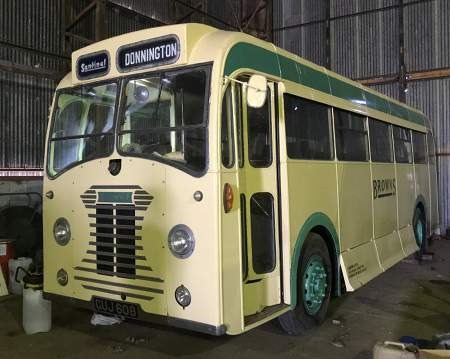
H Brown and Sons - Sentinel STC4/40 - GUJ 608 and Sentinel SLC4/35 - HNT 49


Copyright both shots Peter Williamson
H Brown and
Sons
H Brown and Sons
1950
1951
Sentinel
STC4/40
Sentinel SLC4/35
Sentinel
B40F
Beadle B??F (ex C35C)
The years leading up to 1950 spawned a revolution in the design of single-deck buses and coaches, in
which, in an effort to increase passenger capacity, the engine was removed from its traditional
prominent position "between the shafts", turned on its side, and tucked away ignominiously
under the floor. Leyland had built a class of buses to this design for London Transport before the war,
and BMMO standardised on it from 1946 for their Midland Red fleet.
Coincidentally, when Sentinel
started building diesel lorries in 1946, they mounted the engine horizontally under the cab floor, just
as they had done with their famous steam waggons. This experience, together with with the fact that the
company was by then part of a group which also made panelling for Beadle bus bodies, placed Sentinel in
an ideal position to take part in the underfloor-engined bus revolution. In fact Sentinel was the first
manufacturer to offer such a bus on the open market, exhibiting two complete vehicles at the 1948
Commercial Motor Show, while Leyland - who were developing the Olympic - could only show a horizontal
engine as a taster.
The first models were the STC4, a lightweight integral product with bus
bodywork built by Sentinel to Beadle design, and the SLC4, which was supplied as a chassis for outside
bodying as bus or coach, although most were bodied by Beadle as coaches. Six-cylinder models STC6 and
SLC6 followed after a couple of years, the latter with a wider choice of bodywork. Unfortunately
Sentinel’s reputation in the bus world began as non-existent, started to sink because of early problems
with engines and engine mountings, and never really recovered. The company gave up building road
vehicles in 1956.
With the exception of Ribble, who were involved in the design process and
purchased a total of 20 Sentinels, most buyers were small independents, of which Browns of Donnington
Wood in Shropshire was one of the best known. The STC4 shown here was new as a Sentinel demonstrator,
and the SLC4 had been converted by the operator from a centre-entrance coach to a front-entrance omo bus
by the time these photos were taken in 1968. Both vehicles are still in existence.
Photographs and Copy contributed by Peter Williamson
06/11/11 - 17:14
"Following GUJ 608’s photo from Peter Williamson, in Brown’s colours.
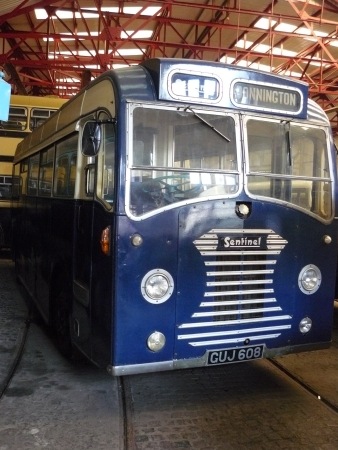
Here’s a photo I took of her yesterday (6th Nov 2011) at the Aston Manor
Museum, Birmingham. The museum officially closed on 30th Oct, but they helpfully let me in. I
couldn’t discover whose livery it was painted in, but maybe it was the one it wore whilst a
demonstrator, bearing in mind it shows Senitinel in the number box.
Its history, prior to
Brown’s ownership, was demonstrator, then Maryland Coaches, East London, for four years, then
Warners of Tewkesbury, for four years. The future of the museum’s collection is now uncertain, as
they must vacate the building by 31st Dec.."
Chris Hebbron
07/11/11 - 12:08
GUJ 608 is currently in the livery it wore as a Sentinel demonstrator at the beginning of its life, although it is believed that it kept this colour scheme while with Maryland Coaches. Warners repainted it in their two-tone green livery.
Neville Mercer
08/01/12 - 11:38
I noted with interest the bus painted blue with Dinnington as its destination
- Hills of Whiston used to make Sentinel buses and two were supplied to a local company - Wigmore’s
that ran between Dinnington and Sheffield - passing
en route Whiston. Could this be one of the
two actual buses. They also produced buses for a firm called Camplejohn. Hope this is of some
interest !
H Tompkin
09/01/12 - 11:38
The destination is Donnington, suggesting that it still has a Browns blind.
As far as I can ascertain, the only Sentinel that ran for Wigmores of Dinnington was JWW 316.
Apparently a second one (unidentified) was exhibited in Wigmores livery at the 1950 Commercial Motor
Show, but was never delivered.
Peter Williamson
10/01/12 - 12:00
Ah! Dear old Wiggy’s. As a slip of a boy (13 or so) I wrote to Wiggy’s and got a very nice invitation to their Dinnington depot. At the time it was in the West Riding - hence the registrations - but post 1974 became part of Rotherham, South Yorkshire. [South Yorkshire is geographically correct - if not historically - and better than Humberside. What was wrong with the Ridings anyway? Did the London centric Civil Servants not understand them?]
David Oldfield
31/12/12 - 07:10
The original livery was cream/green and it was Donnington, this bus was part a fleet of Sentinels that belonged to H. Brown and Sons, H. Brown being Harry Brown who was my late great grandfather, look at Made in Shrewsbury for history of the Sentinels.
Does anyone know where this bus is now?
Phil Brown
31/12/12 - 12:35
The past year has been a torrid time for Aston Manor Museum staff, first moving to what they thought was a secure site, then having to move again. Transferring, by road, some frail items, like part-trams and other barely roadworthy vehicles, proved difficult. They are still near their original site, however and, I assume, GUJ 608 is still with them. They hope to re-open around Easter.
Chris Hebbron
01/01/13 - 11:41
There is an earlier reference to Camplejohn Bros. This company operated in the
Barnsley area before being acquired Yorkshire Traction.
They operated a number of Sentinels
most of which can be seen here: www.jsh1949.co.uk/
Andrew Beever
01/01/13 - 17:32
Re the above link to pics of Camplejohn vehicles, the TTC 882 depicted was, as can be seen but not expressly stated, an Atkinson Alpha. All the other vehicles shown were Sentinels - apart from the obvious Dennis Lancet, of course.
David Call
15/01/13 - 06:14
Stumbled across the picture of the blue Sentinel. I remember the first of these being operated by A C Wigmore (1949) on their Dinnington to Sheffield service. They seemed so modern and advanced when compared to the cab single deck Leylands, operated by East Midlands. As a small boy, I would always watch for this new bus and I remember keeping a blue chalk drawn sketch of it on the inside of my school desk, all through the year. How I wished to drive one!
David Ives
15/01/13 - 14:46
I’ve recently had a visit to the new AMRTM site and my report is at www.focustransport.org.uk/ Due to the building’s smaller size many of their vehicles are being stored off site, and I am assuming this is also the case of the Sentinel which is not at the new site. AMRTM now have a facebook page to keep people up to date about their collection.
Ken Jones
15/01/13 - 16:36
The AMRTM Sentinel belongs to Richard Gray who is a Director. It is I believe
at their off site storage and not on display.
A sister vehicle belonging to Dave Wheatley of
Kenilworth is currently undergoing restoration and I understand could be roadworthy in late
2013
Roger Burdett
12/08/13 - 10:06
It is good to see the old sentinels again that I used to drive on the service
route Donnington to Oakengates and also help maintain them.
They were great years and I
believe Browns were the first to introduce one man operated vehicles and later were one of or maybe
the first who introduced exact fair payment on entrance.
I used to drive both of the above
with HNT 49 being the faster of the two able to do some 45 mph.
Brilliant years.
John Millington
12/08/13 - 14:23
When I was in the RAF at Patrington, East Yorkshire in 1955/6 we often travelled on the buses and coaches of Connor and Graham of Easington, Spurn Point. The small firm had a most interesting and varied fleet, one of which was a Sentinel JWF 176, acquired new. My memories of it are of a comfortable and, for the time, spritely vehicle. On occasions it would operate the 2300 hours on Sunday evenings from Leeds Bridge Street back to our Camp. I’ll never forget the time when JWF 176 arrived, driven by a disgruntled chap called "Jock" who didn’t know the meaning of the phrase "vehicle sympathy." In the early hours of Monday morning as we sped downhill past the race course into sleepy Beverley the exhaust silencer blew open - without even reducing velocity one iota Jock sped on towards the even sleepier Holderness - I wouldn’t be surprised if all the good residents of the many villages en route scrambled for their WW2 gas masks and tin shelters, under the impression that the War was not over after all. The RAF Police sergeant in the guardroom, and his Alsatian, were overcome with shock………… and the epic journey passed into history !!
Chris Youhill
13/11/14 - 06:16
The Aston Manor bus museum has transferred to Northgate, Aldridge, Walsall and is open several times per week.
Peter Green
23/12/14 - 09:01
When I went to Ribble in 1972, Harry Tennant had been Chief Engineer since
1947. He told me that Sentinel’s were used on service around Leyland deliberately to spur Leyland
Motors into faster development of an underfloor engined single deck.
Throughout his reign, on
behalf of Ribble he was often leading vehicle developments. Samples: Gay Hostess, White Ladies, VRL
Coaches, reverting from Atlantean to PD3 with full fronts (so driver could have similar supervision
of forward door), installation of the first 680 engine in a Leyland National (to prod Leyland to get
rid of the fixed-head 510) and the construction of the battery electric Leyland National (complete
with battery trailer) on behalf of NBC.
Geoff Pullin
31/12/14 - 05:55
My father and grandfather were the owners of Maryland Coaches. The sales rep tried to sell the Sentinel to my father he refused telling him it’s not a coach it’s a bus. He was running a fleet of Leyland, Bedfords and AEC coaches. The rep then found my grandfather in the local pub and talked him to signing up for the Sentinel. My father was not very happy with my grandfather. After running the Sentinel for some years they could never get over brake problems then selling GUJ 608. I talked to the owner in 1993/4 told me still had no brakes. The colour was the delivery colour.
M Leader
07/01/15 - 15:01
Hello to you all particularly Phil Brown and John Millington …….
Great to see all this going on , which brings back wonderful memories of my days at H. Brown and
Sons, which was run and managed by my late Stepfather Alfred Richard Brown youngest son of Harry.
There were other sons of Harry who also assisted in the running of H. Brown and Sons.
I
worked in the office and in 1972 ( I was 21 ) I passed my PSV …. second woman in the UK (first
being in London apparently ) but I never got to drive the Sentinels as my Stepfather thought they
were too heavy for me to handle, although I did pass my PSV with a 45 seater Duple with no power
steering.
H. Brown and Sons were the best days of my life and I was so sorry to be made
redundant when my Stepfather decided to sell out in 1978 as he and the remaining family members were
all getting older and the need to retire became more essential !
Marvellous times , fantastic
staff and absolutely tip top maintained coaches and buses by Uncle Sid Brown, his son Chris, John
Millington and Russell Ashley.
Mary Darrall-Brown
19/07/17 - 10:47
I’m Currently working on a Sentinal coach the reg no is AUX 296, we are looking for a Hercules engine as the current one has many parts missing & has Seized. can anyone help, any advise would be most helpful.
Peter Antrobus
26/05/19 - 06:29
Having just skim-read through this section, I am interested in the comments
concerning GUJ being a demonstrator vehicle at the beginning of its life.
Has anyone any
confirmation that this was the vehicle loaned to Luton Corporation, who were known to have a vehicle
on loan as a demonstrator in 1953. My Father drove ‘it’ - whatever vehicle it was - carrying
out stage service work and always said ‘it went like the wind’. Nothing was ever forthcoming
in the way of orders, Luton preferring to stick with Leyland, and in fact the first single deck
vehicles didn’t arrive until 1967 in the shape of Bristol RELL’s!
Paul Fleet
27/05/19 - 08:03
GUJ 608 was sold to Maryland Coaches at the beginning of 1952, so was no longer demonstrating in 1953. In any case, going "like the wind" is an unlikely description of a four-cylinder Sentinel, even though they were lightweights.
Peter Williamson
01/08/19 - 08:59
I and a group of friends have acquired GUJ 608. It is currently still in the blue (ex demo) livery and we would like it back to the browns livery. The bus is coming back home to Donnington and at some point I would like to take it back home to what’s left of the Sentinel works in Shrewsbury.
Benjamin Rothery
02/09/19 - 08:33
With regard to the comment made by Benjamin Rothery, the actual date of us acquiring GUJ 608 was 30 August 2019. We have set up a Facebook page "Friends of GUJ 608 Sentinel Bus" and anyone interested in keeping up with progress is invited to apply to join.
Glyn Bowen
19/11/19 - 06:44
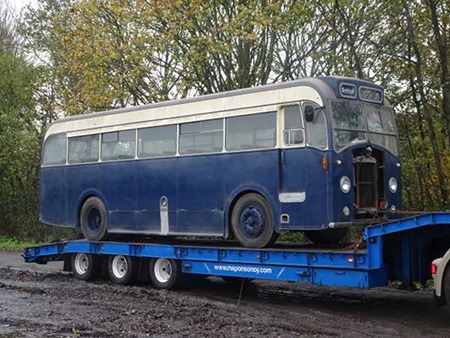
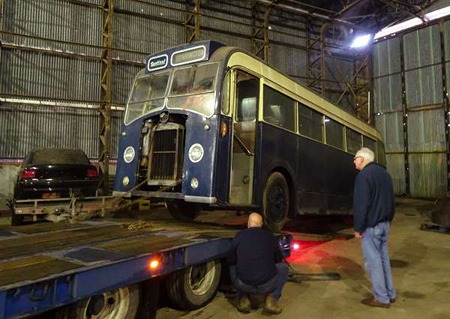
This was moved by new owners to a secure location near Telford.
Glyn Bowen
19/11/19 - 11:51
Sentinel GUJ 608 apparently ran on demonstration to Portsmouth Corporation. A Portsmouth fleet list published by the Worthing Historic Commercial Vehicle Group in 1964 records that it "ran for approximately 9 months from 1950 to 1951 on services O/P". The list records it with chassis no 4.4030, built 1950, with a Sentinel B40- body. No other data is recorded there. This is confirmed in PSVC fleet history PH14, which records it as a STC4 model [4/40/30], with B40F body by Sentinel itself, new c.11/50. It ran in Portsmouth in a blue and cream livery from 11/50 to 1/51. This is probably more accurate than the WHCV record of "9 months". However, no orders were placed by Portsmouth, and it was another nine years or so before single-deckers were placed in service, being Weymann-bodied Leyland Tiger Cubs. These were Nos 16-25, delivered in November 1959, and starting service in April.May 1960.
Michael Hampton
21/11/19 - 06:33
I have a photograph of it operating in Portsmouth but unfortunately do not have permission to post it. Very interesting to note that it was fitted with a different style front grill the likes of which I have not seen on any other Sentinel.
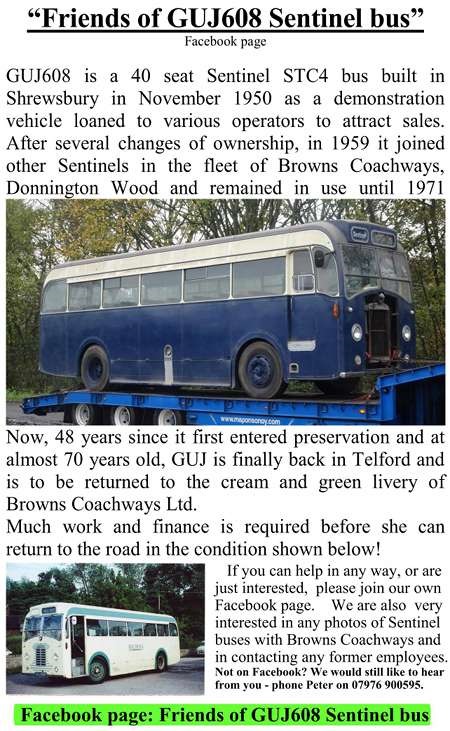
Below is is a poster about our group.
Glyn Bowen
21/11/19 - 15:50
Very glad and grateful to see this Sentinel saved. Paul Fleet comments that the Sentinel his father drove "went like the wind". On one of my Sentinel pilgrimages to Shropshire in about 1969-70 I had a good chat with someone at Browns, who praised these buses for their speed, adding that they were very well balanced—presumably referring to front/rear balance—although I know that some Sentinels had their original 8-stud front axle replaced by a heavier 10-stud one.
Ian Thompson
 Vehicle reminder shot for this posting
25/04/22 - 06:08
Thought you might like an update on GUJ 608.
Despite problems caused by lockdowns etc work has
progressed slowly but surely with GUJ 608. It has been repainted into Browns Coachways of Donnington
Wood livery as shown in the attached photo taken on 21st April 2022. Much work remains to be done
before it runs again but progress is being made.
Glyn Bowen
Quick links to the - Comments Page - Contact Page - Home Page