Portsmouth Corporation – Crossley DD42/7T – EBK 572 – 35
Portsmouth Corporation
1949
Crossley DD42/7T
Crossley H28/26R
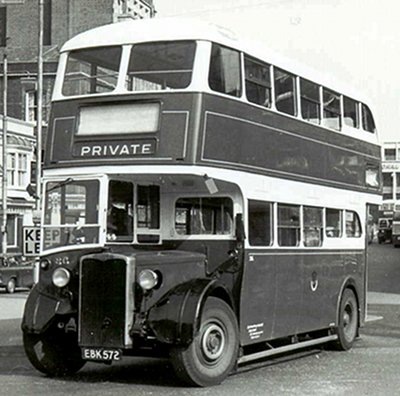
Not many Crossley buses ever found themselves too far from their natural habitat of the North-West, but a sprinkling of them worked on the South Coast. Having bought mainly Leyland TD’s during the 1930’s, and PD’s after the war, too, Portsmouth Corporation dabbled in Crossley DD42’s briefly. Four DD42/5T’s were acquired in 1948, with locally-built Reading bodies. Another two of these arrived in 1949, followed in quick succession by a further 17 DD42/7T’s, all with Crossley bodies with two stepped side windows – very stylish!
The T suffix indicated that they were fitted with Brockhouse Turbo-converters, which performed rather like the Leyland Gearless buses in the 1930’s. I never knew why they were purchased without conventional gearboxes, because the trams were scrapped in the mid-30’s and the trolleybuses not until 1963, so the purchase was not catering to drivers without skills of gear-changing! When the buses pulled away, the engine note would rise up to the governor and stay there until the driver approached a bus stop. He would then take his foot off the throttle, the engine would then tick over and the bus would coast, freewheel-style, until the brakes were applied to stop. I never knew if these vehicles had a direct-drive ‘top’ gear which could be engaged – maybe the bus stops were too close to each other and the terrain too flat for drivers ever to engage it ‘anyone know?’. Crossley buses always gave out a rather ‘woolly’ engine note, as if being slightly strangled in some way. When pre-war Leyland TD4’s were being withdrawn in the late 1950’s, their 20 year old engines and gearboxes were transplanted into the Crossleys, which made them sound very odd after that. It surely improved fuel-consumption, though! Seating was initially H28/26R, but most became H32/26R in 1959/60, the very time the Crossley 100bhp engines were replaced by the 93bhp Leyland engines! Good job all the routes were as flat as a pancake, bar one railway bridge! They were mainly withdrawn in 1966 and 1967, the engines being 30 years old by then!
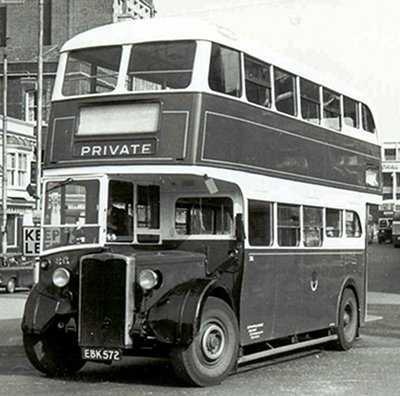
Here is No. 35 (EBK572) in Edinburgh Road, just off the main shopping centre of Commercial Road, in 1965, by which time these buses were usually relegated to peak-time extras.
Photograph and Copy contributed by Chris Hebbron
The Turbo-Transmitter fitted to some Crossley DD42s did have a direct-drive top gear, but it was engaged automatically rather than by the driver.
Peter Williamson
Crossleys were, indeed, strangled, or at least the engines were. An innovative firm with no idea how to fully exploit this commercially, Crossley designed a very good engine for post-war production using Swiss Saurer technology. Crossley realised they needed to pay Saurer for the license to do so but were either unwilling or unable to do so. They took away the Swiss technology – to do with the "breathing" and fuel injection system – and ended up with a "dog".
This had a domino effect. People only bought Crossleys, post-war, because they were available and people were desperate for anything in the late forties. It also led to their demise and take over by AEC. Birmingham Corporation were happy with their late Crossleys but they had had the benefit of AEC engineers modifying the engine.
Nevertheless, AEC still thought highly enough of Crossley to give them the task of developing the Bridgemaster. Not only that, the Crossley Coachworks – which outlasted the engineering by eight years – produced bodies of high quality. Latterly this was to Park Royal design and, like Roe, subcontracted from Park Royal to help when the London branch was already busy. (This included a batch of Diesel Multiple Units for British Rail which are known as the Park Royal class but were built for them by Crossley at Stockport.)
Many Crossleys, particularly in Manchester, were re-engined by Leyland power – often second hand. This extended their lives to a ripe old age.
David Oldfield
Perhaps worthwhile to mention that Crossley had another foray into the railway scene, with its 8-cylinder low-speed two-stroke engine fitted in the infamous "Metro-Vick" diesel electrics, which would have been Class 28 in BR terminology if they had lasted long enough. The locos were peculiar unbalanced machines with a six wheel bogie at one end and a four wheel at the other. I remember them working in pairs during the early 60s on St Pancras – Manchester expresses. Sadly they covered themselves in infamy, being afflicted with more problems that most, and having a tendency, as I recall, to burst into flames spontaneously! They were withdrawn after a service life of only 9 years.
Stephen Ford
Thank you for the comments regarding my Portsmouth Crossley posting.
Peter for answering the turbo-converter direct drive query.
David for your interesting information about the AEC Bridegmaster development being done by Crossley – quite unknown to me.
Stephen for your information regarding Crossleys other foray into the railway scene as you put it, to which I would like to add the following.
The loco itself was pretty sound, but, as stated above, the engines were awful (quelle surprise!). BR did consider re-engining them (it was done in other cases), but was probably not cost-effective with such a small number as 20. Surprisingly, one survives on the East Lancashire Railway, I used to see it parked in a short siding by Swindon Station in the 80’s and 90’s.
Chris Hebbron
Just to correct the quantity of Portsmouth Crossleys, there were 6 DD42/5Ts (1948-49, 11-15 and 28 with Reading bodies), and 25 DD42/7Ts (1949, 29-42, 47-57). The Reading bodied buses kept their Crossley engines and turbo transmitters until withdrawal in 1963/64 – possibly the last turbo-transmitters in service anywhere? It was the 25 DD42/7Ts which had their Crossley engines and transmissions replaced with pre-war engines and gearboxes from withdrawn TD4s. These were reputedly from the batch 131-160 (Craven bodies of 1936/37), but some may have come from the earlier (1935) EEC-bodied (115-126).
In the large "Crossley" book (Michael Heaps, A A Townsin, et al) I seem to remember that only 65 Crossley DD42s were fitted with turbo-transmitters of the whole production for the UK. Some of these were replaced within days or weeks! As 31 were supplied to Portsmouth, it seems they had the lion’s share of such vehicles, and quite possibly kept them the longest? Others might know more.
Michael Hampton
Sadly Crossley had a long and inglorious record of producing fragile diesel engines right back to the early thirties and carried out endless modifications in attempting to improve things. It is significant that at the start of WW2 Manchester Corporation actually had Gardner 5LWs on order for fitting to Mancunians then due for delivery (presumably as a result of happy experience with their Daimler COG5s). In the event delivery of some COGs was aborted because of the bombing of Daimler’s Radford Works and seventy Mancunians eventually got 5LWs, rather more than planned!
David Jones
Thanks for posting the two Portsmouth Corporation Crossley’s. My how they bring back memories. When both these Crossley’s ran, I lived on the ‘Tipner Estate’, in Tipner Green. We always seemed to get the Buses on this route (service ‘O’ & ‘P’ that later became service ’13’ & ’14’), that were near their withdrawal time. The ‘Reading’ bodied Crossley’s did indeed keep their Crossley Engines & Brockhouse Turbomotor Transmitter’s to the end. As a kid, I would spend hours at ‘Range Green’ (their ‘Tipner’ terminus) as they used to reverse into the beginning of Range Green, to face the correct way in Tipner Lane for the return journey. You would often see the Driver standing up in the cab trying to move the stuck ‘direction’ lever, which looked just like a normal Gear lever which you pushed forward to go forwards and pulled back to reverse, between these was neutral. The trick for an easy change of direction was to knock the lever into neutral just before coming to a halt, then stop, then using the ‘Heel Pedal’ under the Drivers seat which was supposed to (but rarely did) stop the transmission from turning, snatch the direction lever quickly to the direction you want to go.
John
Thanks, John, for the interesting comment about how to change from forward to reverse with the turbo-converters – it must have been a real bind for those drivers who weren’t ‘in the know’!
Chris Hebbron
I can remember the Crossleys all parked up at the back of the Central Transport Depot in the Eastern Road awaiting their fate it would have been July 1967. I can see the sign Leyland Diesel on the bonnets I had no idea the engines were from the TD4s, three still ground along the sea front at the time. The Crossleys also made a grinding sound as they trundled along no wonder with those old engines. I suppose they could get over Fratton and Copnor bridges and that was good enough they ran mostly on the circular routes 17 & 18.
Nick Ratnieks
The replacement pre-war ‘Leyland’ 8.6 Litre Engine, which was not the most powerful engine, was however, one of the most reliable. And as a ‘quick dieing’ engine, it made for quick change on the ‘crash’ Gearbox.
Are any of these Buses preserved or restored ?
I hope so !!!!
Anonymous
A couple of the Leyland TD4’s with open-top bodies have been preserved, Anonymous, but, sadly, no Crossleys.
Chris Hebbron
26/09/12 – 18:23
The Bridgemaster was originally marketed as a Crossley and the prototype was so badged.
Crossley engines also appeared in 90 of CIE’s 94 Metrovick diesel engines, delivered in the mid 1950s. They were two stroke V8s and were so poor in performance that eventually they were replaced, from 1967 onwards, with GE units. Their failure, and the success of GE powered engines meant that, for decades, Ireland sourced all its engines from GE in the US (though many were actually Canadian built)
Phil Blinkhorn
27/09/12 – 06:58
All four of the EE-bodied open-top TD4s survive, although to the best of my knowledge, none are currently roadworthy. No 5, originally 115, is privately preserved, No 6 (117) is at the Nort West Museum of Road Transport in St Helens, No 7 (125) is currently under restoration with the City of Portsmouth Preserved Transport Depot, whilst No 8 (127), owned by Portsmouth City Museums, is in exile at Milestones Museum, Basingstoke. I can think of no other instance in which a local authority has chosen to place its heritage on display in a museum some 40 miles away. This bus belongs in its home city!!!
Philip Lamb
27/09/12 – 06:59
Chris H’s comment about Crossleys not usually venturing very far from the North West. Up here in the back of beyond as some politicians refer to the North East, South Shields and Sunderland Corporations both had a sprinkling of Crossleys, but they were the exception rather than the rule, and off hand I cant think of any others in the area.
Ronnie Hoye
28/09/12 – 07:37
I’ve been informed that the N.E.B.P.T. Ltd collection has two of Sunderland Corporation’s Crossley’s. They’re 13 and 22, registrations GR 7100 and GR 9007. I don’t know what state of repair they’re in at the moment, but if they are being restored the trust sets very high standards and it will be interesting to see the end result.
Ronnie Hoye
28/09/12 – 18:09
A PS to my PS, if you go to your web search and type in GR 9007 there are several pictures of the restored no13 in the original red livery of Sunderland Corporation.
Ronnie Hoye
29/09/12 – 07:38
Sunderland 13 is preserved in Essex by Tont Melia and John Jackson. These restorers extraordinaire are currently working on a Northampton Crossley with Roe body.
Philip Lamb
29/09/12 – 12:23
Just to clarify Chris H’s point about Crossleys being unusual outside the north west, in the late ‘forties quite a few operators throughout the country bought one batch of Crossleys, partly because Crossley offered what turned out to be very optimistic delivery times, and partly because they were impressed by the performance of the demonstrator with the original cylinder head with Saurer features, performance that was of course not replicated by the production vehicles, which is why there were no repeat orders. In the south, for instance, apart from Portsmouth, Eastbourne, Plymouth, Reading, and Luton all had one batch of Crossleys.
Michael Wadman
05/06/17 – 06:56
Although some of the 25 Crossley DD42/7T’s received Leyland engines from scrapped Corporation TD4’s, I’ve recently found out that some were taken from ex-Yorkshire Woollen District TS’s, which were driven down to Portsmouth before the engines were removed and overhauled. The engineless remains were towed to J Strudwick’s scrapyard at Bedhampton Chalk Pit, where most of Portsmouth’s trolleybuses also met their fate.
Chris Hebbron
06/06/17 – 07:01
Chris – this has answered a question that has been in my mind for over 50 years. PSV Circle PH14 details only 23 TD4/Craven vehicles whose engines were used and the remaining TD4/Leylands were still operational until after the conversion.Despite many years of interest in this operator I had no idea that withdrawn Leylands were obtained to make up the numbers. Does anyone know what Yorkshire Woollen vehicles were used?
Pat Jennings
06/06/17 – 07:01
Chris, I’m not sure about that transfer being a Corporation exercise. Wasn’t this a Southdown exercise to convert petrol-engined buses and coaches to diesel?
Michael Hampton
07/06/17 – 05:31
I have also tried to work out how many TD4/Cravens buses donated their engines to the Crossleys. I have sometimes thought that the earlier TD4/EEC buses (those 8 not converted to open-top) were also used for this purpose. I once noted a Leylandised Crossley’s radiator, and it had a number stamped on the upper part of the radiator side. This was "122", and I thought then that this was to show that it now had the engine from TD4 No.122, which was indeed one of the EEC-bodied batch of 1935. The PH14 book records this as withdrawn in March 1956, a little early for the conversion programme, but perhaps the engine was set aside for spares initially, and then used for the Crossley. At the time, I half intended to list these numbers, but I went away to College and never got around to it. I’ve never seen any fleet history mention engines coming from outside Corporation sources, although it would be fascinating if this was the case.
Michael Hampton
 Vehicle reminder shot for this posting
04/12/17 – 06:40
Further to Chris Hebbron’s comment of 05/06/17, various letters have recently appeared in ‘Broad Street Broad Sheet’ – the magazine of ‘City of Portsmouth Preserved Transport Depot’ regarding the Crossley buses receiving engines from scrapped Yorkshire Woollen District buses. It appears that this was incorrect information provided by someone at Strudwick’s scrapyard and that the the Portsmouth Crossley buses that were re engined received them from Portsmouth Leyland TD4’s
Andy Hemming
Quick links to the - Comments Page - Contact Page - Home Page
Please leave a comment
Please Note if you want to send a photograph with your comment please use the Contact Page by clicking here or send as an attachment via email.